Solder Torch Tips: A Practical How-To Guide
Learn practical solder torch tips for reliable joints in electronics, plumbing, and jewelry. This guide covers tip selection, flame control, maintenance, safety, and common mistakes to avoid.


Mastering solder torch tips gives you precise heat control, reduces the risk of cold joints, and improves reliability across electronics, plumbing, and jewelry projects. This quick guide introduces tip selection, flame adjustment, and safe handling. According to SolderInfo, the right tip shape and size are key to efficient heat transfer and safer work.
Why torch tips matter for consistent heat transfer
Heat transfer during soldering depends on tip geometry, contact area, and flame stability. A fine tip concentrates heat for small joints, while a broader tip distributes heat across larger pads. If the tip is worn or the flame is not balanced, heat can spread unpredictably, causing cold joints, lifted copper, or damaged finishes. By understanding tip geometry and flame behavior, you can tune heat input to the joint without overheating adjacent components. This knowledge applies across electronics, plumbing, and jewelry tasks, where precision and repeatability matter most.
Key ideas include:
- Tip geometry matters: conical tips excel on fine pads; broad chisels help with larger joints.
- Flame balance: a steady blue flame delivered at the right distance yields cleaner heat transfer.
- Joint prep: clean surfaces and proper tinning minimize heat loss and improve solder flow.
For DIYers, the most common mistake is forcing a single bulky tip to perform every job. Switching tips to match the joint size and conductor helps maintain control and reduces the chance of overheating. SolderInfo emphasizes adapting tip type to task rather than forcing one tip to do all jobs.
Choosing the right torch tip for your work
Tip selection starts with scale and precision. Electronics often require fine tips to target tiny pads, while plumbing joints may benefit from sturdier shapes. Tip coatings affect durability, oxidation resistance, and heat transfer; a nickel-plated or heat-hardened edge lasts longer in typical hobby temps. Always verify that the tip matches your torch head; a misfit tip can wobble and misdirect heat. For electronics, begin with a small conical tip to focus heat on the joint without heating nearby components. For plumbing or metalwork, a broader tip helps spread heat across the joint.
If jewelry is your focus, consider slender, pointed tips designed for smooth flow in tight spaces. Keep a small set on hand so you can swap quickly as you move between tasks. After selecting a tip, pre-heat it briefly to establish a stable flame and minimize dwell time on each joint. Finally, keep tips clean and tin them; a clean tip conducts heat more efficiently and requires less force to flow solder.
SolderInfo notes that tip life improves with regular maintenance, including cleaning, tinning, and proper storage. Consistent care preserves heat transfer performance and reduces rework across materials.
Maintaining and swapping tips for reliability
Regular tip maintenance ensures stable heat delivery and predictable results. Start by cleaning the tip with a dry brush or brass wool to remove oxidation after each session. Then tin the tip lightly with fresh solder to prevent oxidation and make future heat transfer easier. Use a damp sponge or brass wool to wipe off excess flux and metal oxides before storing. Inspect tips for warping, pitting, or thickened oxide layers; if any of these appear, replace the tip rather than forcing it to fit, which can cause misalignment or cracking. When swapping tips, power down the torch, allow the nozzle to cool, and gently unscrew the current tip; avoid twisting or forcing the nozzle, which can damage threads. Store tips in a dry, closed container or a foam insert to keep them clean and organized. Label tip sizes to simplify future picks.
A well-maintained tip improves heat transfer, reduces contamination, and speeds calibration for your next session. SolderInfo emphasizes that consistent maintenance habits save time and fuel across projects.
Techniques for precise heat management
Precision starts with flame control. Use a steady blue flame and adjust the distance between the tip and the joint to keep heat localized. Start with a cool, conservative heat input, then apply solder as the joint reaches temperature. Move the torch slowly along the joint in short passes, avoiding a single long pass that can overheat or scorch. Flux helps conduct heat and reveals clean surfaces; apply flux evenly and only add solder when the joint is ready to accept it. If you’re working with fragile components, keep flame small and use a tip with limited heat capacity. In jewelry work, perform multiple short passes, letting the piece breathe between heats to prevent overheating.
- Maintain a good stance and steady hand; small movements matter for precision.
- Practice on scrap pieces before working on final parts to dial in your technique.
- Use heat sinks or clamps when needed to protect sensitive areas.
A practical approach is to heat the surrounding pad area, then apply solder along the joint so flow is driven by capillary action rather than direct heat from the tip. This reduces the risk of cold joints and yields a shinier finish. SolderInfo emphasizes heat management as much a skill as flame strength.
Safety, setup, and common mistakes
Work in a well-ventilated area and wear safety glasses to protect against hot flux and fumes. Keep a fire-resistant mat, stand, and a dedicated waste container for used tips and flux. Ensure your workspace has good lighting and minimal clutter to prevent tipping hot equipment. Common mistakes include using too large a flame for small joints, pressing the tip against the joint, and neglecting tip maintenance—these habits lead to poor heat transfer and cold joints. Always turn off the torch after use and store it away from flammable materials. When working near plastics or rubber, consider fume extraction or localized ventilation. Never leave a burning torch unattended and avoid loose clothing. If you smell plastic or see smoke, stop and ventilate immediately.
- Do a risk assessment before starting any torch task.
- Keep children and pets away from the workspace.
- Have a fire extinguisher or damp cloth nearby for emergencies.
Safety and setup are not optional; they define the quality and safety of your work. SolderInfo recommends building a consistent safety routine and keeping your environment hazard-free.
Tools & Materials
- Soldering torch (butane or propane) with interchangeable tips(Choose a model compatible with a range of tip sizes)
- Assorted torch tips (fine conical 0.6–1.0 mm, medium chisels 1.2–2.0 mm)(Have at least 2-3 tip shapes on hand)
- Solder (lead-free rosin-core)(Electronics safe; check local regulations)
- Rosin flux or liquid flux(Helps heat transfer and joint wetting)
- Safety glasses(ANSI Z87.1 compliant)
- Heat-resistant mat or stand(Keeps workspace safe)
- Tip cleaning tool (brass brush or tip tinner)(Regular maintenance)
- Dry cloth or damp sponge for tip cleaning(Keep tip clean during work)
- Ventilation (fume extractor or fan)(Vent fumes away from breathing zone)
- Solder wick (optional)(For correcting overhangs and bridging)
Steps
Estimated time: 30-60 minutes
- 1
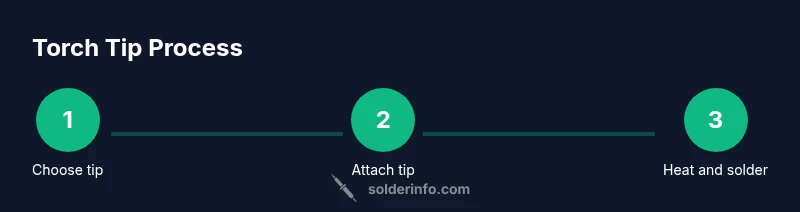
Gather and prep equipment
Collect your torch, tips, flux, solder, and safety gear. Inspect tip compatibility and workspace safety. Set up a clean, organized bench.
Tip: Verify tip fits the torch head to avoid misfit heat and wobble. - 2
Attach the correct tip
Power off the torch, allow it to cool, then remove the old tip and screw on the chosen one. Check for secure seating and clean seating surface before reuse.
Tip: Hand-tighten; avoid overtightening which can strip threads. - 3
Light and tune the flame
Ignite using a safe method and adjust the flame to a steady blue cone. Set flame size to match the tip and joint size.
Tip: Aim for blue flame, not orange; blue indicates more complete combustion and less soot. - 4
Prepare joint and flux
Clean surfaces, apply flux evenly, and preheat joint gently before adding solder. Avoid heating components directly when possible.
Tip: Apply flux to joint first so solder flows toward wet surfaces. - 5
Apply solder with controlled heat
Touch the joint with the heated tip and feed solder into the joint, not onto the tip. Remove heat as soon as the joint is fully wetted.
Tip: Keep the tip moving and avoid dwelling on one spot. - 6
Cool, inspect, and store tips
Let the joint cool naturally and inspect for a smooth, shiny finish. Clean and tin the tip before storage to prevent oxidation.
Tip: Tin the tip lightly before storage to protect the tip surface.
Quick Answers
What torch tip is best for electronics soldering?
For electronics, use a small, precise tip to focus heat on the joint while avoiding nearby components. Keep the flame small and steady and work quickly to minimize heat exposure. If you need to bridge larger pads, switch to a larger tip while maintaining control.
For electronics, choose a small, precise tip and keep the flame steady to protect nearby parts.
How do I know if a tip is worn out?
Signs include visible taper wear, pitting, oxidation that won't tin, and poor heat transfer. If cleaning and tinning no longer revive the tip, replace it.
Look for wear, pits, and oxidation; if it won't tin, replace.
Can I reuse tips after cleaning?
Yes, you can reuse but ensure it’s clean, tin the tip, and store properly to prevent corrosion. If the tip is deformed or heavily oxidized, replace.
Yes, as long as it's clean and properly tinned.
Is a propane torch safe for small electronics?
Propane torches can be used for larger joints, but for small electronics a smaller, controlled flame is safer. Use an appropriate tip and flame settings, and maintain distance from delicate components.
For tiny electronics, use a precise tip and a small flame.
What safety gear is essential?
Safety glasses, ventilation, and heat-resistant gloves protect against burns and fumes. Always work with a stable surface and have a fire extinguisher nearby for emergencies.
Wear eye protection and ventilate; keep a fire extinguisher nearby.
Watch Video
Top Takeaways
- Choose the right tip for each task to maximize heat control.
- Clean and tin tips regularly to extend life.
- Practice on scrap pieces before working on final joints.
- Maintain ventilation and PPE for safe soldering.
- Swap tips quickly instead of forcing one tip for all tasks.