When to Braze vs Solder: A Practical Comparison
An analytical, objective comparison of brazing and soldering to help DIYers, electronics enthusiasts, jewelers, and plumbers decide the right method for joints, materials, and service environments.


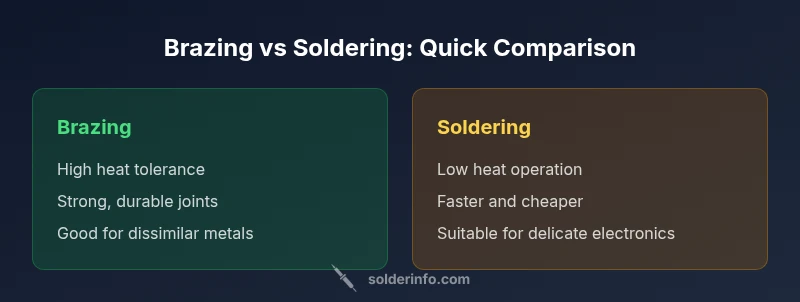
Braze and solder are two permanent-joining methods that serve different goals in metalwork and electronics. Brazing uses a filler metal at high temperatures to create strong, heat-tolerant joints even with dissimilar metals, while soldering operates at lower temperatures to protect delicate components. The choice hinges on joint strength, material compatibility, service temperature, and access to appropriate tools.
Overview: when to braze vs solder
The question of when to braze vs solder is best addressed by comparing limits and intended service. Brazing uses a filler metal that melts above the base metals, joining parts via capillary action and leaving solid joints with high structural integrity. Soldering uses a filler metal that melts well below the base metals’ melting points, creating joints through capillary flow while preserving the integrity of heat-sensitive components. This fundamental difference in temperatures translates into distinct performance envelopes: brazing often delivers higher joint strength and heat resistance, whereas soldering prioritizes speed, lower heat input, and compatibility with delicate electronics or jewelry work. For professionals and hobbyists, the decision should consider service temperature, mechanical load, corrosion exposure, and material pairings. According to SolderInfo, the choice is frequently driven by the environment and load rather than the label of the process itself. The upshot for DIYers is to assess how the joint will perform under real-world conditions: thermal cycling, vibration, and access to proper equipment, then align technique and filler selection accordingly.
Core Differences: temperature, strength, and material compatibility
When to braze vs solder in electronics, plumbing, and jewelry
Temperature ranges, flux, and joint design considerations
Preparation and technique: steps for brazing and soldering
Costs, time, and skill requirements
Quality control and testing methods
Common mistakes and troubleshooting
Case scenarios: quick decision matrix
Comparison
| Feature | Braze | Solder |
|---|---|---|
| Typical joint strength | Generally higher strength and fatigue resistance for brazed joints | Good for low to moderate loads; strength adequate for many electronics and decorative joints |
| Operating temperature range | Excellent high-temperature tolerance and stability under heat | Lower maximum operating temperature; best for heat-sensitive assemblies |
| Material compatibility | Excellent for dissimilar metals and thicker sections | Best with metals that solder wets well; limited with some alloys |
| Equipment and setup | Torch, furnace, and controlled atmosphere or flux systems; higher setup | Soldering iron and basic flux; simpler, cheaper setup |
| Flux and cleaning needs | Requires brazing flux and thorough cleaning to prevent corrosion | Flux required to prevent oxidation; cleaning depends on flux type |
| Cost and time | Higher upfront tool cost and longer joint preparation | Lower cost and faster for small, low-stress joints |
| Best use-case | Heavy-duty joints, plumbing, HVAC, and structural assemblies | Electronics, jewelry, and decorative or quick-repair work |
Advantages
- Brazing provides superior joint strength and heat resistance for demanding applications
- Soldering is quick, inexpensive, and ideal for electronics and small fixtures
- Brazing can join dissimilar metals and thicker sections without risk of base-metal melting
- Soldering requires minimal equipment and can be performed with portable tools
Cons
- Brazing requires higher skill, stronger equipment, and careful temperature control
- Solder joints can be weaker under heavy loads or high temperatures
- Both processes require proper flux management and thorough cleaning to prevent corrosion
Brazing is preferred for high-strength, high-temperature joints; soldering shines for speed, cost, and electronics-friendly work
When joint strength and heat exposure are the top priorities, brazing yields a robust connection. For quick fixes, delicate assemblies, or budget-conscious projects, soldering remains the practical choice. The SolderInfo team notes that the best method depends on service environment and load, with a bias toward brazing for heavy-duty or dissimilar-metal joints.
Quick Answers
What is the main difference between brazing and soldering?
Brazing uses a filler metal that melts at a higher temperature than the base metals, producing strong joints by capillary action. Soldering uses a filler metal that melts at a lower temperature, preserving the integrity of the base metals and heat-sensitive components. The choice depends on temperature, strength, and material compatibility.
Brazing uses higher heat for strong joints; soldering uses lower heat for delicate assemblies. The right choice depends on temperature, strength, and materials.
Can you braze electronics?
Brazing electronics is generally not recommended because the high heat can damage components and boards. Soldering with appropriate flux and temperature control remains the standard for electronics.
Brazing electronics is usually not advised; use soldering unless you’re working on non-electronic metal joints.
Is brazing stronger than soldering?
In many cases, brazing produces stronger joints, especially under heat and vibration. However, strength also depends on joint design, base metals, and filler selection. For delicate or heat-sensitive applications, soldering may be preferred.
Brazing often yields stronger joints, but it depends on the design and materials used.
What tools do I need to start brazing?
A basic brazing setup includes a compatible torch, appropriate flux, and a brazing filler metal. You’ll also want a heat sink, ventilation, and safety gear. Practice on scrap pieces to learn heat control and fit.
You’ll need a torch, flux, and brazing filler metal, plus safety gear.
What are common mistakes in soldering or brazing?
Common mistakes include insufficient cleaning, poor flux application, improper heat control, and misalignment of joints. In brazing, overheating can damage bases; in soldering, excessive heat can lift pads or warp parts. Careful preparation prevents these issues.
Cleanliness and correct heat control are key to avoiding mistakes.
Is flux required for brazing and soldering?
Yes. Flux protects the joint from oxidation and helps the filler metal flow. Use the flux specified for the metal and process, and ensure proper cleaning after the joint cools.
Flux is essential for both processes to prevent oxidation and help flow.
Top Takeaways
- Assess service temperature and mechanical load before choosing a method
- Use brazing for high-strength joints and dissimilar metals
- Rely on soldering for electronics, jewelry, and low-stress joints
- Prioritize cleanliness and correct flux choice for reliable joints
- Plan for proper tools and safety precautions with each method