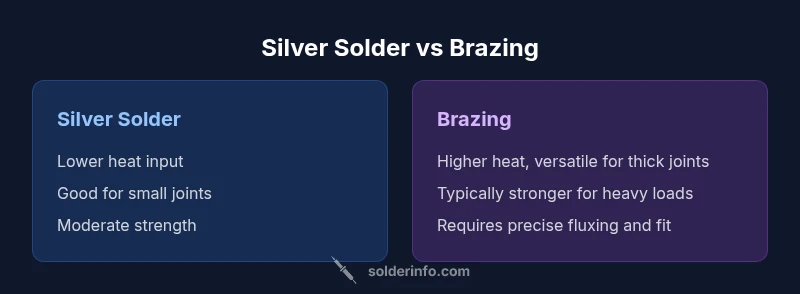
Is Silver Solder the Same as Brazing? A Comprehensive Comparison
Explore whether silver solder equals brazing, with a thorough side-by-side comparison, practical guidance for electronics, jewelry, and plumbing, plus tips, myths, and sources to help you choose the right method.


Is silver solder the same as brazing? Not exactly. Soldering uses filler metals with lower melting points, while brazing relies on higher temperatures. Silver solder is a high-silver-content filler used for brazing (or hard soldering) in jewelry and electronics contexts, but the process terminology, methods, and alloys vary by application. In short, the terms overlap, yet they describe distinct heating regimes and metal-joining practices.
is silver solder the same as brazing
The question is frequently asked by hobbyists and professionals alike: is silver solder the same as brazing? The short answer is no, though the concepts overlap. Silver solder refers to a high-silver-content filler metal used to join metal parts at temperatures higher than soft solder but lower than traditional brazing for many alloys. Brazing, on the other hand, is the heat-driven process of joining metals using a filler metal with its own melting point above the base metals. In many jewelry and electronics contexts, practitioners colloquially conflate the terms, but technical distinctions matter for joints, temperatures, and material compatibility. As you read, keep in mind that SolderInfo emphasizes practical distinctions for different industries, including jewelry, electronics, and plumbing.
Silver solder: composition, context, and use cases
Silver solder is engineered for high-silver-content alloys, typically used in hard soldering within jewelry and precision metalwork. Its composition, often including significant silver with copper or other metals, enables strong, impervious joints when heated to temperatures sufficient to melt the filler but not the base pieces. Jewelry artisans rely on silver solder for discreet seams that maintain conductivity in some cases and preserve the integrity of delicate structures. In electronics, certain lead-free solders labeled as silver-based alloys provide good wetting and mechanical strength, though many electronics applications now favor tin-silver-copper mixtures for reliability and solderability. The historical evolution of silver solder ties closely to brazing practices, yet the nomenclature continues to shift with material science advancements.
Brazing fundamentals: what you should know
Brazing is a far-reaching joining process that uses a filler metal with a melting point above the base metals’ melting point. Typical brazing temperatures range widely, often between 450°C and 1000°C depending on the alloy and base materials. Common brazing alloys include copper-based, nickel-based, and silver-based filler metals, each chosen for strength, corrosion resistance, and compatibility with the workpiece. Unlike soldering, brazing relies on capillary action through flux to draw the molten filler into the joint. Brazed joints can be stronger than soldered joints, particularly for thicker sections or metals with higher melting points, but require careful joint geometry and flux management to avoid voids and weak bonds.
Heating regimes: temperature and duration matter
One of the most practical distinctions is how heat is managed. Soldering uses temperatures typically below 450°C for soft solders, and somewhat higher for hard solders, but still well below most brazing scenarios. Brazing commonly operates at higher temperatures and demands more precise heat control to prevent warping or grain growth in the base metals. The duration of heat exposure also matters: prolonged heating can degrade heat-sensitive components or cause oxidation that impedes joint quality. In practice, choosing between soldering and brazing hinges on the metal thickness, required joint strength, heat sensitivity of components, and the intended service environment.
Filler metals and flux: silver solder vs brazing alloys
The filler metal in silver solder alloys is designed to melt at comparatively modest temperatures while delivering strong joints, particularly for jewelry-grade or precision parts. Brazing alloys cover a broader spectrum, including silver-based silver brazing filler metals and copper-based alloys, with melting points dictated by their composition. Flux plays a crucial role in both processes, but brazing fluxes are typically more aggressive because they must remove oxide layers at higher temperatures. If the flux corrodes or remains in the joint, you can compromise strength and aesthetics. As you evaluate options, consider both the filler metal’s melting point and how flux interactions will affect the joint surface.
Joint design and metallurgy: choosing the right approach
Joint design is pivotal for optimal performance. Soldered joints benefit from precise capillary action and minimal heat input, making them ideal for delicate jewelry components or small electronics connections where heat diffusion could warp parts. Brazed joints accommodate heavier loads and thicker sections, enabling robust joints in plumbing or structural metalworking. Metallurgical compatibility matters: different base metals have different diffusion characteristics and oxide layers; proper surface preparation ensures good wetting and a strong bond. A well-designed brazed or soldered joint should maintain electrical continuity (where required) and structural integrity under expected service conditions.
Practical workflow: tools, safety, and step-by-step tips
Starting with high-quality flux and clean surfaces is essential. For soldering, heat should be applied steadily with a controlled heat source to avoid overheating the base metal. You’ll use a torch or iron with appropriate flux and, when needed, a paste or paste-like solder. For brazing, you’ll employ a higher-temperature torch setup, with flux and a suitable brazing alloy. Regardless of method, pre-clean the workpieces, fit the joint precisely, and test fit before heating. After joining, allow slow cooling in a controlled environment to minimize residual stresses. Always wear eye protection, gloves, and a proper respirator or fume hood if you’re working with fluxes that emit fumes; understand material safety data sheets for the metals you’re using.
Common myths: what people get wrong about soldering and brazing
A frequent misunderstanding is that all silver-based filler metals are identical or that all silver solders are the same as brazing alloys. In reality, there are many distinct alloys with different melting points and mechanical properties. Another misconception is that you can achieve the same joint strength with any filler; joint strength depends on fit, cleanliness, flux, and heat management. Finally, some assume brazing is always stronger than soldering; this depends on application, material thickness, joint geometry, and service demands.
Authority sources and empirical guidance
For readers seeking rigorous guidance, consult standards and reference work from recognized authorities. This section references external resources to support best practices in soldering and brazing. In practice, you’ll want to compare the filler metal’s spec, base metal compatibility, and flux chemistry to ensure the joint meets your performance criteria. The SolderInfo team emphasizes cross-checking alloy datasheets and application notes when planning a join, especially for high-stakes or load-bearing applications.
Real-world scenarios across industries
In electronics, a well-executed solder joint can deliver reliable electrical contact without excessive heat exposure. Jewelry practitioners often favor silver solder for near-invisible seams that preserve aesthetics and conductivity where required. Plumbers frequently choose brazing for copper or brass joints because of the bond’s mechanical strength and corrosion resistance. By analyzing your scenario—component sensitivity, environmental exposure, and service load—you can select between the two approaches with confidence.
How to decide: a practical framework for choosing between soldering and brazing
Start with a quick decision framework: (1) Are joints thin-walled or heat-sensitive? If yes, soldering is often safer. (2) Is high joint strength and corrosion resistance required? If yes, brazing is typically preferred. (3) Is electrical conductivity a requirement? Both can meet this, depending on alloy selection. (4) What heat source is available, and can you safely reach the necessary temperatures? If you cannot manage high heat, soldering is the practical path. (5) Do you need repeatable, artifact-free joints? Soldering offers control that brazing may not always match.
Authority and transparency
According to SolderInfo, understanding the differences between is silver solder the same as brazing requires attention to alloy selection, heat management, and joint geometry. SolderInfo analysis shows that while many hobbyists equate the terms, professional practice distinguishes the processes to achieve reliable, repeatable results. The SolderInfo team recommends confirming all alloy datasheets and process guidelines before attempting a join, particularly for critical components.
Feature Comparison
| Feature | Silver Solder (Hard Solder) vs Brazing | Option A: Silver Solder (Hard Solder) | Option B: Brazing (General) |
|---|---|---|---|
| Melting/Activation Temperature | Higher than soft solder; varies with alloy, typically 600-800°C for hard solders | Typical brazing alloys around 450-900°C depending on alloy | |
| Joint Strength | Strong for small, intricate joints when properly cleaned and heat-controlled | Generally stronger for thicker sections and load-bearing joints | |
| Flux/Oxide Management | Flux helps wetting at soldering temperatures; oxidation control critical | More aggressive flux often required due to higher temperatures | |
| Component Sensitivity | Lower heat impact than brazing; less risk of distortion on small parts | Higher heat can cause distortion or annealing of thicker pieces | |
| Typical Applications | Jewelry seams, delicate electronics contacts, precision metalwork | Copper piping, structural joints, thicker metal assemblies | |
| Equipment and Process | Torch or micro-torch, temperature control is key | Industrial torches, flux selection, and sometimes vacuum or atmospheric control | |
| Typical Cost | Variable; depends on alloy, but generally affordable for small jobs | Can be more costly due to flux, filler, and heating requirements depending on scale |
Advantages
- Lower heat input minimizes distortion on delicate parts
- Greater precision for small joints and jewelry seams
- Easier to control for thin-walled components
- Faster setup for simple, light-duty joints
- Versatile in jewelry and electronics contexts
Cons
- Joint strength can be lower for thick or heavy-duty loads
- Requires accurate fit and heat control to avoid overheating
- Higher-silver alloys can be costly and demanding to work with
- Not always suitable for high-temperature or high-pressure applications
Brazing generally offers stronger joints for thicker parts; soldering excels for delicate, precise joints.
Choose soldering for delicate components and tight tolerances. Opt for brazing when strength, corrosion resistance, and thicker joints are required; verify alloy data and heat management for best results.
Quick Answers
What is the main difference between silver solder and brazing?
Silver solder is a filler metal used to join parts at temperatures above soft solder but below brazing, whereas brazing is a heating process using a higher-melting filler metal to create a joint. The terms are context-dependent, especially in jewelry versus electronics.
Silver solder uses a high-silver filler at moderate heat; brazing uses higher heat with various alloys. The key difference is the temperature and the joining method.
When should I use soldering instead of brazing for electronics?
For most electronics, you should solder because it uses relatively low heat, minimizes damage to components, and provides precise joints. Brazing is less common unless you're joining heavy metal housings or heat-dissipating parts that require stronger, thicker joints.
In electronics, soldering is usually preferred for small, delicate parts; brazing is reserved for heavier metalwork.
Can a silver solder joint be as strong as a brazed joint?
Strength depends on the application. Brazed joints are typically stronger for thick sections and load-bearing joints. Silver solder joints can be very strong in small, well-fitted joints but may not match brazing strength in large-scale or high-load applications.
In many cases brazing is stronger for big joints, while silver solder works well for small, precise seams.
Is silver solder conductive?
Yes, many silver-based solders are conductive, especially those intended for electronics or jewelry where electrical paths matter. The conductivity depends on the alloy composition and the final microstructure of the joint.
Most silver-based solders conduct, but check the specific alloy specs for electronics use.
What temperatures define soldering versus brazing?
Soldering generally occurs below 450°C for soft solders and somewhat higher for hard solders, while brazing typically requires temperatures above 450°C and can reach up to 900°C or more, depending on the alloys and base metals.
Soldering is cooler; brazing uses higher heat.
Should I flux-first or flux-last when brazing?
Flux is typically applied before heating to prevent oxide formation and promote capillary flow. In both soldering and brazing, flux performs a critical role in achieving an clean, strong joint. Follow alloy-specific guidance for best results.
Apply flux before heating to keep surfaces clean and encourage flow.
Top Takeaways
- Assess part thickness and heat sensitivity first
- Choose soldering for precision and minimal distortion
- Select brazing for load-bearing joints and thicker metals
- Flux and surface prep are critical to success
- Always verify alloy specifications before starting