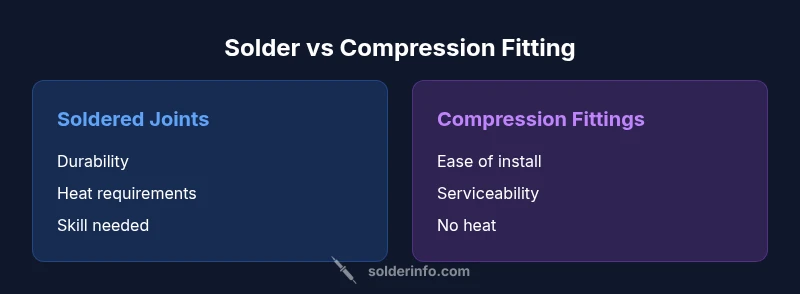
Solder vs Compression Fitting: A Practical Comparison
Compare soldering joints and compression fittings to decide which method fits electronics, plumbing, and jewelry projects. Learn differences, pros and cons, and best practices for reliable, maintainable joints.


In most setups, solder joints deliver durable, leak-resistant connections when done correctly, while compression fittings offer faster, reversible installations with less heat exposure. For permanent, vibration-prone systems such as copper plumbing or electronics enclosures, soldering is typically the better choice; for serviceable lines or temporary runs, compression fittings shine. The optimal decision depends on material compatibility, system pressures, and maintenance plans.
Understanding the Solder vs Compression Fitting Debate
Solder vs compression fitting is a foundational choice in both electronics soldering and plumbing. Soldering creates a continuous metal bond by melting a filler metal to join surfaces, while compression fittings rely on ferrules and seals tightened mechanically. The decision hinges on factors like the operating environment, expected service life, material compatibility, and the ability to perform maintenance without destructive disassembly. According to SolderInfo, the best approach starts with a clear understanding of joint goals: permanence, inspectability, and tolerance to vibration or temperature changes. When you weigh solder vs compression fitting, you’re balancing reliability and future serviceability against speed and ease of installation. This analysis will help you map your project needs to the most appropriate method.
In many contexts, the choice is not binary; professionals often combine both methods within a single system to optimize performance. For example, electronics enclosures and copper plumbing shares may benefit from soldered joints for reliability in critical sections and compression connections in serviceable segments. For DIY jewelry, small-scale solder joints may outperform mechanical fittings in appearance and longevity, while for certain garden or outdoor plumbing, compression fittings may simplify field maintenance. The core question remains: which method aligns with your application’s demands for leak resistance, ease of repair, and long-term durability?
When evaluating solder vs compression fitting, it’s essential to consider the entire lifecycle of the joint—from installation to potential rework. Solder joints typically require flux preparation, heat control, and proper cooling, all of which influence reliability. Compression fittings demand accurate sizing and clean surfaces to prevent leaks. In 2026, practitioners increasingly emphasize joint cleanliness, material compatibility, and adherence to best practices as the primary drivers of success, regardless of which method you choose.
Comparison
| Feature | Soldered joints | Compression fittings |
|---|---|---|
| Installation complexity | Higher (flux, heating, cooling, and joint cleanliness required) | Lower (hand-tightened, no heat, quicker to install) |
| Reliability under vibration/pressure | Typically high when executed with proper technique and clean surfaces | Can loosen over time with vibration or cycling pressures |
| Reworkability | Desoldering or restarting the joint is possible but can be tedious | Easier to disassemble and modify or replace without heat exposure |
| Material compatibility | Copper, brass, some steels; requires suitable flux and clean surfaces | Copper-to-plastic adapters common; works with metal ferrules and seals |
| Joint profile and cleanliness | Flush, compact joints with careful technique | Visible seams; profile depends on ferrule design and tube prep |
| Temperature exposure | Heat can affect nearby components in sensitive assemblies | No heat exposure to adjacent elements |
| Cost and time | Skill-dependent; setup, flux, and equipment add to cost and time | Often lower upfront cost and faster for simple runs |
Advantages
- Produces durable, leak-resistant joints when properly executed
- Reworkable in certain materials with careful desoldering
- Supports compact joint profiles suitable for electronics and plumbing
Cons
- Requires skill, flux, and controlled heat; mistakes can cause leaks or damage
- Longer setup and cure times than many fittings
- Heat exposure can affect nearby components in sensitive assemblies
Soldering is often the more durable, permanent choice; compression fittings excel in quick, serviceable installations
Choose soldering for fixed, vibration-prone, or temperature-sensitive systems. Choose compression fittings when you need fast assembly and easy disassembly.
Quick Answers
What is the primary difference between soldering and compression fittings?
Soldering forms a continuous metallurgical joint by melting a filler metal to bond surfaces, offering high leak resistance when done correctly. Compression fittings seal through mechanical compression of ferrules onto the tubing, allowing for quicker assemblies and easier disassembly without heat. The choice hinges on permanence, serviceability, and operating conditions.
Soldering creates a strong, permanent joint with heat and flux; compression fittings seal through tightening, which is quicker and easier to service.
Can soldering be used with all plumbing materials?
Soldering works best with copper and similar metals when correct flux and clean surfaces are used. It is not universally suitable for all plastics or all metals without adapters or special fittings. For mixed materials, consider appropriate adapters or alternative methods.
Soldering is great for copper, but some plastics and composites need adapters.
Are compression fittings suitable for electronics or high-vibration systems?
Compression fittings are common in plumbing and low-vibration systems but are less typical for delicate electronics where heat-sensitive components exist. In high-vibration environments, ensure ferrule integrity and proper material selection to minimize leakage risk.
They’re common for plumbing and some low-vibration uses, but electronics usually favor solder for reliability.
What tools are essential for each method?
Soldering requires a soldering iron, flux, solder, cleaners, and safety gear. Compression fittings require wrenches, the correct-size ferrules, pipes or tubing cutters, and inspection tools like a go/no-go gauge. Having the right tools reduces mistakes and leakage.
You need a soldering iron and flux for soldering, and wrenches plus ferrules for compression fittings.
Is one method inherently more leak-proof than the other?
Both methods can be leak-proof when properly designed and installed. Solder joints can outperform fittings in heat-stressed metal joints, while well-installed compression fittings excel in serviceability and easy inspection.
Both can seal reliably if done right; solder can excel in long-term durability, compression in serviceability.
How does one decide between solder vs compression fitting for a project?
Start with the environment, material compatibility, required permanence, and maintenance plans. If you need a permanent, high-durability joint in metal tubing, soldering is often preferred. If you require quick installation and future disassembly, compression fittings may be better.
Think about permanence, maintenance, and material compatibility to pick the right method.
Top Takeaways
- Assess serviceability needs before choosing method
- Match material compatibility and system pressures
- Plan for heat-affected zones in electronics
- Prioritize proper preparation and cleanliness
- Consider future maintenance when selecting joints