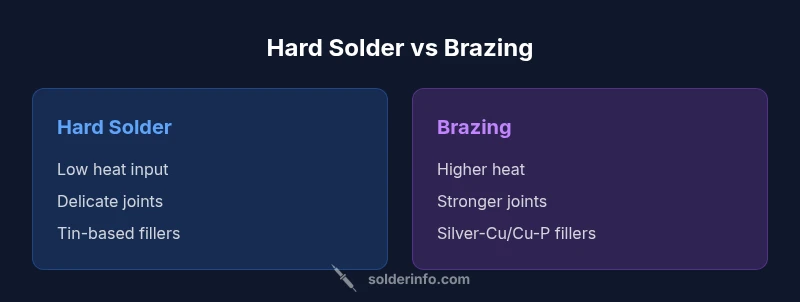
Hard Solder vs Brazing: An Analytical Comparison
A rigorous, analytical comparison of hard solder and brazing, covering temperatures, alloys, joint types, substrates, and best-use scenarios for electronics, jewelry, and plumbing.


For most hobbyists and pros, hard solder is not the same as brazing: hard solder uses lower-temperature alloys and capillary flow for delicate joints, while brazing employs higher temperatures and stronger filler metals for larger joints. The choice hinges on substrate materials, joint geometry, and desired strength. In short, hard solder shines on jewelry and fine electronics, brazing on plumbing and heavier metalwork.
Definitions and scope: hard solder vs brazing
According to SolderInfo, hard solder and brazing describe two classic metal-joining methods that share a family of alloys but differ in practice. In this article we define the terms and frame the scope of this comparison. Hard solder generally refers to low-temperature filler metals that melt below 450°C, though the exact threshold varies by alloy; brazing employs higher temperatures with stronger filler alloys to form robust joints. Crucially, both rely on capillary action and flux to create a clean, sealed joint, but the materials, heat input, and typical applications diverge. For the purpose of this article, we treat hard solder as the family of tin-based and similar alloys used for delicate jewelry, electronics, and small assemblies where precision matters. Brazing, by contrast, is favored for plumbing, HVAC components, and mechanical assemblies requiring higher load-bearing capacity. The practical distinction often rests on service environment and material compatibility; when you choose one method over the other, you set the baseline for the entire fabrication process.
Temperature regimes and filler metals
Hard solder operates in a low-to-mid temperature window, with alloys designed to melt at substantially lower temperatures than brazing fillers. This makes it suitable for heat-sensitive substrates and precision joints. Brazing uses higher-temperature filler alloys that create stronger, more durable joints and can accommodate larger geometries. Filler metals for brazing include silver-copper, copper-phosphorus, and similar systems that fuse at temperatures well above typical hard-solder alloys. The choice of alloy influences capillary action, wetting, and joint geometry, which in turn affects how you design the joint. In practice, the temperature differential also influences flux choice and cleaning requirements, so plan accordingly.
Joint design and material compatibility
Joint design is a critical differentiator. Hard solder joints favor fine joints, gentle curves, and thin-walled structures like jewelry settings or electronics tab connections. They benefit from capillary flow and careful fixture alignment. Brazing tolerates more substantial gaps and complex geometries, making it ideal for plumbing fittings, heat exchangers, and structural components where mechanical load is higher. Material compatibility matters as well: some metals respond better to low-temperature solders, while others require the corrosion resistance and bonding strength offered by brazing alloys. SolderInfo notes that compatibility testing and surface prep are essential to avoid brittle joints or poor wetting.
Flux, cleaning, and joint preparation
Flux is a cornerstone for both methods, but the approach differs. Hard solder often uses milder fluxes or fluxless work with precise pre-cleaning to avoid oxide formation that can prevent capillary flow. Brazing generally uses stronger, specialized fluxes designed to handle oxides on a broader range of metals, including stainless steel and brass. Proper joint preparation—clean surfaces, appropriate fit-up, and reasonable gaps—drops the risk of cold joints and improves capillary action. In both cases, surface lubrication and contamination control are critical for reliable results.
Materials and alloy options for each method
Hard solder employs tin-based or tin-silver-based alloys with relatively low melting points. These fillers permit delicate work with minimal heat transfer to surrounding features. Brazing fillers include silver-copper, copper-phosphorus, and similar families that create higher-strength joints and better corrosion resistance. Availability and cost vary by region, with hard-solder alloys typically cheaper and easier to source for jewelry and electronics work, while brazing alloys are more common in plumbing and HVAC trades. Soldering tool inventories (tongs, torches, heat sinks) also differ by method, which can affect upfront costs.
Process steps: prep to finish
A typical hard solder process begins with meticulous cleaning, oxide removal, and snug joint fit. Heating is controlled to reach the solder’s melting range, allowing capillary flow to draw filler into the joint. Quick cooling and quenching may be used for certain tin-based alloys. Brazing follows a staged approach: preheat, apply flux, then heat the assembly until the brazing filler flows and wets all surfaces. Cooling is gradual to avoid thermal shock. Post-assembly cleaning removes flux residues that could promote corrosion. In both pathways, inspection for gaps, porosity, and surface finish determines readiness for service.
Strength and service environment: what to expect
Hard solder joints deliver adequate strength for delicate assemblies and non-structural components. They excel in jewelry settings and sensitive electronics where heat must be minimized. Brazed joints, by contrast, offer higher load-bearing capacity and better corrosion resistance in harsh environments, making them suitable for plumbing and mechanical assemblies that encounter vibration, pressure, or temperature swings. Understanding the service environment helps you pick the right method: a failure mode analysis often reveals whether joint mobility or structural rigidity matters more.
Applications by discipline: jewelry/electronics vs plumbing
For jewelry and fine electronics, the priority is precision and minimal heat impact. Hard soldering supports intricate joints and delicate components without deforming metal or damage to substrates. In plumbing and HVAC, brazing is favored for its strength, leak resistance, and compatibility with diverse metals. The decision should align with performance requirements and craftsmanship expectations: jewelry calls for finesse; plumbing demands reliability under pressure. SolderInfo emphasizes that practitioners should develop a method-specific workflow to optimize results across materials and joint sizes.
Cost, availability, and skill requirements
Hard solder materials tend to be affordable and plentiful, with lower equipment intensity. They require steady hands and careful temperature control, which is accessible to hobbyists and professionals alike. Brazing fillers can be more expensive, and the process often requires more robust equipment and ventilation to handle higher heat and flux combustion products. Skill development tends to be steeper for brazing due to tolerance for heat and macro-level joint geometry. Investing time in mastering cleaning and flux handling pays dividends in reliability.
Safety, fumes, and health considerations
Both methods produce fumes and residues; ventilation and PPE are non-negotiable. Solder-related fumes can irritate the respiratory system and eyes, so use fume extraction and eye protection. Flux residues may be corrosive, especially in brazing, so thorough cleaning is essential. Workspaces should be designed to minimize heat exposure to surrounding components and to control soldering smoke. Safety planning is part of the craft, not an afterthought, and responsible shops implement dedicated extraction and safe handling practices.
How to choose between hard solder and brazing: a decision framework
Start with the joint load, geometry, and substrate. For delicate jewelry or sensitive electronics where heat must be minimized, favor hard solder. For plumbing fittings, heat-resistant joints, or large assemblies with higher mechanical loads, brazing is more appropriate. Consider cost, skill level, and required equipment, then validate with a small test piece before scaling to production. SolderInfo recommends documenting the decision criteria to accelerate future project selections.
Real-world examples and quick-start checklists
In practice, a jewelry piece with tiny prongs and fine wires benefits from hard solder; a copper-to-brass water fitting benefits from brazing. A quick-start checklist helps you plan: (1) choose method based on load and heat tolerance, (2) select compatible metals and flux, (3) ensure clean surfaces and proper fit, (4) practice on sample pieces, (5) document results for future use.
Comparison
| Feature | Hard solder | Brazing |
|---|---|---|
| Temperature range | low-to-mid temperature range, designed for delicate joints | higher-temperature range, enabling stronger joints |
| Filler metal | tin-based or tin-silver-based alloys | silver-copper or copper-phosphorus-based alloys |
| Joint strength | adequate for jewelry and electronics; limited mechanical load | high strength suitable for plumbing, HVAC, and structural joints |
| Flux requirements | often fluxless or mild flux; careful cleaning needed | specialized flux designed for brazing; robust cleaning required |
| Substrate compatibility | best with copper, precious metals, and soft alloys | broad compatibility including stainless steel and dissimilar metals |
| Cost and availability | generally cheaper; widely available filler alloys | fillers can be more expensive; equipment and ventilation considerations |
| Best for | delicate, small-scale joints; precision work | load-bearing, larger joints; leak-proof assemblies |
| Process time | short cycle with quick heating and cooling | longer heating cycle to ensure proper flow and wetting |
Advantages
- Low heat input preserves delicate substrates
- Excellent for precision, small-area joints
- Faster setup for tiny components
- Good for jewelry and electronics work where heat must be controlled
Cons
- Limited mechanical strength for structural loads
- Not ideal for dissimilar metals with high thermal expansion
- Filler availability may be region-dependent
- Careful cleaning needed to prevent corrosion and oxidation
Brazing generally offers greater strength and versatility; hard solder excels in delicate, small-scale work where heat must be minimized
If your project involves tiny, heat-sensitive parts, choose hard solder. For plumbing, mechanical joints, or larger assemblies, brazing delivers higher strength and reliability. Consider substrate, load, and heat tolerance to decide the best method.
Quick Answers
What is hard solder?
Hard solder refers to low-melting filler alloys used to join metals at relatively low temperatures. It is favored for delicate joints in jewelry and electronics where heat control is essential. The solder melts and flows into a tight joint via capillary action, often requiring careful fluxing and cleaning.
Hard solder uses low-melting alloys for small, delicate joints—great for jewelry and electronics where heat control matters.
What is brazing?
Brazing is a high-temperature joining process that uses a filler metal with a melting range well above the base metals. It produces strong, leak-proof joints suitable for plumbing, HVAC, and mechanical assemblies. Proper fluxing and surface preparation are critical to success.
Brazing uses higher heat and strong fillers to create robust joints, great for plumbing and mechanical work.
When should I use hard solder instead of brazing?
Use hard solder when joints are small, delicate, and heat sensitivity is critical. Jewelry and fine electronics often benefit from lower temperatures and minimal distortion. If the substrate is easily damaged by heat or requires precise geometry, hard solder is usually the better choice.
Choose hard solder for small, delicate work where heat must stay low.
Do I need flux for brazing?
Yes, brazing typically requires specialized flux to remove oxides and promote wetting across the joint. Flux performance strongly affects joint quality, corrosion resistance, and end-user safety. Always follow the flux manufacturer’s guidance and clean residues after the joint cools.
Brazing needs special flux to clean oxides and help the filler flow nicely.
Are there health risks with solder fumes?
Soldering fumes can irritate the eyes, throat, and respiratory system. Use adequate ventilation or fume extraction, and wear appropriate PPE. Work with lead-free solders when possible and follow safety guidelines for flux residues.
Solder fumes can irritate you; ventilate and wear protection.
Can I repair joints with either method if something goes wrong?
Yes, but the repair approach depends on the method. Rework may require removing old filler and re-preparing surfaces. For critical joints, perform a test on scrap pieces to validate the reparability and ensure that the selected method will achieve the desired strength.
You can rework joints, but plan a test on scrap first to avoid repeating mistakes.
Top Takeaways
- Choose hard solder for delicate, heat-sensitive joints
- Opt for brazing for strong, leak-proof, larger joints
- Match filler metals to substrate and desired strength
- Prioritize proper fluxing and joint fit for reliable results
- Always test on a scrap piece before final production