Hard solder vs soft solder: A practical comparison
An analytical guide contrasting hard solder (brazing/silver solder) with soft solder, covering melting behavior, joint strength, workflows, and best-use scenarios across electronics, jewelry, and plumbing.


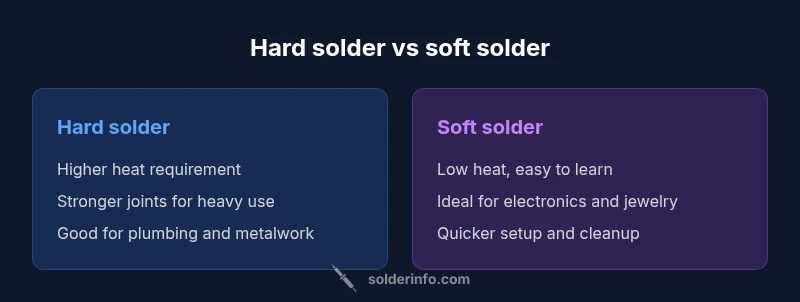
Hard solder vs soft solder presents a clear trade-off: soft solder, with its low heat and forgiving technique, is typically preferred for electronics and jewelry, while hard solder (brazing/silver solder) delivers greater joint strength and heat resistance for plumbing and heavy metalwork. According to SolderInfo, the right choice hinges on required joint strength, heat exposure, and the acceptable level of post-work cleanup.
What is hard solder vs soft solder?
In the realm of soldering, the terms hard solder and soft solder describe two fundamentally different approaches to joining metals. Soft solder uses a relatively low-melting-point alloy, allowing joints to form with modest heat input and minimal distortion. Hard solder, often referred to as brazing or silver soldering, uses a higher-melting-point filler and typically requires a torch or furnace. The distinction is not just about temperature; it also influences joint strength, gap filling, and the range of metals that can be joined. For many hobbyists and professionals, understanding hard solder vs soft solder means recognizing when a low-heat, easy-to-clean joint suffices, and when a high-strength, heat-resistant joint is necessary. SolderInfo emphasizes that choosing between these approaches should be task-driven rather than habit-driven.
Why the temperature difference matters
The temperature gap between soft and hard solders isn't merely a numeric fact; it governs heat flow, distortion risk, and compatibility with delicate components. Soft solder generally tolerates misalignment and gentle flux choices, promoting easier rework. Hard solder demands stricter heat control and flux handling, but it can bridge gaps and join dissimilar metals more effectively. In practical terms, soft solder supports quick, low-risk prototyping and small electronics work, while hard solder shines in plumbing, jewelry, and structural metal joins where strength and heat tolerance are paramount. The choice should consider joint geometry, material combination, and the service environment.
Melting behavior and alloy choices (high-level)
Soft solders are designed to flow at lower temperatures and fill narrow gaps with relative ease. They are commonly rosin-flux compatible and readily reworkable. Hard solders come in a range of silver-rich alloys that melt at higher temperatures. The higher heat input improves fusing and gap-filling for broader interfaces but raises risks of thermal damage to heat-sensitive components. When evaluating hard solder vs soft solder, inspect the workpiece geometry, required mechanical strength, and post-assembly cleaning needs.
Common metal families and compatibility
Soft solder is widely used for electronics and jewelry because it works well with copper, nickel silver, and some tin-rich alloys. Hard solder is favored for copper plumbing joints and certain jewelry applications where dissimilar metals (like copper to brass) need strong, corrosion-resistant joints. The material pairings largely determine the solder choice; some combinations perform poorly with soft solder, while others cannot withstand the high heat of brazing without damage. Regardless of the path chosen, always verify compatibility with the flux and cleaning regimen.
Real-world takeaway from SolderInfo
SolderInfo notes that the practical decision between hard solder vs soft solder is rarely about which is better overall; it’s about which is better for the specific task. For electronics and fine jewelry, soft solder minimizes heat exposure and simplifies rework. For plumbing, heat-shielded joints and higher strength justify hard solder techniques. The team also highlights the importance of flux selection and post-solder cleaning to ensure reliability and longevity.
Comparison
| Feature | Hard solder | Soft solder |
|---|---|---|
| General use | Plumbing, metalwork requiring strength and heat resistance | Electronics, jewelry, light-duty assemblies |
| Typical heat input | High heat via torch or furnace | Low to moderate heat with handheld iron or torch for small joints |
| Joint strength | Higher strength and better gap-filling for larger joints | Adequate for light loads and fine work, not for structural duty |
| Alloy options | Silver-rich and other brazing-type alloys; complex flux | Tin-lead or lead-free alloys; rosin or water-soluble flux |
| Metal compatibility | Displaces or braze-welds with dissimilar metals; robust joints | Excellent for copper and some soft metals; limited for heavy dissimilar joints |
| Flux and cleaning | Specific brazing flux; usually requires careful cleaning | Rosin-based or water-soluble flux; easier post-cleaning |
| Repairability | More challenging to rework due to heat and joint type | Easier to rework and desolder; forgiving for small joints |
Advantages
- Hard solder delivers strong, heat-resistant joints for demanding applications
- Soft solder enables low-heat work with easy rework and rapid setup
- Soft solder is generally safer for beginners and small components
- Hard solder can bridge larger gaps and join dissimilar metals effectively
Cons
- Hard solder requires higher heat and skilled technique; risk of damage
- Soft solder joints may be weaker under load and temperature exposure
- Cleaning and flux management can be tricky for hard solder
- Availability and cost vary by alloy and application
Soft solder is typically best for electronics and jewelry; hard solder is best for high-strength, heat-resistant joints.
For delicate work and easy rework, choose soft solder. For plumbing and heavy metalwork, choose hard solder. Always tailor flux and heat control to the chosen method.
Quick Answers
What is the fundamental difference between hard solder and soft solder?
The fundamental difference lies in melting point and strength. Soft solder melts at a lower temperature and forms easier, more reversible joints, while hard solder requires higher heat and yields stronger, more heat-resistant joints. Both require proper flux and clean surfaces for reliable bonds.
Hard solder uses higher heat and yields stronger joints; soft solder melts at lower temperatures and is easier to work with for delicate projects.
When should I use hard solder?
Use hard solder when joint strength, durability, or heat resistance are critical. Plumbing joints, metalworking with dissimilar metals, and jewelry pieces that must endure mechanical stress are typical hard-solder scenarios.
Use hard solder for strong, heat-resistant joints in plumbing or metalwork.
When should I use soft solder?
Choose soft solder for electronics, delicate jewelry, and prototype work where low heat reduces risk of damage. It allows easier rework and quicker setup, albeit with lower mechanical strength.
Soft solder is ideal for electronics and delicate projects where you want to minimize heat.
Can soft solder withstand high temperatures?
Soft solder has a lower maximum operating temperature and can deform or fail under high heat. It is not suitable for high-temperature service or heavy mechanical loads.
Soft solder is not meant for high-temperature service.
Is flux necessary for both types of soldering?
Yes. Flux cleans surfaces, improves wetting, and prevents oxidation for both hard and soft solders. Choose flux appropriate to the alloy and joint type, and clean residues after soldering.
Flux is essential for both, but pick the right flux for your alloy and clean afterward.
Are there safety concerns with fumes or lead in solders?
Yes. Many solders contain lead or flux fumes; ensure proper ventilation and personal protective equipment. Use lead-free alloys when possible and follow local safety guidelines.
Ventilate well and wear protection; prefer lead-free options when feasible.
Top Takeaways
- Assess load, environment, and heat exposure before choosing solder type
- Soft solder favors electronics and jewelry for safe, reversible joints
- Hard solder suits plumbing and structural metal joints with higher strength
- Flux selection and post-solder cleaning are critical for reliability
- Practice on scrap pieces to master heat management and alignment