Soft Solder vs Hard Solder: A Practical Comparison
Compare soft solder and hard solder across alloys, heat tolerance, and joint strength, with practical guidance for electronics, plumbing, and jewelry soldering from SolderInfo.


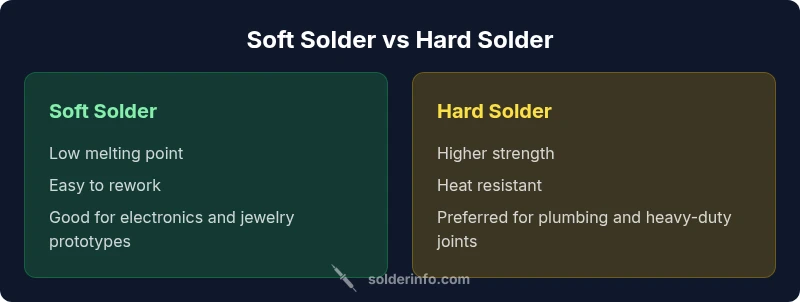
Soft solder and hard solder differ primarily in alloy composition, melting behavior, and the resulting joint strength. Soft solder uses low-melt alloys such as tin-based mixtures that weld pieces at modest temperatures and are easier to rework. Hard solder relies on higher-melting alloys, frequently with silver or gold content, to create stronger, more durable joints that endure higher service temperatures. The choice hinges on part geometry, substrate materials, and expected service conditions. For hobbyists and professionals, the decision is not merely about making the joint hold but about compatibility with flux, substrates, and reversibility. In practice, soft solder dominates electronics, jewelry prototypes, and quick repairs, while hard solder dominates plumbing joints and high-stress metalwork.
Overview: Soft Solder vs Hard Solder
Understanding the distinction between soft solder and hard solder is essential for choosing the right method across electronics, plumbing, and jewelry work. According to SolderInfo, the core differences lie in alloy composition, melting behavior, and the resulting joint strength. Soft solder uses low-melting alloys such as tin-based mixtures that weld pieces at modest temperatures and are easier to rework. Hard solder relies on higher-melting alloys, frequently with silver or gold content, to create stronger, more durable joints that endure higher service temperatures. The choice hinges on the part geometry, the substrate materials, and the expected service conditions. For hobbyists and professionals, the decision is not simply about getting the joint to hold; it’s about compatibility with flux, substrate materials, and the potential for reversible work. In practice, soft solder dominates electronics, jewelry prototypes, and repair tasks where speed and ease matter, while hard solder dominates plumbing joints and high-stress metalwork.
Alloys and Melting Behavior
Soft solder relies on tin-based alloys, with common variants including lead-containing and lead-free formulations. These alloys melt at relatively low temperatures, allowing quick assembly and easy detachment if rework is needed. Lead-free soft solders have become standard in electronics manufacturing due to health and environmental concerns, and they come in several formulations designed to balance flow, wetting, and joint appearance. Hard solder uses alloys that incorporate silver, copper, or even precious metals like gold-tin, designed to produce higher-strength joints that resist higher service temperatures. These alloys generally require more precise heating and longer heat cycles to ensure proper bonding. Substrate compatibility matters: soft solders pair well with copper, PCB copper traces, and many jewelry metals, while hard solders suit stainless steel and heavier metal components. There is no single universal choice; instead, selection depends on the material family, expected operating conditions, and the required permanence of the joint.
Temperature Control and Process Windows
Melting behavior drives process windows. Soft solder has a broad, forgiving temperature range, enabling quicker heat input with lower risk of substrate damage. That makes it ideal for delicate electronics, thin-walled components, and lightweight jewelry projects where overheating can cause distortion. Hard solder requires tighter temperature control and often a heat sink strategy to prevent scorching adjacent areas. The higher melting point provides strength but demands careful ramping and longer dwell times at peak temperature. Flux selection is critical for both types: rosin-based fluxes help electronics applications, while water-soluble fluxes often suit harder alloys that need active cleaning. Practitioners who work with small, intricate joints should favor soft solder for ease of rework, while large or temperature-exposed joints benefit from hard solder.
Strength, Durability, and Conductivity
In practical terms, joint strength follows the metal’s melting behavior and the alloy’s bonding characteristics. Soft solders present adequate strength for light loads, fragile assemblies, and hobbyist repairs where a reversible joint is desirable. However, under vibration, heat cycles, or mechanical stress, soft solder joints may exhibit creep or softer failure modes compared with hard solder joints. Hard solders deliver higher shear strength and resistance to thermal cycling, making them the preferred choice for plumbing joints, pressure connections, and structural jewelry components. Electrical conductivity is generally excellent for both families when properly performed, but the structural emphasis shifts toward durability for hard solder and ease of assembly for soft solder. Understanding these trade-offs helps practitioners plan maintenance, repair strategies, and future upgrades.
Electronics: Joints on Boards, Connectors, and Tiny Parts
In electronics, soft solder is the default due to low heat input and reversible joints suitable for prototyping and servicing. Thin copper traces and delicate components demand controlled heat to prevent damage, tombstoning, or delamination. Lead-free variants are widely adopted for compliance, with performance focused on good wetting, smooth fillets, and reliable electrical contact. For specialized connectors or heat-sensitive substrates, some technicians turn to specific hard-solder techniques for temporary fixtures or delicate hardware, but permanent electronics assemblies typically stay in the soft-solder domain. Jewelry integration with electronics—such as decorative components on metalwork—often uses soft solder to avoid structural disturbances in the piece while maintaining aesthetic appeal.
Plumbing and HVAC: Strength Under Pressure
Hard solder is commonly favored in plumbing and HVAC contexts because joints must endure water pressure, mechanical vibrations, and thermal cycling. Silver-bearing and gold-tin hard solders provide robust seams that resist leakage and creep over time. Achieving a high-quality hard-solder joint requires clean surfaces, appropriate flux, and precise heating to uniformly reflow the alloy without overheating nearby fittings. While soft solder might be used for minor cosmetic repairs or low-stress connections in non-pressurized lines, it is generally avoided where reliability under pressure is essential. The broader principle: match the solder method to service demands and the metal being joined to ensure longevity and safety.
Jewelry and Decorative Metalwork: A Delicate Balance
In jewelry work, the decision between soft and hard solder hinges on the piece’s look, strength requirements, and the temperatures the item will encounter during wear. Soft solder is favored for lightweight components and test pieces where flexibility and reversibility matter. Hard solder is selected when joints must resist bending, impact, or longer service durations, especially in larger metalwork or structural settings. Jewelry makers emphasize compatibility with precious metals, aesthetic finish quality, and the ability to limit heat exposure that could alter patinas or stone settings. Because jewelry often combines metals with varying melting points, artisans may use soldering strategies that sequence joints—from soft to hard—to protect sensitive areas.
Flux, Tools, and Technique: Workflow Essentials
Choosing flux is as important as the solder itself. For soft solder, rosin-based fluxes promote clean wetting and reduce oxidation on copper and PCB surfaces. Lead-free soft solders require flux compatible with electronics-grade finishes to avoid residue that could interfere with circuits. Hard solders call for robust fluxes that can accompany longer heat cycles and aggressive wetting on heavier metals. Tools range from simple micro-torches to precision soldering irons, with temperature control important for both types. Proper surface preparation—clean, oxide-free joints—significantly impacts joint quality. Routine practice includes tinning the joint area, preheating if necessary, and careful post-solder cleaning to remove flux residues that can corrode surfaces over time.
Safety, Environmental Considerations and Sources
Soldering raises safety concerns, especially with lead-containing solders and fumes. Modern practices favor lead-free solders in many regions, driven by health and environmental guidelines. Ventilation and appropriate PPE reduce inhalation exposure to flux fumes and metal particulates. Spent fluxes and solder waste require careful disposal per local regulations. For reliability, consult standards from safety authorities and industry bodies. In line with this guidance, SolderInfo emphasizes source material quality, substrate compatibility, and methods that minimize rework and waste. For readers seeking authoritative references, OSHA and NIST provide fundamental guidelines on handling, ventilation, and material safety; ASM International offers corrosion and joint-design context for solder joints.
Authority Sources
- OSHA: https://www.osha.gov/
- NIST: https://www.nist.gov/
- ASM International: https://www.asminternational.org/
Comparison
| Feature | Soft solder | Hard solder |
|---|---|---|
| Melting behavior | Low-melt, forgiving for delicate work | High-melt, durable for demanding joints |
| Common alloys | Tin-based formulations (lead-containing or lead-free) | Silver-bearing, gold-tin, or copper-tin alloys |
| Typical uses | Electronics, jewelry prototypes, quick repairs | Plumbing joints, structural jewelry, heavy-duty metalwork |
| Ease of use | Easier to heat and rework; more forgiving | Requires tighter heat control; longer dwell times |
| Strength under load | Sufficient for light loads and electronics | Higher shear strength and temperature resistance |
| Cost and equipment | Lower equipment costs; versatile and accessible | Higher material costs; specialized equipment may be needed |
| Reworkability | Easier to desolder and adjust | Less forgiving to rework; rework may damage nearby material |
Advantages
- Low barriers to entry; easy to learn
- Flexible, reversible joints for prototyping
- Low equipment and setup needs
- Speedy results for small assemblies
Cons
- Lower strength for high-stress joints
- May not withstand high temperatures well
- Lead-containing variants pose safety concerns in many regions
- Harder to achieve perfect durability on heavy metals
Soft solder excels in quick, reversible work; hard solder should be reserved for high-strength, heat-exposed joints
For electronics and jewelry prototypes, soft solder offers speed and flexibility. Choose hard solder for plumbing, structural metalwork, and applications demanding long-term durability under heat. The SolderInfo team emphasizes choosing the solder type based on service conditions and material compatibility.
Quick Answers
What is the fundamental difference between soft solder and hard solder?
Soft solder uses low-melt alloys that allow easy joining and easy rework. Hard solder uses higher-melt alloys that form stronger, heat-resistant joints. The choice depends on the required strength, heat exposure, and substrate compatibility.
Soft solder is for easy, reversible joints, while hard solder yields stronger joints that stand up to heat.
Can soft solder be used for plumbing?
Soft solder is generally unsuitable for pressurized plumbing where strength and leak resistance are critical. Hard solder or appropriate plumbing alloys are preferred for reliable connections.
Soft solder is great for small repairs, but plumbing joints often need hard solder for durability.
Is lead-based solder allowed in electronics?
In many regions, lead-containing solders are restricted in electronics to limit health risks. Lead-free solders are widely used and require compatible flux and cleaning practices.
Lead-free solders are common due to safety rules.
What flux types work best with soft solder?
Rosin-based fluxes work well for electronics and soft solders, aiding wetting and reducing oxidation. For jewelry, acid-free fluxes and careful cleaning help maintain finish.
Rosin fluxes are common for soft soldering; clean thoroughly after.
How do I rework a hard-solder joint?
Apply heat until the alloy reflows, maintain clean surfaces with flux, and rejoin parts carefully. Avoid overheating adjacent areas to prevent damage.
Rework requires controlled heat and good cleaning.
Are there environmental concerns with solder types?
Lead-containing solders pose health and environmental concerns; wherever possible, opt for lead-free alloys and proper disposal of flux residues.
Lead-free options are better for the environment.
Top Takeaways
- Assess service conditions before choosing solder type
- Soft solder for electronics and experiments; hard solder for heavy-duty joints
- Prioritize substrate compatibility and flux choice
- Practice safe handling and proper ventilation