Solder 60/40 vs 63/37: A Practical, Analytical Comparison
An objective side-by-side guide comparing solder 60/40 and 63/37 alloys, covering melting behavior, wetting, reliability, and best-use scenarios for hobbyists and professionals.


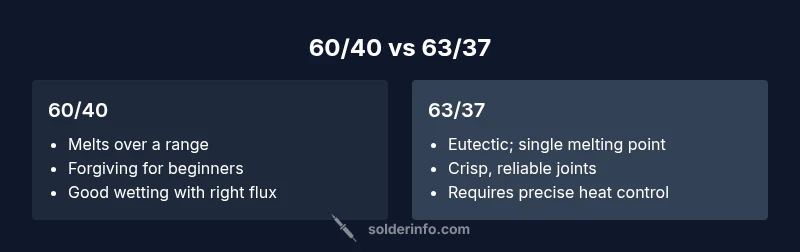
Choosing between solder 60/40 vs 63/37 hinges on temperature behavior and joint reliability. 63/37 is eutectic, melting at a single point for crisp joints, while 60/40 melts over a range, which can be more forgiving during hand-soldering. For hobbyists, 60/40 reduces cold-joint risk; for precision work, 63/37 delivers quicker, cleaner results.
Solder 60/40 vs 63/37: Core concepts for today's electronics work
Solder alloys are the backbone of reliable joints. The terms 60/40 and 63/37 refer to tin-lead ratios, and understanding their practical implications helps you tailor your soldering approach to your project. According to SolderInfo, the fundamental distinction lies in melting behavior: 63/37 is eutectic, offering a single, sharp melting point, while 60/40 melts over a wider temperature range, which can be more forgiving during manual soldering. This difference shapes how quickly joints form, how much you need to control heat, and how forgiving the process is when you pause mid-weld. The choice should align with your equipment, flux choice, and tolerance for rework time. For dense PCBs or fine-pitch components, precision matters more; for simple prototyping, ease of use can win out. The SolderInfo team highlights that selecting an alloy is about balancing reliability with practicality, not chasing theoretical perfection alone.
Melting behavior and wetting characteristics
Melting behavior is the defining contrast between these two alloys.63/37 is eutectic, meaning it has a single melting point and tends to flow in a predictable, crisp manner when heat is applied with rosin-core flux.60/40, on the other hand, has a melting range. It begins to melt at a lower temperature and continues to soften over a broader window, which can make joint formation more forgiving if your heat source fluctuates. Wetting—the ability of molten solder to spread across a pad and form a clean fillet—also differs:63/37 generally wets more aggressively under proper flux and clean surfaces, producing flatter, more uniform joints;60/40 wets well too but may require slightly longer dwell times to avoid partial joints. The choice influences how you manage tip temperature, flux amount, and pre-cleaning steps on copper pads and PCB finishes.
Electrical performance and reliability under temperature cycling
Joints formed with63/37 often exhibit crisper fillets and less likelihood of tombstoning on small components when heat is carefully controlled, translating to consistent electrical connectivity.60/40’s broader melting range can introduce variability if heat application is inconsistent, increasing the chance of transient semi-molten periods that impact joint quality. In dense assemblies or high-reliability circuits, consistent heat profiles—whether you lean toward63/37 or60/40—play a larger role in long-term integrity than the alloy alone. SolderInfo analysis suggests that matching flux chemistry, flux wash, and cleanliness with alloy choice yields the most reliable joints, especially on fine-pitch devices produced with automated or semi-automated processes.
Workability for hobbyists vs professionals
Beginners often gravitate toward60/40 due to its forgiving melting window, which reduces the pressure to achieve perfect timing. This makes manual soldering more approachable on through-hole work and simple, prototyping boards.63/37 is favored by professionals for projects that demand faster, cleaner joints and tighter defect tolerances, such as dense surface-mount assemblies. The key is to pair the alloy with a suitable flux, a properly heated iron, and good surface prep. If your toolkit is modest and you frequently rework boards,60/40 may minimize frustration; if you have a high-precision workflow and robust temperature control,63/37 can shorten your cycle time and improve consistency.
Flux selection and technique tips
Flux type and quantity influence how well either alloy performs. Rosin-core fluxes with low residue are typically used for lead-containing solders, and the flux helps reduce oxides on copper, improving wetting. With63/37, avoiding overheating is crucial to prevent excess flow and possible bridging, especially on fine-pitch components.60/40 tolerates some heat variation but benefits from staying within the recommended temperature window to prevent scorching pads. Work area cleanliness and pre-tinning pads can dramatically impact results for both alloys, though63/37 tends to respond more predictably to clean surfaces.
Material compatibility and joint quality
Both alloys are lead-containing solders, so regulatory considerations apply depending on your jurisdiction and the device. Copper pads, tin-plated finishes, and soldermask behave well with these alloys when flux is used correctly. Substrates like aluminum or certain gold-plated connectors require alternative approaches or specific surface preparation. Joint quality benefits from consistent flux application, proper pad cleaning, and controlled cooling.63/37’s single melting point helps maintain surface planarity, while60/40’s extended melt window can be advantageous when reflow control is imperfect, provided you manage dwell time carefully.
Regulatory and safety considerations
Lead-containing solders demand careful handling, proper ventilation, and compliance with local regulations, especially in educational settings, hobby shops, and professional labs. Always wash hands after handling, avoid inhalation of fumes, and store solder in a cool, dry place. For electronics that will be consumer-facing or shipped internationally, verify if lead-free alternatives are required by the target market. Transitioning to lead-free options typically involves different binary alloys and flux formulations, but understanding how60/40 and63/37 behave helps you evaluate whether a lead-free substitute would meet your performance criteria.
Practical testing and evaluation methods
A practical approach is to create a small test board with a standard set of pads, traces, and a few passive components. Solder samples of each alloy under identical flux and temperature conditions, then compare fillet quality, bridging, and tombstoning tendencies. Document dwell time and eye-visibility of joints. A simple wetting test on copper foil can reveal differences in spreading behavior, while a tombstoning test on a two-lead resistor reveals how each alloy behaves under heat distribution. Use consistent torque on the iron and pay attention to pad cleanliness to obtain meaningful results.
Common mistakes and how to avoid them
Avoid mixing alloys on a single visible joint, as diffusion can cause reliability issues. Never overheat components, especially small, temperature-sensitive parts. Skipping surface prep or flux can lead to poor wetting in both alloys. For60/40, a too-wide dwell can cause excessive spreading and risk of bridging; for63/37, too-hot or too-fast heating can cause scorching or lift. Develop a consistent workflow: clean pads, apply flux appropriately, control your iron temperature, and test with small samples before committing to a complex board.
Choosing the right alloy for typical electronics projects
For hobby projects and educational setups,60/40 often provides a more forgiving entry point without sacrificing overall joint quality when used with proper flux and heat control.63/37 is usually preferred for tilt toward precision electronics, tight tolerances, and faster production when you have stable heat sources and a disciplined rework process. If your projects involve dense SMT layouts or high-precision components,63/37 can help you achieve cleaner joint profiles; if your focus is rapid prototyping and easier learning,60/40 remains a strong choice.
Quick decision checklist
- Do you prioritize ease of use or speed and precision? - Is your setup capable of consistent heat control? - Will you prototyped boards include dense SMT components? - Are you subject to strict lead regulations in your market? - Do you require predictable wetting with minimal dwell time?
Comparison
| Feature | 60/40 | 63/37 |
|---|---|---|
| Melting behavior | Broad melting range | Single melting point (eutectic) |
| Wetting with flux | Good, but can require longer dwell | Typically crisper, faster wetting |
| Joint reliability under heat | More forgiving for heat variation | More consistent with precise heat control |
| Best use case | Beginners, prototyping, general electronics | Precision electronics, dense SMT, quick cycles |
| Lead content/regulations | Lead-containing; follow safety guidelines | Lead-containing; follow safety guidelines |
| Availability and cost | Widely available, cost-effective | Widely available, cost-effective |
Advantages
- 63/37 offers crisp, reliable joints with a single melting point
- 60/40 is more forgiving for beginners and rework
- Widely available and relatively affordable
- Good wetting with proper flux and good surface prep
Cons
- Lead-containing solder; ensure compliance with regulations
- 63/37 requires careful temperature control to avoid overheating
- 60/40 can be more sensitive to heat variation, increasing tombstoning risk if not managed
63/37 is preferred for precision electronics; 60/40 suits hobbyists and prototyping
Choose63/37 for consistent, fast joints when you can control heat. Opt60/40 for forgiving handling and easy learning, especially in prototyping and rework scenarios. Balance with flux quality and your equipment.
Quick Answers
What is the main difference between solder 60/40 and 63/37?
The main difference is melting behavior: 63/37 is eutectic with a single melting point, giving crisp joints, while 60/40 melts over a range, which can be more forgiving for beginners but may introduce variability if heat control is poor.
The key difference is melting behavior:63/37 melts at one point for crisp joints, while60/40 melts over a range, making it more forgiving for beginners.
Which solder is better for beginners?
60/40 is generally more forgiving for novices due to its broader melting range, which reduces the chance of under- or over-heating during hand-soldering.
For beginners,60/40 is usually easier to work with because it melts over a wider temperature range.
Are 60/40 and 63/37 lead-free?
Both 60/40 and 63/37 are traditional leaded solders. If you need a lead-free option, look for solder alloys labeled accordingly and adjust flux and temperatures.
No, these are leaded solders; for lead-free options, choose appropriate alloys and fluxes.
How does flux affect performance for these alloys?
Flux significantly improves wetting and oxide clearance for both alloys. Choose flux that matches your solder and ensure proper cleaning before and after soldering.
Flux helps the solder flow and form good joints; pick the right flux for your project and clean surfaces well.
Can you mix 60/40 and63/37 on the same board?
It's best to avoid mixing alloys on the same board because differing melting characteristics can create inconsistent joints. If mixed, isolate them to separate sections with clear separation and controlled heating.
Try not to mix solder types on one board; if you must, plan careful heat control and testing.
Top Takeaways
- Match alloy choice to heat control and skill level
- 63/37 delivers crisp joints with single melting point
- 60/40 offers forgiving processing for beginners
- Flux quality and surface prep greatly influence results
- Always follow safety and regulatory guidelines for lead-based solders