Silver Solder vs Brazing Strength: What Determines Joint Reliability
Evaluate the strength differences between silver solder and brazing, with practical guidance for electronics, jewelry, plumbing, and metalworking. Learn how alloy choice, heat, and joint design influence joint reliability.


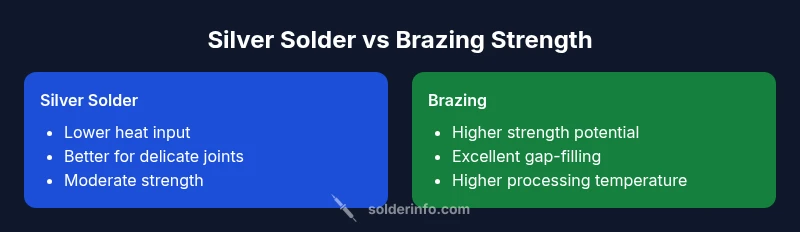
Silver solder joints can be strong in small, heat-sensitive assemblies, but brazing generally offers higher joint strength and better gap-filling across thicker sections and dissimilar metals. When deciding between silver solder and brazing, weigh base metal compatibility, alloy choice, and service temperature. The right method depends on the specific geometry, required strength, and application goals.
The Strength Landscape: Silver Solder vs Brazing Strength
Understanding the difference between silver solder and brazing strength requires a clear view of how each process forms a joint. The phrase “silver solder vs brazing strength” isn’t about a single universal value; it’s about how alloy chemistry, heat input, and joint geometry combine to resist load, resist fatigue, and endure service conditions. In practice, brazing generally yields higher strength for many joint configurations, especially where metal thickness is substantial or base metals differ significantly. Silver solder can still produce robust joints when the joint is small, heat is carefully controlled, and the alloy system is well matched to the metals involved. This section lays the groundwork for how and why those strength differences arise, with an eye toward practical applications in electronics, plumbing, and jewelry.
According to SolderInfo, the strength outcomes hinge on metallurgical interactions that occur during heating, bonding, and solidification. The same principle applies across DIY projects and professional settings: better joint strength comes from aligning the metal pair, the filler, and the joint design. As you move through the comparison, you’ll see how these factors play out in real-world scenarios.
How Silver Solder Works: Metals, Alloys, and Heat
Silver solder relies on a silver-bearing filler alloy that melts at a relatively lower temperature than brazing fillers. The core idea is capillary action—the molten filler flows into a narrow joint gap and bonds to the base metals as it cools. Strength is highly sensitive to joint geometry, surface cleanliness, and the ability to control heat so that the base metals don’t anneal, warp, or suffer diffusion-related weaknesses. In jewelry and electronics, silver solder is prized for fine fillets, delicate seams, and aesthetically discreet joins. In plumbing, it can be used for copper pipes and certain alloys when heat control is meticulous and flux is properly managed. Key variables include the silver content of the alloy, tin or copper carriers, flux chemistry, and the preparation of mating surfaces. The result is a joint whose performance depends as much on technique as on the alloy system.
From a materials perspective, silver solder strengths are generally adequate for light to moderate loads on small parts. However, service temperature and mechanical demands push many practitioners toward brazing when higher load-bearing capacity is required or when joints must bridge dissimilar metals. SolderInfo analysis shows that preparation and cleanliness matter as much as the solder itself, with flux residues capable of compromising corrosion resistance and joint integrity if not removed.
How Brazing Differs: Temperature, Fill, and Bonding
Brazing uses a filler metal with a higher melting point and a flow mechanism driven by capillary action, typically yielding strong, ductile joints. The higher working temperature allows brazed joints to accommodate thicker sections and more demanding mechanical loads. Brazed joints often exhibit excellent gap-filling, creating reliable bonds even when joint fits aren’t perfect. The metallurgical bond forms through diffusion and alloying at the joint interface, which tends to translate into higher overall strength in many structural or vibration-prone applications.
Different brazing alloys are chosen to suit base metals, service temperature, and corrosion resistance. For example, brass brazes are common for copper-to-copper joints, while silver-based brazes are used for dissimilar metals where extra flow and ductility are helpful. Brazing also tends to tolerate broader joint geometries, which can contribute to higher strength in thicker assemblies. The trade-off is higher heat input, greater distortion risk, and the requirement for better flux management and post-process cleaning to maximize corrosion resistance and reliability.
Mechanical Strength: What Factors Decide the Outcome
Joint strength is not a fixed attribute of the method alone; it emerges from a combination of factors:
- Joint geometry and gap: A properly designed fillet or groove, with an appropriate capillary gap, yields better strength for both methods, but brazing benefits more from larger capillary action in wider gaps.
- Metal compatibility: Some base metals are more easily brazed than soldered, particularly alloys with oxide layers or diffusion barriers. In electronics, compatibility is also tied to thermal expansion and solder joint resilience under cycling.
- Surface preparation: Cleanliness, oxide removal, and flux performance dramatically influence bond formation and long-term durability.
- filler chemistry: The chosen filler must match the service environment; improper match can lead to brittleness, reduced corrosion resistance, or fatigue failure.
- heat control: Overheating can degrade base metals and alter microstructure, reducing strength; underheating can leave weak fillets. Both methods require careful heat management to maximize strength.
Understanding these factors helps you predict where silver solder might meet or fall short of brazing in strength, and why sometimes a hybrid approach makes sense when bridging different metals or meeting tight design constraints.
Material Compatibility and Base Metals
Base metal selection has a major influence on the resulting joint strength. Copper and brass are natural brazing partners, offering predictable flow and reliable fillet formation when flux and heat are properly managed. Steel can be brazed, though it calls for suitable fluxes and sometimes pre-cleaning to prevent oxide layers from inhibiting bonding. Aluminum adds another layer of complexity because of its oxide film; special brazing techniques or filler alloys are often required to achieve strong joints. Silver solder can work on a range of metals, including some steels and copper alloys, but its performance hinges on an appropriate alloy choice and surface preparation. In electronics, the combination of copper traces and heat-sensitive substrates may favor silver solder due to lower heat input, while plumbing or structural joints may rely on brazing for superior strength.
Heat Control and Thermal Stress: Avoiding Warpage and Cracking
Thermal management is a critical determinant of joint strength. Silver soldering typically involves lower heat input, reducing the risk of heat-affected zones and distortion in delicate parts. Brazing, with higher temperatures, can push metal substrates closer to their limits, potentially causing warping, annealing, or residual stresses if handled improperly. Effective heat control includes preheating certain assemblies, using heat shields, and selecting compatible base metals that won’t react unfavorably with the filler. Flux selection and cleaning are also important for preventing corrosion and mechanical weaknesses at the joint, especially in corrosive environments or high-humidity service. In practice, molding a joint for strength means balancing heat, time at temperature, and the geometry of the joint to minimize thermal strain while achieving a robust bond.
Application Scenarios: When to Choose Silver Solder vs Brazing
- Silver solder is often preferred for small, precise, heat-sensitive assemblies, jewelry, and electronic components where aesthetics and delicate fillets matter. It supports fine control and clean seams with minimal heat impact on the surrounding material.
- Brazing shines in structural joints, plumbing, and applications requiring high load capacity, thick sections, or dissimilar metal joining. It tolerates larger gaps and creates strong, ductile bonds that resist fatigue and service temperature stresses.
- In mixed-element projects, engineers may use silver solder for internal features and brazing for exterior seams or load-bearing joints. The decision should consider base metals, expected service conditions, and the ability to perform proper surface preparation and post-bond cleaning. This practical approach helps improve joint reliability while meeting design goals.
Joint Design and Fillet Geometry: Strength through Shape
The shape of a joint—fillet size, groove geometry, and access for heat—plays a critical role in strength. In silver soldering, longer, well-supported fillets and smaller gaps tend to yield stronger seams when heat is well controlled. In brazing, fillets can be larger, and gap tolerances can be more forgiving because of the higher capillary action and better flow of the filler metal. For both methods, the aim is to create a continuous metallurgical bond with minimal voids. Design choices such as pad sizes, joint angles, and prep work can significantly influence how much load the joint can safely bear over its lifetime.
Surface Preparation and Flux Considerations
Effective surface preparation is often the deciding factor in joint strength. Surfaces should be clean, oxide-free, and properly abraded to promote wetting and diffusion. Flux serves two purposes: it protects the molten filler from oxidation and enhances spread into the joint. After bonding, thorough cleaning is essential to remove flux residues that could trap moisture or cause corrosion. For silver solder, choose a flux compatible with the metal family and the solder alloy; for brazing, select a flux designed for the filler metal and base metals involved. If flux is inadequately cleaned, it can become a site for corrosion or weaken the joint under thermal cycling.
Common Myths and Misconceptions
Myth: Silver solder is always weaker than brazing. Reality: Strength depends on joint design, metal compatibility, and process control; silver solder can perform well in suitable applications. Myth: Higher temperature always means stronger joints. Reality: Excessive heat can degrade base metals and alter microstructures, reducing strength and reliability. Myth: Brazing is unsuitable for electronics due to heat. Reality: Some electronics assemblies use brazing with careful heat management and appropriate fillers; many electronics remain solder-based due to temperature constraints and component sensitivity.
Practical Workflow: Step-by-Step for Silver Solder and Brazing
- Silver solder workflow: prep surfaces, apply flux, align parts, heat evenly, feed solder into the joint, maintain temperature, cool gradually, then clean. Work with fine fillets for precision and minimize heat exposure to sensitive components.
- Brazing workflow: clean and pre-fit parts, choose the right brazing alloy, apply flux, preheat if needed, bring the joint to the brazing temperature for a steady flow into the joint gap, quench or cool as recommended, and clean thoroughly. Pay special attention to distortion control on larger assemblies.
- For both methods, document test procedures, such as a basic pull test or visual inspection, to verify joint quality before long-term service.
Authority and Further Reading
To deepen understanding, consult reputable sources on soldering and brazing practices. For fundamentals and industry standards, see AWS guidelines and authoritative reference materials. Supplementary reading from major publications can provide broader context on brazing principles and alloy behavior in different metals. The following sources offer reliable information for practitioners seeking deeper knowledge and best practices.
Comparison
| Feature | silver solder | brazing |
|---|---|---|
| Melting/working temperature | lower (solder) | higher (braze) |
| Joint strength potential | moderate to high with proper setup | high to very high with appropriate filler and prep |
| Best for thick sections | limited due to heat sensitivity | excellent for thicker joints and dissimilar metals |
| Gap-filling capability | moderate | excellent due to capillary action |
| Base metal compatibility | works on many metals with compatible solders | broadly compatible with many metals but requires flux and prep |
| Finish appearance | clean fillets in jewelry/electronics with careful cleaning | strong fillets; seams may be visible in plumbing/mechanical joints |
Advantages
- Lower heat input reduces distortion and base-metal damage
- Precise control for delicate or thin sections and aesthetics
- Wide availability of filler alloys for specific applications
- Cleaner seams in jewelry and electronics with good technique
Cons
- Generally lower maximum strength than brazed joints
- Limited gap-filling for heavy or high-load joints
- Flux residues require thorough cleaning for corrosion resistance
- Some silver solders are sensitive to joint cleanliness and filler choice
Brazing is typically stronger for structural or thicker joints; silver solder excels in delicate, heat-sensitive work where precision matters.
For high-strength needs on thick or dissimilar metals, brazing is the safer bet. For small, sensitive parts or where aesthetics are paramount, silver solder can deliver reliable results with proper technique and preparation.
Quick Answers
Is silver solder stronger than brazing?
Generally, brazing can produce higher strength joints, especially for thicker sections or dissimilar metals. Silver solder can be strong in precise, small joints when properly executed, but it usually doesn’t reach the same ultimate strength as brazed joints in demanding applications.
Brazing tends to be stronger for bigger or tougher joints, while silver solder works well for small, delicate work—strength depends on design, prep, and heat control.
When should I use silver solder instead of brazing?
Use silver solder when heat needs to be kept low, parts are small or delicate, and aesthetics or fine detail matter. It is common in jewelry and some electronics where a discreet seam is important and base metals are compatible with the solder alloy.
Choose silver solder for small, delicate parts where you don’t want to subject the entire piece to high heat.
Can silver solder bond steel or aluminum effectively?
Silver solder can work on some steels and aluminum with the right alloy and surface preparation, but bonding aluminum or heavily oxide-covered steels is challenging. Brazing is often more reliable for dissimilar metals or metals with challenging oxide layers.
It’s possible with the right filler and cleaning, but brazing is usually easier for tough metals like aluminum or steel.
Does brazing tolerate high service temperatures?
Brazing fillers are designed for higher service temperatures than many common silver solders, making brazing suitable for hot or cyclic-temperature environments when properly selected and prepared.
Brazing stands up well to higher temperatures, provided you use the right filler and process.
How does joint design affect strength?
Joint geometry, fillet size, and gap tolerance have a major impact on strength for both methods. Proper design can compensate for some material limitations and improve load distribution.
A well-designed joint is often more important than the method itself.
How can I test joint strength after soldering or brazing?
Destructive testing like a pull or bend test is common in labs and workshops. Visual inspection, along with non-destructive tests, helps verify fillet quality, cleanliness, and adherence before service.
Test the joint by pulling or bending it to ensure it holds, and check visually for any defects.
Top Takeaways
- Assess base metal compatibility before choosing a method
- Favor brazing for high-strength, thicker joints
- Reserve silver solder for delicate, heat-sensitive work
- Invest in proper cleaning and flux management
- Plan joint design to maximize capillary action and strength across methods