Lead Free Solder vs Lead Solder Plumbing: An Objective Comparison
A rigorous, objective comparison of lead-free solder and lead solder for plumbing. Learn safety, code compliance, performance, and best-use scenarios for DIYers and professionals in 2026.


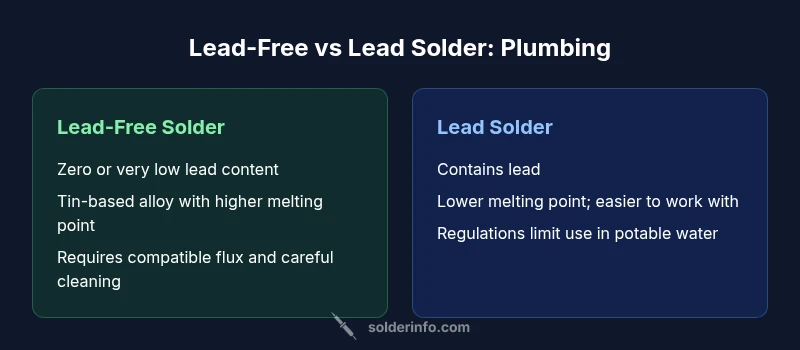
Across most plumbing applications, lead free solder vs lead solder plumbing clearly favors lead-free options due to safety, health, and code compliance. Lead-free solders reduce lead exposure and meet contemporary regulations, but they may require compatible flux, slightly higher temperatures, and careful cleaning to prevent cold joints. Always verify local codes before mixing solder types on water lines.
What are lead free solder and lead solder in plumbing?
In plumbing, solder is used to create a leak-tight bond between copper pipes and fittings. The two main families are lead-free solders and traditional lead-containing solders. Lead-free solders are typically tin-based alloys designed for potable water systems, while lead solders use tin-lead compositions. The health, safety, and regulatory implications of these two choices are central to the discussion of lead free solder vs lead solder plumbing. According to SolderInfo Team, most modern codes emphasize eliminating lead from drinking-water connections, driving broad adoption of lead-free alloys. For DIYers and professionals, understanding the fundamental differences—composition, heat behavior, and flux compatibility—helps you select the right option for each job, from a simple joint in a fast-repair to a new-weld on a well-piped system. This section lays the groundwork by clarifying what each category is and where it is typically used.
Comparison
| Feature | lead-free solder | lead solder |
|---|---|---|
| Lead content | 0% lead content (lead-free) | high lead content (traditional) |
| Melting behavior | higher melting point tendency (tin-based lead-free alloys) | lower melting point (tin-lead) |
| Code compliance | generally required for potable water in many jurisdictions | often restricted or prohibited for drinking-water lines in many areas |
| Compatibility | best with modern flux and fixtures | works with older systems but risk of incompatibility with current codes |
| Availability/Cost | widely available; cost varies by region | commonly cheaper in some markets but with regulatory limits |
| Joint durability | can be more brittle if joints are not well executed | tin-lead solder can be more ductile but poses health risks |
Advantages
- Improved safety and reduced lead exposure
- Better alignment with modern plumbing codes
- Compatible with contemporary fixtures and fluxes
- Easier compliance for new installations while future-proofing projects
Cons
- Higher melting temperatures may require hotter soldering tools
- Potentially higher material costs and flux requirements
- Compatibility challenges with legacy fittings or coatings
- Limited availability in ultra-regional markets or older homes
Lead-free solder is the recommended default for most residential plumbing.
It minimizes lead exposure and aligns with modern codes. For legacy systems or non-potable lines, verify local regulations and material compatibility with the AHJ before proceeding.
Quick Answers
Is lead-free solder mandatory for potable water plumbing in most areas?
In many regions, lead-free solder is required for drinking-water systems. Local codes vary, so always consult the AHJ before starting a project. Lead-free options reduce lead exposure and help ensure compliance.
Yes. Most places require lead-free solder for drinking-water pipes; check your local codes for specific rules.
Can I mix lead-free solder with traditional lead solder on the same system?
Mixing solder types on a single plumbing system is generally discouraged due to potential contamination and incompatible joints. If mixed, use purpose-built adapters or consult the AHJ. Consistency helps ensure joint reliability and code compliance.
Avoid mixing; stay consistent with one solder type per system to prevent issues.
What flux should I use with lead-free versus lead solders?
Use flux formulations designed for the alloy you select. Lead-free alloys typically require flux optimized for tin-based systems. Tin-lead fluxes should not be used with lead-free solders, and vice versa. Always follow manufacturer guidance.
Pick the flux that matches your solder alloy and pipe material.
Are there safety concerns beyond lead exposure when using lead-free solder?
Besides reducing lead exposure, proper ventilation, eye protection, and careful handling of flux residues are important. Ensure good cleanliness and avoid inhaling fumes from hot flux or solder.
Safety is about good ventilation and protective gear, not just the alloy.
Does lead-free solder perform as well as tin-lead solder under high pressure?
Both can perform well in typical household pressure ranges when joints are properly prepared. Lead-free alloys can be more temperature-sensitive, so heating technique and flux quality matter for durable joints.
If you solder correctly, both can hold up well under normal home pressures.
What are best practices for joining copper pipes with lead-free solder?
Clean and flux the joint, heat evenly, apply solder from the bottom up, and inspect for full capillary flow. Use a compatible flux and avoid overheating, which can degrade the joint. Practice makes perfect for consistent results.
Clean, flux, heat evenly, and check the joint thoroughly.
Top Takeaways
- Opt for lead-free solder for new work to meet codes.
- Always verify local regulations before switching solder types.
- Choose flux and alloys that match the pipe material and environment.
- Be aware of higher heat requirements with lead-free solders.
- Test joints thoroughly after installation to ensure leak-free performance.