Is Solder Stronger Than Copper? A Comprehensive Comparison
Explore whether solder is stronger than copper across electronics, plumbing, and jewelry. Learn how joint strength is achieved, what governs strength in each context, and best practices from SolderInfo.


Is solder stronger than copper? In bulk terms, copper is stronger, but solder is engineered to create reliable joints at moderate temperatures. The bond strength depends on the alloy, surface preparation, and joint design rather than metal strength alone. For electronics, plumbing, and jewelry, solder provides adequate, ductile joints even when copper is intrinsically stronger. Context matters for the overall performance.
is solder stronger than copper? Understanding the claim
According to SolderInfo, the question of strength hinges on context. In general terms, copper is a stronger bulk metal than solder, which is designed for bonding rather than carrying load. The SolderInfo Team found that joint performance depends more on the solder alloy, surface preparation, and how the joint is executed than on the metal pair alone. Put simply, copper provides raw mechanical strength, while solder provides a ductile, conductive bridge that holds components in place under thermal cycling and vibration. In electronics, a soldered joint must tolerate heating and cooling cycles without cracking; in plumbing, it must withstand pressure and moisture; in jewelry, it must balance ease of work with faithful aesthetic. Across these domains, strength is a function of the bond geometry, wetting, and metallurgy rather than a single universal rule. By examining these factors, we can compare strength outcomes across scenarios more fairly and accurately.
Material properties: Copper vs Solders
Copper is a bulk metal whose strength comes from its crystal lattice and ductility. It resists deformation well and maintains electrical conductivity, making it invaluable for wires and pipes. Solder, by contrast, is a low-melting alloy designed to wet surfaces and form a cohesive join. Common solders range from tin-lead to lead-free tin-silver-copper variants. The strength of a solder joint is not the same as the metal’s own tensile strength; it depends on how well the solder wets the surface, the formation of reliable intermetallics, and the geometry of the joint. In practical terms, a copper part may tolerate higher forces, but a well-executed solder joint can endure meaningful mechanical and thermal stresses in staged assemblies.
How joint strength is measured in practice
Engineers assess joint strength using standardized tests such as pull tests and shear tests. In electronics, joints must resist rework stress while remaining electrically conductive, and repeated thermal cycling can cause intermetallic growth that weakens the bond over time. In plumbing, joints are tested for leak resistance under pressure; the joint’s reliability hinges on flux effectiveness, clean surfaces, and consistent heating. Jewelry applications emphasize graceful failure modes that preserve metal integrity and allow easy repair. Across all applications, the tests focus on the joint, not merely the base metals, because the bond’s performance defines service life more than the metal’s intrinsic strength.
The electronics context: Why solder strength matters
Electronics demand joints that endure heat, cold, and vibration without fatiguing or cracking. Solder strength in this context correlates with wetting quality, the thickness of the solder fillet, and the presence or absence of voids. Flux choice and residue control influence long-term reliability by preventing corrosion at the joint. Proper tinning, tip temperature control, and paste deposition patterns all contribute to robust connections. In many cases, the copper traces and components provide the electrical path, while the soldered joint anchors them physically and thermally. The SolderInfo Team emphasizes that a strong joint is a balance between metallurgical bonding and mechanical design, not simply the metal pair involved.
The plumbing context: copper pipe vs solder joint
In plumbing, copper pipes carry fluid and are joined using solder or brazing alloys. The joint must be watertight and durable under pressure and temperature fluctuations. While copper pipe has geometric and material strength, it relies on the solder joint to seal and bind sections effectively. Flux cleanliness and heating discipline are critical: overheated joints can degrade the flux and weaken the seal, while underheated joints may fail to wet properly. The takeaway is that, for plumbing, joint reliability emerges from surface prep, proper heating, and correct alloy choice as much as from the copper itself.
Jewelry considerations: solder in jewelry
Jewelers use solder to join components and set settings without compromising the aesthetic or the metal’s integrity. Jewelry solder typically prioritizes smooth flow, minimal grain disruption, and aesthetically pleasing seams. The alloy choice matters for color and hardness; silver and gold jewelry rely on specific solder families to match metal finishes. The joint’s endurance depends on the fit-up, flux, and heat control, since jewelry often experiences bending and flexing during wear. In this context, solder strength is about workmanship quality and alloy compatibility rather than metal-to-metal strength alone.
Solder alloys and their strength implications
Alloy composition directly affects melting behavior and bond quality. Tin-based solders come in various formulations, including lead-containing and lead-free options. Lead-free variants often include tin-silver-copper and related alloys designed to meet environmental standards while maintaining good wetting. The solder’s mechanical behavior—its ductility, creep resistance, and resistance to fatigue—depends on alloy microstructure and cooling rate. While copper remains the stronger bulk metal, the specific solder alloy chosen can make a substantial difference in joint reliability through better wetting and appropriate intermetallic formation.
Surface preparation and process: edge cases
Surface cleanliness drives wetting and bond strength. Oxidation on copper or flux residues can prevent proper wetting, creating weak joints or cold solder fillets. Preheating recommendations and appropriate flux types minimize voids and ensure a continuous path for current or fluid. Temperature control matters: too much heat can degrade the flux or cause thermal damage to components, while too little heat yields incomplete joints. The best outcomes arise from disciplined surface preparation, controlled heating, and a deliberate soldering sequence that respects joint geometry and material compatibility.
Common misperceptions debunked
A frequent myth is that solder is universally weaker than copper in every scenario. In reality, copper is stronger in bulk, but solder joints excel when designed for the specific load paths and thermal environment they must endure. Another misconception is that any solder will fix everything; the truth is that poor surface prep, incorrect flux, or incompatible alloys can lead to joint failure. Recognizing the limits of solder versus copper helps technicians choose the right approach for each project rather than assuming one metal outperforms the other in all cases.
How to design stronger solder joints
Designing stronger solder joints starts with geometry: maximizing fillet surface area, ensuring proper fit-up, and avoiding sharp corners that concentrate stress. Cleanliness and flux selection matter as much as the alloy itself. Use appropriate heating protocols to achieve reliable wetting without overheating components. Consider joint redundancy for high-stress applications and plan for thermal expansion mismatch. Finally, choose solder alloys aligned with the parent metal to prevent brittle intermetallics and ensure consistent long-term performance.
Environmental factors: corrosion and aging
Over time, corrosion and environmental exposure affect both copper and solder joints. Copper can oxidize unless protected or plated, potentially impacting conductivity and joint appearance. Flux residues, if not cleaned, may promote corrosion at the seam. Solder joints, especially those containing lead, must be managed according to environmental and safety guidelines. Lead-free solders reduce toxicity concerns but may require more precise process control to achieve the same reliability. The net effect is that environmental factors require careful material selection, process discipline, and post-solder cleaning to preserve performance over years of service.
Practical tips for starting projects
For hobbyists and professionals alike, starting with a clean surface, the right flux, and a suitable solder alloy sets the foundation for reliable joints. Practice on test pieces to gauge how geometry affects strength and how heat input alters wetting. Always review component compatibility and follow safety guidelines, especially around flux fumes and hot surfaces. With consistent technique and quality materials, you can achieve joints that meet both performance and cosmetic goals across electronics, plumbing, and jewelry.
Comparison
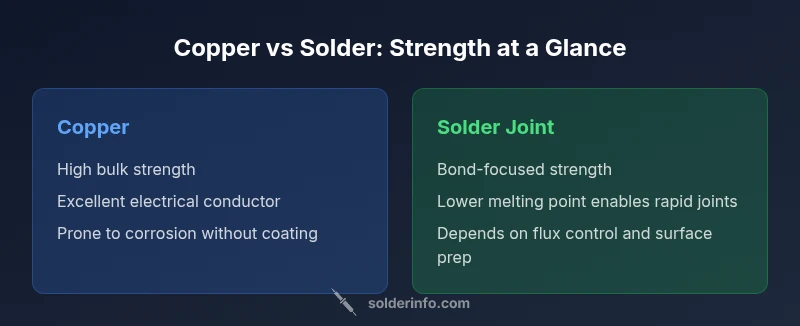
| Feature | Copper | Solder Joint |
|---|---|---|
| Intrinsic material strength | High bulk strength; strong in tension | Bond-focused strength; depends on alloy and joint geometry |
| Typical uses | Bulk conductive paths, structural components | Electrical/thermal joints in electronics, plumbing, and jewelry |
| Failure modes | Fatigue under high load, creep in some conditions | Voids, poor wetting, and intermetallic growth under stress |
| Temperature considerations | Maintains strength at moderate to high temps | Melts and reflows; needs controlled heating |
| Repair/maintenance | Difficult to restore bulk strength after deformation | Joints repaired or replaced; dependent on bond integrity |
Advantages
- Creates a clean, conductive joint at lower temperatures
- Allows rapid, repeatable assembly with standard tools
- Offers ductility that accommodates thermal cycling
- Widely available and cost-effective for many projects
Cons
- Weak in bulk compared to copper
- Joint strength is highly dependent on surface prep and flux
- Lead-containing solders pose environmental concerns (use lead-free variants)
- Flux residues can cause corrosion if not cleaned adequately
Copper wins for bulk strength; solder wins for reliable joints in controlled contexts
Copper is the stronger bulk metal, but soldering excels where joint reliability, repeatability, and low-temperature processing matter. The best choice depends on design goals and environmental constraints; use copper for load-bearing paths and solder for secure, serviceable joints in electronics, plumbing, and jewelry.
Quick Answers
Is solder stronger than copper in electronics?
In electronics, soldered joints provide reliable electrical connections and ductility, but copper remains the stronger bulk metal. The joint strength is driven by wetting, intermetallic formation, and thermal cycling tolerance rather than copper’s inherent strength alone.
In electronics, the bond strength comes from the solder, not copper’s bulk strength, which is higher but not what's tested in joints.
How does lead-free solder affect joint strength?
Lead-free solders are formulated to maintain good wetting and mechanical integrity, but process control becomes more important to avoid voids and weak joints. Strength is comparable when properly applied and age-tested under typical service conditions.
Lead-free solders work well if you focus on proper flux, cleaning, and heating to ensure solid joints.
Can copper be soldered to copper without issues?
Yes, copper-to-copper soldering is common in both electronics and plumbing. It requires clean surfaces, compatible flux, and correct heat management to create a reliable bond that lasts under expected service conditions.
Copper-to-copper joints are standard, but cleaning and heat control are key for strong bonds.
What tests verify solder joint strength?
Tests typically include pull tests and shear tests to evaluate bond integrity and reliability. Standards bodies provide guidelines for reproducible results, focusing on the mounted assembly rather than raw metal strength.
Joints are checked with pull and shear tests to ensure they’ll hold up in real use.
Is soldering always the right choice over brazing or welding?
Soldering is ideal for low-temperature joining with minimal distortion. Brazing or welding may be needed for high-strength or high-load applications. Choose based on heat tolerance, joint design, and service conditions.
Soldering fits light-to-moderate loads; for heavy-duty needs, brazing or welding might be better.
Top Takeaways
- Choose material based on application and load expectations
- Joint strength hinges on alloy, surface prep, and technique
- In electronics, prioritize wetting and thermal cycling tolerance
- In plumbing, ensure leak-free seals with flux management
- In jewelry, balance aesthetics with joint integrity