How Much Solder to Use on Copper Pipe: A Practical Guide
Learn how to determine the right amount of solder for copper pipe joints with step-by-step guidance, tips, and safety considerations for reliable, leak-free plumbing.


You don’t measure solder by weight for copper pipe joints; you aim for a smooth, continuous fillet around the seam. For common sizes like 1/2
How Much Solder to Use on Copper Pipe: A Practical Guide
For copper piping, the goal isn’t to pour in a large amount of solder but to create a clean, watertight joint using capillary action. The exact mass of solder matters less than forming a continuous fillet around the seam with even coverage. When done correctly, the joint shows a uniform ring of solder encircling the joint, typically about 1/16 to 1/8 inch thick once cooled. For common sizes such as 1/2-inch and 3/4-inch copper, this fillet is usually all that’s required to seal the joint without excessive build-up. Always use lead-free solder for potable water and a reputable flux to promote flow. Begin by preparing clean pipe ends, fitting snugly, and applying flux evenly. Heat the joint evenly, touch solder to the seam, and let capillary action draw it into the gap. Stop feeding solder when the seam is fully filled and remove heat promptly. If you notice a thick outside bead or a gap, you’ve overheated or not prepared the joint properly. The right amount is the amount that yields a clean, continuous bead with no gaps or drips, not a heavy pile that obscures the joint. This approach minimizes waste and improves joint longevity.
For readers new to plumbing, achieving the correct solder amount is a skill built through practice and careful observation. The key cues are a consistent, glossy seam and a ring of solder that follows the circumference without gaps. Over time, you’ll recognize the ideal fillet by feel and by the joint’s appearance after cooling. In short, quantity matters less than flow quality and complete coverage.
Tools & Materials
- Copper pipe (1/2(Nominal size matching fittings; ensure clean ends)
- Copper fittings (tees, elbows, couplings)(Choose compatible sizes and materials for potable water or HVAC use)
- Lead-free solder (sn60% or 95/5 tin-copper depending on standard)(Lead-free recommended for drinking water; verify code compliance)
- Flux (rosin-based or water-soluble)(Apply flux to all mating surfaces for proper solder flow)
- Soldering torch (propane or MAPP gas)(Adjust flame to a neutral, steady heat; avoid overheating)
- Flux brush or wiping rag(For applying flux and cleaning excess residue)
- Pipe cutter and deburring tool(Ensure clean, square cuts; deburr inside edge to prevent turbulence)
- Emery cloth or file(Clean and prepare pipe ends and fittings; remove oxidation)
- Safety gear (gloves, safety glasses, ventilation)(Protect hands and eyes; ensure working area is well-ventilated)
- Water for testing (pressure test setup)(Used for leak testing per local codes)
Steps
Estimated time: 60-120 minutes per joint
- 1
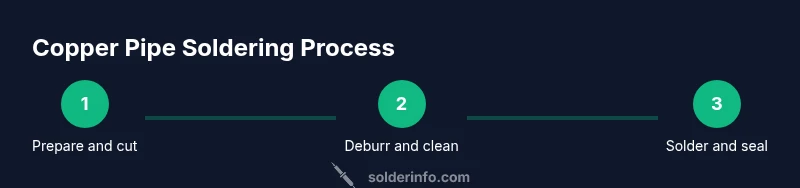
Cut and deburr
Use a sharp pipe cutter to cut the copper pipe to length. Deburr the inside edge with a deburring tool or file to remove burrs, which can trap flux and hinder solder flow. A clean, square cut forms a solid base for the joint.
Tip: A square cut reduces misalignment and ensures better seating of the fitting. - 2
Clean and flux
Wipe the cut ends with a clean rag to remove oil and fingerprints. Apply flux evenly to the outside of the pipe end and the inside of the fitting. Flux promotes capillary action and helps solder flow into the seam.
Tip: Flux should be visible as a thin film; heavy flux can burn off and reduce flow. - 3
Fit and align
Push the pipe fully into the fitting so there’s no gap between surfaces. Rotate the joint slightly to check that it remains square and flush. A snug, well-aligned fit minimizes the amount of solder needed to fill the seam.
Tip: If the joint binds, recut or deburr the pipe ends and reapply flux. - 4
Preheat the joint
Begin heating the joint with the torch, moving the flame evenly around the seam. Keep the heat focused on the metal, not the solder, and avoid overheating the surrounding area. The goal is to bring the joint to a uniform temperature that enables solder to flow.
Tip: Use a steady, sweeping motion to prevent hot spots. - 5
Apply flux and check flow
As the joint comes to heat, apply a tiny amount of flux again if needed. Observe the surface for a smooth, silvery sheen as the flux wets the metal and prepares it for solder.
Tip: If flux beads up or burns, re-clean the joint and reapply flux. - 6
Feed solder into the seam
With the joint hot, touch the solder to the seam from the outside edge and allow capillary action to draw it into the gap. Keep the torch slightly moving to maintain even heat while you feed a thin bead around the circumference.
Tip: Feed slowly; rushing can cause cold joints or gaps. - 7
Form the fillet
Continue applying solder until the seam is filled and a consistent bead forms around the joint. Rotate the joint as needed to ensure even coverage and avoid excessive buildup at any one point.
Tip: A proper fillet shows a smooth, continuous ring with no visible gaps. - 8
Cool and wipe
Remove the flame and allow the joint to cool undisturbed. Wipe away flux residue with a damp rag to prevent corrosion and staining.
Tip: Don’t move or flex the joint while it’s cooling. - 9
Inspect and test
Inspect the joint for uniform appearance and no gaps. If required by code, perform a leak test (pressure or dye test) to confirm integrity before putting the line into service.
Tip: Always follow local codes for testing procedures.
Quick Answers
Is there a hard rule for how much solder to apply to copper pipe joints?
There isn’t a universal weight-based rule. Focus on a smooth, continuous fillet that fully covers the joint without large beads. Practice and observation will help you gauge when enough solder has flowed.
There isn’t a fixed amount—look for a smooth, continuous ring around the joint that covers the seam.
Can I reuse joints if I over-solder or miss a spot?
If a joint is over-soldered or has gaps, you can rework it by reheating and adding solder to the deficient area after cleaning. In some cases, cutting out the joint and starting fresh with clean surfaces is more reliable.
Yes, you can rework or re-cut the joint if needed, ensuring clean surfaces and proper flux.
What’s the difference between lead-free and leaded solder for copper pipe?
Lead-free solders are recommended for potable water due to safety concerns. Leaded solders were common in the past but should be avoided for drinking-water lines. Check local codes for approved compositions.
Lead-free is the safer choice for drinking water; always follow local codes.
Why does my joint leak after cooling, even though I heated and soldered correctly?
Common causes include dirty surfaces, improper flux, or misalignment leading to gaps. Recut, clean, flux, and re-solder, ensuring the seam fills completely and fits snugly.
Leaks usually come from poor fit or dirty surfaces—re-cut, limpiar surfaces, re-solder.
Do I need to test joints under pressure, and how?
Yes, test joints per local codes before use. A basic pressure test with water or air may be appropriate; follow safety guidelines and wear protective gear.
Yes—test according to local codes to confirm the joint is watertight before putting the line into service.
Watch Video
Top Takeaways
- Solder quantity is guided by flow, not weight.
- Aim for a uniform fillet around the joint.
- Well-prepared, clean surfaces improve flow and seal.
- Overheating increases risk of joint failure and copper damage.
- Always test joints per local codes before use.