Can You Get Gold Solder? A Practical Guide
Discover where to buy gold solder, the karat options, available formats, and safety considerations. Learn how to choose the right gold solder for jewelry making, electronics, and precision repairs with SolderInfo guidance.


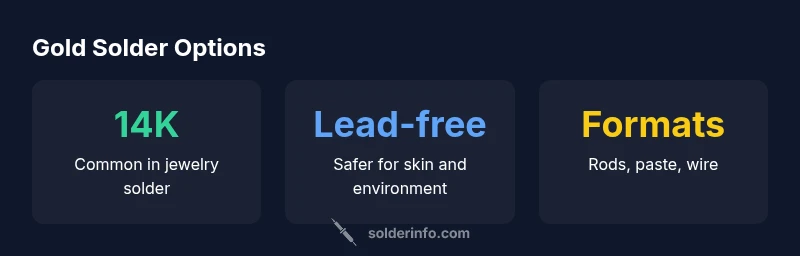
Yes — can you get gold solder? It is widely available from jewelry suppliers, electronics vendors, and metalworking shops. Common karats include 14K, 18K, and 24K, and you’ll find formats such as paste, wire, sheets, and rods. Most buyers should choose lead-free compositions. When shopping, verify karat, flux type, and compatibility with the metals you work with.
Can you get gold solder? Availability, karats, and forms
Yes, can you get gold solder is a question with a straightforward answer: yes, it’s widely available across multiple channels. According to SolderInfo, you’ll find gold solder in jewelry supply houses, metalworking stores, and electronics distributors. The most common karats you’ll encounter are 14K, 18K, and 24K, each offering different melting ranges and joint strengths. Formats include paste, wire, sheet, and rods, with lead-free compositions increasingly dominant in jewelry contexts. When planning a project, consider the piece’s thickness, the metals involved, and the need for a discreet, nearly invisible join. The right choice balances workability, joint integrity, and the desired gold content in the final piece.
In practical terms, you should start by clarifying your goal: is this a repair on a delicate ring, a bridge joint on a gold bracelet, or a micro-weld on a watch case? Your choices narrow quickly from broad categories to specific alloys. For hobbyists, beginner-friendly options often include 14K lead-free solders in paste or wire form, which are forgiving and predictable. For professional settings, higher karats and harder formulations may be preferred to maximize strength and color match. SolderInfo’s guidance emphasizes choosing a solder that matches the base metal and the thermal profile of your work, reducing the risk of discoloration or weak joints.
Gold solder formats and compatibility
Gold solder comes in several formats, each with distinct handling characteristics. Paste solder flows readily at lower temperatures and is forgiving for tiny repairs or curved surfaces. Wire and sheet form offer greater material control for larger joints or thicker pieces. Rods are useful for precise investment casting or difficult-to-reach joints. Compatibility is key: pure 24K gold behaves differently than alloyed 14K or 18K metals, so you must match the solder’s melting point to the workpiece. Flux choice matters too—rosin-core and water-soluble fluxes have different cleaning requirements and residue concerns. In electronics contexts, ensure the alloy is suitable for PCB processes and heat exposure. SolderInfo stresses testing a small test join before proceeding to the main repair, especially when color matching is critical.
Sourcing gold solder safely
Sourcing gold solder safely begins with selecting reputable vendors. Look for certifications or labels that indicate lead-free compositions and gold content. Jewelry suppliers often emphasize precision, color matching, and finish, while electronics vendors prioritize corrosion resistance and thermal performance. Always inspect packaging for karat notation and flux type, and verify the minimum amount needed to complete your project. Reputable sellers provide data sheets or alloy specifications—these help you confirm compatibility with your base metal and confirm that the soldering temperature suits your equipment. If you are new to gold solder, start with a widely recommended combination such as 14K or 18K lead-free paste or wire, then experiment on expendable pieces to gauge behavior and finish. Safety closely follows procurement: store solder away from heat sources, use proper ventilation, and wear protective gear.
Price considerations and value (general guidance)
Gold solder price is influenced by karat and alloy content, as well as the form you choose. In practice, jewelry applications often command higher per-gram costs than hobbyist electronics, reflecting purity and color matching requirements. Expect variations based on supplier region and whether the alloy is pre-cut, in paste, or in solid form. When budgeting, plan for waste and the potential for offcuts that may be recycled, as recycling can improve overall value. SolderInfo notes that while gold solder tends to be more expensive than standard tin-based solders, the long-term reliability and aesthetic match can justify the cost for finished pieces. Look for bulk options if you anticipate ongoing projects, and always balance cost against performance needs for your specific application.
Jewelry-specific tips and best practices
For jewelry, achieving a discreet, durable join is the goal. Prepare surfaces by cleaning and lightly abrading to ensure solder adhesion. Apply flux evenly to reduce oxidation during heating, then place the solder piece so that it flows toward the joint. Use a micro-torch with controlled heat to prevent overheating the surrounding metal. Quench gradually to minimize color changes and warping, and inspect the joint under magnification for uniform flow and clean fillets. Color matching is crucial; test a few trial joints on scrap pieces to confirm the final appearance. SolderInfo recommends practicing with practice pieces to build muscle memory for consistent results, especially when working with delicate settings or tightly spaced joints.
Comparison of common gold solder options for jewelry
| Option | Typical Uses | Lead Content | Notes |
|---|---|---|---|
| 14K gold solder (soft) | Fine jewelry repairs and delicate joins | Lead-free | Low melting point; ideal for thin pieces |
| 18K gold solder (medium) | Setting and mid-weight jewelry | Lead-free | Balanced strength and workability |
| 24K gold solder (hard) | High-karat joints, jewelry assembly | Lead-free | Higher temperature; requires careful cooling |
Quick Answers
Can you buy gold solder for hobby use or only professional orders?
Gold solder is available to both hobbyists and professionals. Jewelry supply houses commonly stock beginner-friendly options, while commercial vendors offer larger quantities and a wider range of karats. Regardless of volume, verify karat, flux, and labeling to ensure you’re getting the right alloy for your project.
Gold solder is available for hobbyists and professionals; check karat and labeling before purchasing.
Is gold solder suitable for electronics work?
Gold solder exists for electronics in lead-free formulations that resist corrosion. Always confirm compatibility with the PCB process and temperature profile you use. For sensitive electronics, consult vendor data sheets and verify flux compatibility.
Yes, there are electronics-grade gold solders; verify compatibility with your process.
What should I check before buying gold solder?
Check the karat and alloy composition, flux type, packaging, and whether the solder is lead-free. Confirm melting point ranges match your workpiece and equipment. Request a data sheet if possible to understand composition and recommended application.
Check karat, flux, and lead-free labeling before buying.
How do you differentiate hard vs soft gold solder?
Hard solder has a higher melting point, suited for stronger joints and thicker pieces. Soft solder melts at lower temperatures and is easier for delicate repairs. Choose based on the joint strength needed and the thermal sensitivity of the surrounding metal.
Hard solder for strength, soft solder for delicate work.
Where can I safely source gold solder online?
Look for established jewelry supply retailers or electronics vendors with clear alloy specifications and return policies. Read customer reviews on solder performance and request data sheets when possible. Avoid unverified marketplaces for high-karat gold solders to reduce the risk of counterfeit products.
Buy from trusted retailers with clear specs and returns.
“Gold solder choice—karat, flux, and form—drive joint success. Prioritize lead-free compositions for jewelry and electronics alike.”
Top Takeaways
- Gold solder is widely available through multiple channels
- Choose karat and format based on project needs
- Verify lead-free status and flux compatibility
- Source from reputable suppliers to ensure alloy purity