Solder Paste vs Tinning Flux: A Practical Comparison for Soldering
A comprehensive, evidence-based comparison of solder paste and tinning flux for electronics, plumbing, and jewelry soldering. Learn when to use each, how they affect joints, and practical tips from SolderInfo.


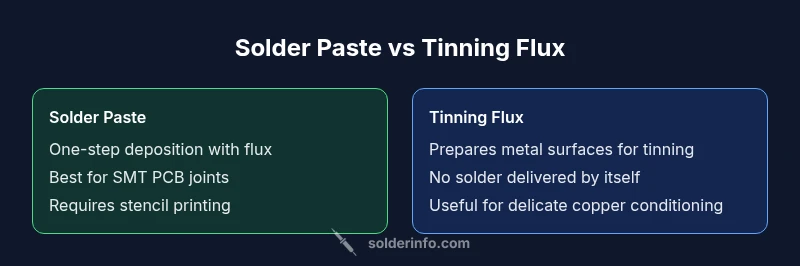
When deciding between solder paste vs tinning flux, consider the joint type and process. Solder paste is designed for PCB SMT deposition, delivering both solder and flux in one step, while tinning flux is applied to bare metal surfaces to prep for tinning or soldering. For through-hole work, jewelry, or plumbing, separate fluxes or methods may be more appropriate. See the full guide for nuances.
Definition and scope of solder paste vs tinning flux
solder paste vs tinning flux are two foundational materials used across electronics, plumbing, and jewelry soldering. In practical terms, solder paste combines solder alloy particles with a flux system, enabling deposition and simultaneous wetting in a single step. Tinning flux, by contrast, is a flux designed to prepare metal surfaces so a thin tin coating can be applied or soldering can proceed more reliably. The distinction matters in how you apply material, what joints you prepare, and how you post-clean residues. According to SolderInfo, understanding the intended workflow helps you choose correctly and avoid bridging, cold joints, or excessive flux residues.
Key takeaway: the choice between solder paste vs tinning flux often hinges on whether you need an all-in-one deposition (paste) or surface prep for tinning (flux).
How the two actually work in practice
Solder paste contains tiny alloy particles suspended in flux. When heated, the paste flows, the alloy reflows into a uniform joint, and the flux cleans the surfaces to improve wetting. Tinning flux, meanwhile, does not deliver solder itself; it lowers the oxidation barrier and encourages tin deposition when you later apply solder or tinning. In many electronics workflows, paste is the preferred option for surface-mmount technology (SMT) because it provides deposition and flux in a single step. For larger copper surfaces or wires, a dedicated tinning flux can better prepare the surface for subsequent soldering steps. SolderInfo team notes that the real ask is whether you need a one-step deposition or a prep stage for tinning.
Composition and chemistry: what makes each option unique
Solder paste blends low-melting solder spheres with a resin or activator flux chosen for the target board. The flux chemistry affects residue, cleaning needs, and compatibility with subsequent processing. Tinning flux is formulated to reduce oxide formation on copper, tin, and other metals; it often yields cleaner tinning and better solderability for pre-tinned parts. The chemistry choice matters for lead-free vs. tin-lead alloys, the cleaning regimen after reflow, and the required storage conditions. SolderInfo explains that chemistry comes with performance trade-offs, so select a formulation aligned with your alloy system and cleaning steps.
Application methods: deposition vs surface prep
PCB assembly with SMT commonly uses solder paste applied through stamping or screen printing onto predefined pads. The paste then reflows in a controlled reflow oven, forming reliable joints. Tinning flux is typically applied with a brush or pen to bare copper or connectors before tinning or soldering, ensuring the surface is receptive to the tin layer and subsequent solder. In jewelry or plumbing, the workflow may involve flux-assisted tinning or fluxless processes, depending on the alloy and heat source. The practical rule is to match the tool, method, and flux type to the joint geometry and material compatibility.
When to favor paste for electronics, what to pick for other crafts
For electronics, solder paste is often the default for surface-mount components due to accuracy, repeatability, and the ability to stencil deposits. For through-hole or copper-tine connections, tinning flux with a separate solder may be more appropriate, particularly when you need precise tinning before a larger soldered joint. For jewelry and plumbing, the decision hinges on surface preparation and the needed cleanliness of residues. SolderInfo emphasizes evaluating the workflow: does the job require a one-step deposition, or is surface prep the priority?
Storage, shelf life, and handling considerations
Paste and flux storage differ in practice. Paste typically requires temperature-controlled handling and can dry out or separate if left unsealed; proper refrigeration or cool storage is often recommended by manufacturers. Tinning flux tends to be more resilient but can degrade with exposure to air or moisture, reducing activity. Regardless of choice, keep containers tightly closed, rotate old stock, and maintain clean application tools to avoid contamination that would compromise joints. SolderInfo notes that long-term storage quality depends on formulation and storage conditions, not just the base material.
Flux chemistry and residue management
Flux characteristics—rosin-based, water-soluble, no-clean—affect cleaning needs after soldering and how residues interact with subsequent steps. Solder paste flux is typically chosen to balance flux efficiency with residue removability; some through-hole or high-pin-count surfaces may require thorough cleaning to prevent corrosion or poor reliability. Tinning flux often aims for minimal residue after tinning, making post-cleaning simpler. Understanding these differences helps you plan cleaning steps and quality checks in your production line.
Lead-free considerations and alloy compatibility
Lead-free solders have different wetting and flow behaviors compared to traditional tin-lead alloys. Paste formulations and tinning fluxes must be compatible with the chosen alloy to prevent thermal creep or poor wetting. Some lead-free systems benefit from specific flux chemistries that enhance visibility and cleanliness, while certain tinning fluxes may be more effective with specific copper conditioning. SolderInfo recommends testing any new combination on representative test coupons before scaling up production.
Quality control, inspection, and cleaning implications
Inspection criteria for joints made with solder paste vs tinning flux include wetting quality, fillet shape, presence of voids or bridging, and cleanliness of residues. Paste deposits require careful inspection after reflow, with a plan for residue if needed. Flux residues from tinning may be milder or more challenging to remove depending on chemistry and board materials. Adherence to IPC or industry standards, plus in-house acceptance criteria, helps ensure repeatable outcomes. SolderInfo highlights the importance of process controls and documentation for traceability.
Practical workflow tips and decision framework
When building a decision framework, start with the joint type and order of operations. If you are prototyping SMT PCBs, solder paste offers speed and repeatability. For custom pre-tinning tasks or repair work, tinning flux may be the better choice. Consider the cleaning process, the required velocity of throughput, and post-solder testing to decide. The best practice is to map tasks to the product type and to maintain a small, well-defined set of flux and paste formulations that align with your alloy strategy.
Common mistakes and how to avoid them
Over-applying flux or paste can create excessive residues or bridging; under-applying can cause poor wetting and weak joints. Mixing flux types mid-workflow without re-validation can lead to unpredictable results. Always verify the compatibility of paste or flux with your solder alloy and substrate, perform a calibration test on representative coupons, and implement a cleaning protocol that matches your flux chemistry. SolderInfo suggests documenting observed outcomes to guide future decisions.
Decision framework for production versus prototyping
In production environments, paste-based SMT is common for efficiency, repeatability, and automation-friendly processes. For prototyping or repair tasks, tinning flux offers flexibility and surface prep options that can save time and material costs. The rule of thumb is to use paste for high-volume SMT and flux-based approaches when surface prep or tinning is critical. Ongoing data collection and constant evaluation help refine the best practice for your facility.
Comparison
| Feature | Solder Paste | Tinning Flux |
|---|---|---|
| Application Method | Stencil/print deposition for PCB assembly | Brush/pen application to bare metal surfaces |
| Typical Use Case | SMT PCB joints and rework where deposition and flux are required | Pre-tinning prep and tinning steps, or surface conditioning before soldering |
| Wetting and Wet Ability | High wetting with appropriate paste formulation | Improved tinning readiness but no solder deposition |
| Residue and Cleaning | Residue depending on paste chemistry; no-clean variants available | Residues may be minimal but require post-clean in some cases |
| Shelf Life and Storage | Requires controlled storage; paste can separate if mishandled | Generally stable but storage quality impacts activity |
| Lead-Free Compatibility | Yes with compatible alloy systems | Primarily a surface prep flux; not a solder |
| Cost Context | Typically higher per unit but saves processing steps in SMT | Lower per-use cost but adds separate solder steps |
| Best For | High-volume SMT, precise deposition | Pre-tinning, surface prep, or delicate copper conditioning |
Advantages
- Convenient for electronics SMT workflows (paste)
- One-step deposition and flux delivery reduces handling steps
- Broad compatibility with lead-free solders when matched to paste chemistry
- No-clean variants simplify post-processing and inspection
Cons
- Paste handling requires appropriate storage and temperature control
- Cleaning residues may still be necessary depending on formulation
- Through-hole or large metal surfaces may not benefit from paste
- Tinning flux cannot replace solder deposition in SMT without separate solder
Solder paste is generally the better default for electronics SMT, while tinning flux excels at surface prep and tinning tasks.
For most PCB assembly, paste provides both solder and flux in one step, enabling efficient deposition and reliable joints. Tinning flux is preferable when you need dependable surface preparation for tinning or soldering, especially on copper surfaces. The best approach is to align your choice with joint type and workflow, using paste for high-volume SMT and flux for prep or repair tasks.
Quick Answers
What is solder paste?
Solder paste is a suspension of tiny solder alloy particles in a flux matrix. It is designed for deposition onto pads (often via stencil) and, when heated, the solder reflows to form the joint while the flux cleans the surface to improve wetting.
Solder paste is a solder-into-one-step material used on PCBs; it deposits solder and flux at once.
What is tinning flux?
Tinning flux is a flux formulated to prepare bare metal surfaces for tinning or soldering. It reduces oxidation and helps tin adhere to copper or other metals, but it does not deliver solder itself.
Tinning flux helps surfaces get ready for tinning or soldering, but it doesn’t carry solder.
Can I use solder paste for all joints?
Paste works well for SMT joints and small through-holes, but not all joint types are ideal for paste deposition. For large wires or through-hole components, a separate solder and potential surface prep step may be required.
Paste isn’t always ideal for every joint type; some tasks need separate solder and flux steps.
Is tinning flux suitable for electronics PCB work?
Tinning flux can prep copper surfaces for tinning or soldering, but it is not a substitute for solder deposition on most PCB SMT joints. Use paste for SMT where precise deposition is needed.
For PCBs, paste is usually better; tinning flux alone doesn’t replace solder paste for SMT deposits.
How do I store solder paste and flux safely?
Store solder paste in a cool, sealed container and follow the manufacturer’s storage guidance to preserve flux activity and solder integrity. Flux can also be sensitive to air and moisture, so keep containers closed when not in use.
Keep both paste and flux sealed and cool, following the manufacturer guidance to prevent drying out or loss of activity.
Which is better for lead-free soldering?
Lead-free soldering requires compatible flux and paste chemistry to ensure reliable wetting. Both options can be used if matched to the alloy system and flux residues are managed appropriately.
Lead-free requires matching chemistry; both paste and flux can work with careful selection.
Top Takeaways
- Choose paste for SMT deposition and automation
- Use tinning flux for surface prep and tinning tasks
- Match flux chemistry to solder alloy and substrate
- Plan cleaning based on residue needs
- Test a representative coupon before scaling up