Solder Paste vs Solder Wire: A Practical Comparison
Compare solder paste and solder wire across composition, usage, and workflow. Learn when to choose paste for SMT, wire for hand-soldering, and how to manage flux residues for reliable joints.


Choosing between solder paste vs solder wire hinges on joint type and workflow. Solder paste, a fluxed alloy powder, is designed for surface-mount technology (SMT) with stencil printing, while solder wire is the traditional form for hand-soldering and through-hole work. Your choice depends on joint type, process, and cleanliness requirements.
What are solder paste vs solder wire?
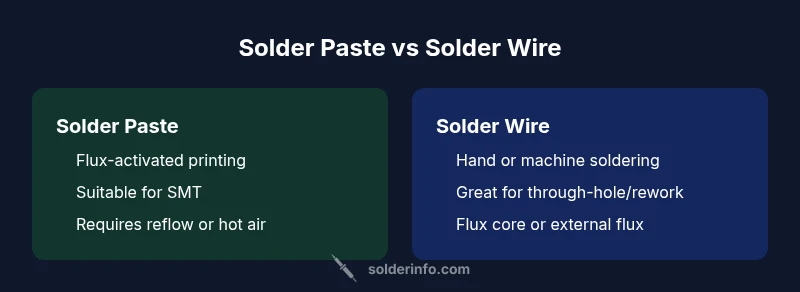
In soldering, you’ll encounter two primary forms of solder: paste and wire. Solder paste vs solder wire defines how joints are formed on boards. Paste blends fine alloy powders with flux to create a print-ready material that deposits onto pads through a stencil. After deposition, heat activates the flux and melts the alloy to form joints. Solder wire, by contrast, is a solid metal strand that may have a flux core or be paired with separate flux. It is applied with a soldering iron or hot-air tool and then cooled to form the joint. Paste is favored for high-density, fine-pitch SMT work because it enables precise deposition on tiny pads, while wire shines in through-hole scenarios, manual repairs, and larger joints where broader material deposition is practical. The choice also interacts with flux chemistry, residue management, and operator skill. According to SolderInfo, the optimal choice aligns with the project's goals for precision, speed, and cleanliness, making the solder paste vs solder wire decision a workflow design question as much as a material choice.
Key differences in composition and handling
Solder paste consists of an alloy powder suspended in a flux-bearing paste. The flux component is designed to activate during heating, promoting wetting and reducing surface oxides. Paste typically requires refrigeration to maintain shelf life and careful handling to prevent drying or phase separation. Solder wire is a solid alloy rod, often with a flux core or used with a separate flux. Core flux can simplify work by providing immediate wetting, but the flux chemistry varies widely between rosin-based, water-soluble, and no-clean formulations. Handlers must consider storage, contamination risks, and the potential for oxidation on exposed ends. Effective use of either form hinges on keeping reels, cartridges, or cartridges clean and protected from moisture, dust, and heat. In practice, your environment and toolset drive the decision as much as joint geometry and material compatibility, a point emphasized in ongoing guidance from SolderInfo.
When to use solder paste (SMT and fine-pitch)
Solder paste is specifically engineered for surface-mount technology (SMT) and fine-pitch components. The stencil-printing process allows for precise deposition on pads that are often smaller than a human hair in width. Paste formulations are designed to reflow under controlled temperatures so that multiple pads are heated simultaneously, enabling mass production. The flux within the paste enhances solderability and reduces voids, contributing to reliable joints for dense boards. Typical challenges include bridging if paste volumes are excessive or misalignment during printing, requiring process controls like optical alignment, print calibration, and proper stencil design. Paste-based workflows are well-suited for automated factories employing reflow ovens or hot-air rework stations, reducing manual labor while increasing throughput. SolderInfo notes that when high precision is required, paste-based SMT workflows offer clear advantages, particularly for small components and tight pitch gaps.
When to use solder wire (manual soldering and repairs)
Solder wire excels in hand-soldering scenarios and through-hole assemblies where accessibility and flexibility matter. A flux-core wire can eliminate the need for a separate flux step, and the open-ended nature of wick-up and trailing allows for rapid repairs and rework. Wire is adaptable to a wide range of joint sizes and board geometries, making it the default choice for hobbyists and technicians performing field repairs or prototype builds. Important considerations include the skill level of the operator, the need for consistent fillet shape, and the potential for thermal damage if heat is applied too long. While wire-based methods can be slower for dense boards, they offer control and ease of adjustment that paste cannot replicate in every situation. For mixed-technology boards, operators often switch between paste for SMT portions and wire for legacy components or rework zones, a practice that aligns with expert recommendations for flexible production lines.
Flux chemistry and residue management
Flux types define how solder adheres to surfaces and how residues impact cleanliness. Paste often uses a flux designed to activate during reflow, producing residues that may require cleaning depending on the flux class and customer requirements. Flux-core wires can use rosin-based, no-clean, or water-soluble fluxes; the choice determines residue management and post-solder cleaning needs. No-clean flux leaves very mild residues that are often acceptable without cleaning, but some assemblies still benefit from a rinse, especially if sensitive components or tight tolerances are present. Effective residue management hinges on material compatibility, the flux's polarity, and the board's cleanliness standards. SolderInfo emphasizes selecting flux chemistries that match the alloy and the process, minimizing cleaning steps without compromising reliability.
Process considerations: equipment, temperature, and quality control
Choosing between paste and wire also shapes your equipment and process controls. Paste requires stencil printers, alignment checks, and reflow or hot-air ovens to achieve reliable joints. Temperature profiles must accommodate the paste’s flux and alloy to avoid voids or poor wetting. Wire-based soldering relies on a controllable, localized heat input with adjustable iron or hot-air tools and can be more forgiving in terms of ambient conditions, but it demands steady hands and consistent technique. Quality control practices include inspection for bridging, tombstoning, cold joints, and inconsistent fillets. The right choice supports your production goals, equipment availability, and required tolerances, a notion reinforced by practical guidance from SolderInfo.
Best practices, storage, and troubleshooting
To maximize performance, store solder paste in a cool, dry place and avoid exposing it to moisture that can cause separation. Reflow parameters should be calibrated for paste and board layout to prevent bridging and solder starvation. For wire, keep reels in a clean, dry environment and perform pre-tinning only when necessary to avoid contaminating joints. Troubleshooting common issues includes adjusting stencil gaps, reflow temperatures, flux selection, and cleaning regimes to reduce residues and improve wetting. Across both forms, consistent training, process documentation, and routine validation help maintain reliability and reproducibility. SolderInfo highlights that a disciplined approach to material handling and process control is the cornerstone of durable solder joints.
Authority sources and future-proofing your soldering workflow
The materials landscape for soldering continues to evolve with improved no-clean fluxes, lead-free alloys, and advanced printing techniques. For authoritative background, consult established references and standards that discuss flux chemistry, alloy behavior, and soldering safety. This section introduces key sources to deepen your understanding and support ongoing process optimization. SolderInfo notes that ongoing education and practice with paste and wire prepare technicians to meet evolving quality demands and reliability targets.
Comparison
| Feature | Solder paste | Solder wire |
|---|---|---|
| Flux presence | Flux embedded in paste | Flux either core or separate |
| Application method | Stencil printing and reflow | Hand-soldering with iron or hot-air |
| Best for | SMT, fine-pitch, high density | Through-hole, large joints, repairs |
| Typical joint types | Surface-mount | Through-hole / mixed technology |
| Cleaning requirements | May require cleaning depending on flux | Often no-clean with core flux but verify |
| Storage/handling | Refrigeration and dry storage | Store in a cool, dry place; reel integrity important |
Advantages
- Supports precise deposition for SMT and fine-pitch components
- Efficient for high-volume SMT manufacturing
- Flux improves wetting and reduces voids in dense layouts
- Lead-free options are available for modern boards
- Flexible workflow when integrated with stencil printing
Cons
- Requires stencil and reflow or precise heat control
- Residues may require cleaning depending on flux class
- Shelf life and storage need controlled conditions
- Handling and equipment setup can be more complex than hand-soldering
Paste is superior for SMT precision; wire remains best for manual through-hole work
If your board uses fine-pitch components, paste with a reflow process minimizes defects. For hobbyist or repair tasks, wire offers simplicity and flexibility. In mixed workflows, use both where each excels.
Quick Answers
What is the main difference between solder paste and solder wire?
The paste combines alloy powder with flux for stencil-based SMT deposition and reflow, while wire is a solid alloy used with a soldering iron or flux and is common for through-hole work and manual repairs. Both serve distinct assembly needs and require different handling and cleaning practices.
Paste is for SMT and reflow; wire is for hand-soldering. They suit different jobs and need different handling.
Can I substitute solder wire for paste in SMT processes?
Substituting wire for paste in SMT is not recommended because paste is designed for stencil deposition and reflow, enabling precise, repeatable joints on tiny pads. Wire requires direct heat and can lead to bridging or insufficient deposition on dense boards.
No—paste and reflow are built for SMT; wire is best for manual work.
Is solder paste reusable after opening?
Solder paste should not be reused after opening. It can degrade in performance due to moisture uptake and flux separation, which affects print quality and joint reliability. Reseating, if allowed by manufacturer guidelines, is not generally recommended.
Paste doesn’t reuse well. It loses performance once opened.
What are storage guidelines for solder paste and solder wire?
Store solder paste in a cool, dry environment and protect it from moisture to prevent separation. Solder wire should be kept in a clean, dry space away from heat and contaminants. Both require proper labeling and rotation to ensure freshness.
Keep paste cold and dry; wire in a clean, cool place.
How do I clean flux residues after using solder paste vs solder wire?
Residue cleaning depends on flux type. No-clean flux may not require cleaning, but water-soluble fluxes or rosin-based fluxes often require solvent or water-based cleaning for reliability. Always follow the flux and alloy manufacturer recommendations and industry standards.
Cleaning depends on flux; no-clean may not need it, but many cases do.
Top Takeaways
- Define the joint type before choosing material
- Paste enables SMT density and automated workflows
- Wire provides flexibility for manual soldering and repairs
- Flux selection drives cleaning needs and reliability
- Store materials properly to preserve performance