Solder Without Wire: A Paste-Only Soldering Guide
Learn how to solder without wire using paste and flux. This 1800-word how-to from SolderInfo covers tools, techniques, safety, and tips for electronics, jewelry, and plumbing projects.


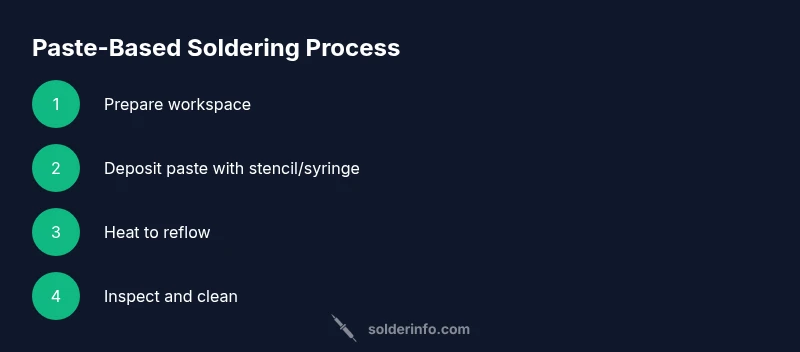
With this guide you will learn how to solder without wire using solder paste, flux, and heat control. You'll gather a paste-friendly kit, prepare components, apply flux, deposit solder paste precisely, align parts, and heat them to reflow for reliable joints. This method reduces stray solder and is ideal for tiny surface-mount work and delicate jewelry projects.
What solder without wire actually is
Solder without wire refers to techniques that rely on solder paste, flux, and controlled heat to create joints without the traditional spooled solder wire. This approach is widely used in electronics for surface-mount devices, as well as in jewelry and some plumbing situations where wire is impractical. Paste-based soldering leverages tiny solder spheres embedded in flux, which reflow when heated, forming a solid joint without pulling a separate wire through delicate gaps. Understanding how paste behaves under heat helps you predict flow, wetting, and the formation of a reliable bond. For the DIYer, mastering this method expands what you can repair or assemble with minimal bulk and maximum precision.
When to choose paste-based soldering
Paste-based soldering shines when you work on crowded or tiny joints where traditional wire is hard to route. It’s ideal for surface-mount electronics, micro jewelry components, and small-diameter pipe joints where solder wire would be unwieldy. However, it’s not a universal replacement: through-hole components, thick-walled plumbing joints, or projects requiring high-megohm insulation may benefit from alternative approaches. Solder without wire can reduce bridging on dense PCBs, improve joint consistency on SMT pads, and enable consistent gap filling where gaps are small. In contrast, it demands precise deposition, controlled heat, and thorough cleanliness to avoid cold joints or voids.
Tools, materials, and workspace setup
A clean, static-safe workspace is essential when working with paste-based soldering. You’ll need a fine-tipped iron or a hot air rework station, no-clean flux, solder paste (lead-free preferred for electronics and jewelry), and a few precision applicators like a syringe or stencil. Tweezers, a magnifier, and a steady PCB holder help keep components aligned while the paste reflows. Ensure you have IPA (isopropyl alcohol) for cleanup, lint-free wipes, and an anti-static mat with a wrist strap. Good lighting and a temperature-controlled environment prevent overheating and help you judge paste viscosity and flow. According to SolderInfo, starting with small test pads reduces surprises on real boards or jewelry.
Deposition methods: stencil, syringe, and cartridge
There are several ways to deposit solder paste accurately. A stencil can place paste on a PCB pad with high repeatability, especially for multi-pad soldering. A syringe offers direct control for single-point deposits or very small pads, while a cartridge with a nozzle can serve as a middle ground. When you deposit, keep the nozzle perpendicular to the pad and release the paste in one smooth motion. If you overshoot, use a moistened brush tip or a wick to correct the line without lifting the pad. For jewelry work, paste can be dabbed in tiny spots using a fine tip and tweezers. The key is to minimize air entrapment and ensure even coverage of the pad surface.
Heating strategies: iron vs hot air
Heating is the make‑or‑break moment for solder without wire. A precision iron with a small chisel or conical tip is excellent for targeting individual pads and controlling heat input. For SMT arrays or fine jewelry filigree, a hot air rework station can reflow multiple joints simultaneously with uniform temperature. In both cases, watch the paste visually: it should melt and flow into the joint without excessive spatter. Use cooling time after the paste reflows to prevent cold joints from forming. Set the temperature based on the solder alloy in use and the component tolerances; typical ranges for lead-free alloys sit around 240–260°C for reflow, with adjustments for delicate parts.
Inspecting joints and finishing touches
After reflow, inspect each joint under a loupe or microscope. Look for smooth, glossy fillets that wet the pad and lead without puddling or bridging. If you see gaps or voids, apply a tiny amount of paste and reflow that specific area. Clean flux residues with IPA if you’re using non-no-clean flux, though many no-clean formulations leave minimal residue. Wipe the board gently with lint-free wipes; avoid abrasive cleaners that could damage finishes. For jewelry, inspect solder joints for symmetry and consistent bead size, then file or sand any excess solder with care.
Troubleshooting common issues
Bridging occurs when two adjacent pads receive paste that flows together; reduce paste volume or adjust deposition technique. Cold joints feel dull and crumbly; reheat slowly and verify that the paste is fully reflowed. Insufficient paste will cause weak joints or gaps; ensure precise exposure of each pad and consistent heat. If flux residue appears sticky or tacky after cooling, you may be using a low-pinetic flux; switch to a no-clean flux or thoroughly rinse with isopropyl alcohol, depending on flux type. Always use PPE and proper ventilation when heating plastics or adhesives that may outgas.
Safety, quality, and maintenance
Safety comes first when soldering without wire. Work in a well-ventilated area or under a fume extractor, wear eye protection, and use gloves if handling hot components. Keep a clean station, store flux and paste in sealed containers, and label your tools for quick identification. Regularly check your tips and nozzles for wear; damaged geometry can skew deposition and heating. For jewelry, ensure that solder paste and flux used are skin-safe and non-toxic. Soldering without wire is a precise skill; practice with scrap boards or jewelry components before tackling a real project.
Authority sources and further reading
For safety and process standards, consult trusted sources like OSHA and NIST for general electronics-safe work practices and material handling. Visit IEEE for publications on advanced soldering methods and reliability testing. These resources provide background on controlling heat, contamination, and joint quality in soldering practices. URLs: https://www.osha.gov, https://www.nist.gov, https://ieeexplore.ieee.org
Tools & Materials
- Solder paste (lead-free)(No-clean formulation recommended; dispense with syringe or stencil)
- Flux (no-clean or resin)(Apply a thin layer to pads or the joint area)
- Soldering iron with fine tip(Tip size around 0.4–1.0 mm; temperature 260–350°C)
- Hot air rework station (optional)(Useful for multi-pad reflow or delicate parts)
- Tweezers (anti-magnetic)(For precise placement and handling)
- Magnification loupe or microscope(1.5x–3x preferred)
- ESD mat and wrist strap(Protects sensitive components)
- Isopropyl alcohol (IPA 70–99%)(Clean pads and paste residues)
- Lint-free wipes(Avoid fibers sticking to pads)
- Precision stencil or syringe tips(For accurate paste deposition)
- Heat-resistant mat(Protects work surface)
- Safety goggles(Eye protection during heating)
- Respirator or fume mask(Ventilation especially for flux fumes)
Steps
Estimated time: 45-75 minutes
- 1
Prepare workspace and components
Set up an ESD-safe bench, arrange all parts, paste, flux, and tools. Clean surfaces to remove oils that could interfere with wetting. Keep the project within easy reach and ensure good lighting for alignment.
Tip: Double-check pad orientation and polarity before deposition. - 2
Apply flux to pads
Coat the pads with a thin, even layer of flux. Flux improves paste flow, reduces oxidation, and helps paste wet the metal. Too much flux can cause contamination; aim for a light coating.
Tip: If flux runs, use a lint-free wipe to remove excess from adjacent pads. - 3
Deposit solder paste onto joints
Using a syringe, stencil, or nozzle, place a small amount of solder paste on each pad. For fine-pitched components, deposit only on the pad, not the component lead. Ensure paste size matches pad area to avoid bridging.
Tip: Start with test pads to dial in amount before working on the real board. - 4
Place components accurately
Position components with tweezers, aligning pins to pads. Hold them in place while you check alignment. A slight misalignment can cause bridging when the paste reflows.
Tip: Use a magnifier to confirm alignment on tiny parts. - 5
Reflow the joints with heat
Apply heat with the iron or hot air until the paste reflows and forms a smooth fillet. Watch for a glossy, uniform finish indicating good wetting. Avoid overheating, which can damage components.
Tip: Move heat in small circles to promote even reflow. - 6
Cool and inspect
Let joints cool undisturbed, then inspect under magnification. Look for clean surfaces, complete wetting, and no bridges. If needed, reheat the joint for minor touch-ups.
Tip: Quench heat gently; rapid cooling can cause thermal shock. - 7
Clean residues and test
Wipe away flux residues with IPA if required by flux type. Test the circuit or jewelry piece for continuity and function. Validate that joints meet mechanical and electrical expectations.
Tip: If a joint looks dull or grainy, reflow once more after cleaning. - 8
Document and store
Record materials used, temperatures, and deposition methods for future projects. Store paste, flux, and tips in sealed containers away from heat and moisture to extend shelf life.
Tip: Label lots and expiry dates for traceability.
Quick Answers
What is paste soldering?
Paste soldering uses solder paste mixed with flux to form joints without a traditional wire. The paste melts and wets the pad when heated, creating a reliable connection. This method is popular for surface-mount electronics and small jewelry components.
Paste soldering uses solder paste and flux to form joints when heated, common in compact electronics and tiny jewelry parts.
Can I use this method for plumbing?
Paste-based soldering is less common for plumbing because pipe joints require robust mechanical seals. When used, select a paste rated for plumbing metals and temperatures, and ensure proper cleanliness. For most plumbing, traditional hard soldering or brazing is preferred.
It's generally not ideal for plumbing; traditional methods are usually better for pipe joints.
Is solder without wire safe for electronics?
Yes, when done with proper paste, flux, ventilation, and clean handling, electronics can benefit from paste-based soldering. Use lead-free alloys where required and avoid overheating sensitive components.
Yes, with proper paste, flux, and heat management, electronics can be soldered without wire safely.
What are common failures in paste soldering?
Common failures include cold joints, bridging due to excessive paste, and poor wetting from contamination. Controlling paste volume, pad cleanliness, and heat profile minimizes these issues.
Typical failures are cold joints or bridging; manage paste amount and heat.
Do I need special equipment?
A precision iron or hot air station, paste syringe or stencil, flux, and a clean workspace are essential. Optional items like a micrscope or test fixtures can improve accuracy.
Essential tools are a precise iron and paste; extras help with accuracy.
How do I store solder paste?
Store solder paste in a cool, dry place and refrigerate if the manufacturer recommends. Keep the cap tight to prevent drying and contamination.
Keep paste sealed in a cool place, refrigerate if advised, to prevent drying.
Watch Video
Top Takeaways
- Solder without wire uses paste and flux plus controlled heat for joints.
- Deposition accuracy and heat control are the keys to success.
- No-clean flux reduces cleanup but validate residues for your project.
- Practice on test pads to minimize risk on real components.
- Follow safety and ventilation guidelines for healthier work.