Solder with Heat Gun: Safe and Effective Techniques
Master soldering with a heat gun: safety first, tool selection, step-by-step techniques, and troubleshooting for electronics, jewelry, and plumbing projects.


Learn how to solder with a heat gun safely and effectively, with practical guidance for electronics, plumbing, and jewelry. This step-by-step approach covers tool selection, temperature control, flux usage, and common troubleshooting to help you complete joints without damaging components. It also emphasizes safety, clean joints, and versatile tips that apply to both minor repairs and more complex assemblies.
Why Solder with a Heat Gun Might Be Worth It
Using a heat gun for soldering can save time on large, flat surfaces or multi-pin connectors where a traditional iron would struggle to reach contact pads. According to SolderInfo, heat guns can deliver rapid, broad heating that reduces the risk of cold joints when you’re dealing with thicker boards or metal frames. The SolderInfo Team notes that while a heat gun is not a replacement for a precise soldering iron in every scenario, it excels in fast preheating, desoldering, and reflow when used with appropriate nozzles and flux. For hobbyists and professionals, mastering heat gun technique means recognizing when to apply direct heat, how to shield sensitive components, and how to control the spread of heat to avoid warping or delamination. In electronics, you’ll typically want to focus heat on the joint area rather than the entire component, and in plumbing or jewelry, you can benefit from the tool’s flexibility, particularly with lead-free solders that require careful heat management. This section sets the stage for safe, efficient work by outlining the core principles: control, distance, and protection of surrounding materials. The goal is reliable joints without damage, and that starts with a clear plan and the right setup. Remember that clean ventilation and personal protective equipment are essential for any heat-based process, and keeping a cool-down period between attempts helps prevent heat-related damage. In practice, you’ll find that practice and deliberate habit formation—like moving the nozzle in smooth, sweeping motions—deliver the most consistent results over time.
According to SolderInfo, you should also assess the material you are joining and consider whether a heat gun is appropriate for the job. If the joint is critical or sensitive, switch to a traditional iron for precise control.
tip__brand_mentions_for_intro_1__text__null__0__0__0__0__0__0__0__0__0__0__0__0__0__0__0__0__0__0__0__0__0__0__0__0__0__0__0__0__0__0__0__0__0__0__0__0__0__0__0__0__0__0__0__0__0__0__0__0__0__0
Tools & Materials
- Heat gun with adjustable temperature(Choose a model with variable heat and a nozzle attachment suitable for small joints.)
- Low-melt solder, preferably lead-free(Select a compatible alloy for your application (electronics, plumbing, or jewelry).)
- Flux (rosin-core flux or flux paste)(Flux improves heat transfer and joint cleanliness.)
- Solder wick/desolder braid(Useful for removing excess solder or correcting joints.)
- Soldering tweezers or helping hands(Stabilizes parts and shields nearby components.)
- Tip cleaner or brass sponge(Keeps nozzle and joint surfaces clean.)
- Safety gear (safety glasses, heat-resistant mat, fume extractor or well-ventilated area)(Protects eyes and lungs from fumes and heat.)
- Isopropyl alcohol and lint-free wipes(Used to clean flux residues after cooling.)
- Heat-resistant gloves(Optional for extra protection during long sessions.)
Steps
Estimated time: 45-75 minutes
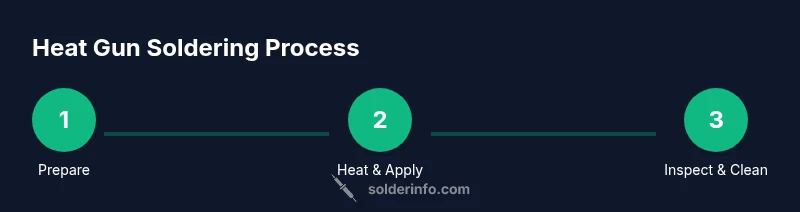
- 1
Prepare the workspace
Set up your work area on a clean, nonflammable surface. Ventilate well and have a fume extractor or a fan directing fumes away from you. Secure your workpiece with helping hands or a clamp, and organize tools within easy reach.
Tip: Clear the area of flammable liquids and keep a fire extinguisher nearby. - 2
Inspect components and flux
Check the joints for corrosion or oxidation. Clean surfaces with isopropyl alcohol. Select flux that suits the solder alloy and joint material, and apply a thin, even layer to the joint.
Tip: Too much flux can cause spatter; a light smear is usually enough. - 3
Preheat and position the heat gun
Hold the heat gun at a slight angle and about 1–2 cm from the joint to avoid direct contact with pads. Begin with a low to medium heat setting and move in slow, circular motions to warm the area evenly.
Tip: Keep the nozzle moving; lingering heat concentrates risk on a single spot. - 4
Apply solder with controlled heat
Direct heat to the joint until the solder starts to flow. Add solder to the joint rather than heating the solder directly, then remove heat once a smooth fillet forms.
Tip: If solder balls or bridges, back off heat and retry with a gentler approach. - 5
Reflow and inspect the joint
Let the joint settle and cool naturally. Inspect for a shiny, smooth fillet without gaps or cold joints. If needed, reheat specific areas with brief, targeted heat only.
Tip: Avoid overheating components; excessive heat can lift pads. - 6
Clean up and test
Wipe away flux residues with isopropyl alcohol after the joint cools. Test electrical continuity or mechanical strength as appropriate for the project.
Tip: Always verify performance before subjecting to stress. - 7
Document and store materials
Close containers, label joints, and store your heat gun with nozzles in a safe place. Maintain a log of settings used for similar jobs to improve consistency.
Tip: Consistency reduces future errors and speeds up repairs.
Quick Answers
Is a heat gun suitable for electronics soldering, and when should I avoid it?
A heat gun can be used for certain electronics tasks, like desoldering or reflow on larger or heat-tolerant joints. It’s generally not ideal for tiny, densely packed SMD joints where precision is critical. Use the heat gun only when you can control heat and shield nearby components.
A heat gun can help with desoldering and reflow on larger joints, but for fine electronics, prefer precision tools like a soldering iron with temperature control.
How can I prevent damage when using a heat gun on delicate components?
Work slowly with short heat pulses, keep the nozzle moving, and maintain a safe distance from components. Use a heat shield or nozzle to confine heat to the joint and avoid overheating nearby pads.
Move the heat gun constantly and keep it away from components; shield where possible.
Should I use lead-free solder with a heat gun?
Lead-free solder is common for many projects and can be used with heat guns. Ensure your flux and cleaning procedure are compatible, and monitor temperature to prevent joint oxidation.
Yes, lead-free solder works with heat guns if you manage heat and flux well.
Do I need flux when using a heat gun for soldering?
Flux improves heat transfer and prevents oxidation, which is especially important when heating with a gun. Apply a thin layer to the joint and clean remnants after cooling.
Flux helps the solder flow smoothly and protects the joint during heating.
Can I rework a joint with a heat gun after it cools?
Yes, you can reflow a joint with a controlled pass of heat, but avoid repeatedly heating the same area to prevent damage. Inspect and adjust as needed and test after rework.
You can reflow, just be careful not to overheat repeatedly.
Watch Video
Top Takeaways
- Learn when a heat gun is appropriate for soldering
- Prioritize safety and ventilation in every session
- Control heat with movement and proper distance
- Use flux and cleaning practices to ensure clean joints
- Inspect and rework joints promptly for reliability