Solder vs Super Glue: Practical DIY Comparison
Compare soldering and super glue for electronics, jewelry, and plumbing. Learn when to use each method, surface prep, safety tips, and best practices for durable repairs.


Overview: In the world of DIY repairs, soldering and super glue serve different purposes. For electrical joints and durable seals, soldering offers conductivity and heat resistance, while super glue provides fast, non-conductive bonds for non-electrical fixes. This quick comparison highlights when each method shines, and the safety steps you should follow.
Solder vs Super Glue: Core Differences
Solder vs Super Glue describes two distinct bonding approaches, each with its own rules, strengths, and limits. This article compares heat-enabled metal joints with fast-curing adhesives, focusing on electronics, jewelry, and plumbing contexts. For the keyword solder vs super glue, both methods are evaluated on conductivity, durability, safety, and ease of use. Understanding the core differences helps you pick the right tool for the job and avoid common failures.
Think of soldering as a process that creates a metal bridge between surfaces, enabling electrical flow and heat transfer. Super glue creates a resin-based bond that glues surfaces without needing heat, but may trap moisture and fail under vibration. The choice isn't about which is universally better; it's about using the method that aligns with the functional requirements (electrical vs non-electrical), operating environment, and future maintenance. We'll lay out a detailed framework that covers use cases, surface prep, and long-term reliability.
When to Use Solder
Soldering is the go-to technique when electrical continuity, heat transfer, and durable metal-to-metal joints are required. In electronics, solder enables reliable connections on PCBs, connectors, and wires. In plumbing, lead-free solder provides a corrosion-resistant seal for copper pipes when done with proper flux and cleaning. Jewelry makers also rely on solder for metal joints that form permanent, conductive links between pieces. Key principles include clean, tinned surfaces, appropriate flux, and controlled heat. Overheating can damage components or melt plastics, so a steady hand and a temperature-controlled iron are essential. If your project involves current flow, heat dissipation, or mechanical load on metal parts, soldering is typically the superior choice. However, it demands skill, patience, and ventilation to manage fumes from flux.
When to Use Super Glue
Super glue, or cyanoacrylate adhesive, shines for fast, non-conductive bonding where heat is undesirable or impractical. It’s ideal for temporary repairs, prototyping, or joining non-metal parts where a quick cure is valuable. Glue bonds are immediate and can work on many substrates, including some plastics, ceramics, and wood—provided surfaces are clean and dry. Be mindful: cyanoacrylate is generally brittle under impact and temperature cycling, and it can leave residue that’s hard to remove. In electrical contexts, super glue is typically avoided because most formulations are insulative and can trap moisture or components if not used carefully. For quick fixes, alignment aids, and non-electrical assemblies, super glue is a practical option.
Material Compatibility and Surface Prep
Surface preparation is a critical step for both methods, though the specifics differ. Soldering relies on clean, degreased metal surfaces, flux to promote wetting, and correct tinning. Flux residues need to be cleaned after the joint cools to prevent corrosion, especially in electronics and plumbing. Super glue requires dry, clean surfaces for best adhesion. Some materials (certain plastics or porous substrates) may absorb adhesive or react with solvents, weakening the bond. When preparing surfaces, choose compatibility: metals with flux-friendly joints for solder; smooth, sealed surfaces for glue. If you cannot ensure a clean, dry surface, neither method will perform consistently. In mixed-material assemblies, consider alternative approaches or mechanical fasteners combined with adhesive beads.
Electrical Performance: Conductivity and Resistance
The electrical performance of a joint is a decisive factor in choosing between solder and glue. Solder joints are designed to conduct electricity, carry currents, and, if properly fluxed and cleaned, resist corrosion over time. Glue bonds are typically insulating, which is advantageous when you don’t want unintended conduction but problematic if a conductive path is needed. Some specialty adhesives claim conductivity, but they require careful selection and testing. In projects where signal integrity matters—PCB connections, sensor wires, or power lines—soldering is usually the preferred method. Glue alone should not be relied upon for electrical joints unless you’re standardizing on a conductive adhesive with proven reliability for the application.
Mechanical Strength and Durability
Mechanical strength differs markedly between the two methods. Solder joints form metal bridges that are strong under vibration and thermal cycling when executed well, but can fail if the pad is damaged or the joint is overheated during repair. Glue bonds tend to be strong in shear and provide rapid bonding across mismatched substrates, but they can be brittle under impact or sustained loads and may creep as the adhesive ages. For metal-to-metal joints or where a fixed, conductive bond is essential, solder delivers durability. For lightweight, non-structural components or quick fixes, super glue offers a convenient alternative that can be removed or repositioned with difficulty later.
Thermal Considerations and Heat Tolerance
Thermal behavior dictates the suitability of each method. Soldering uses heat to fuse metals; the heat can damage nearby components if not careful, but solder joints can tolerate temperature-related stresses once cooled. Glue bonds are sensitive to heat; high temperatures can soften or degrade adhesives, weakening the bond or causing warping in plastics. Temperature cycling can also cause differential expansion, leading to crack formation at the bond line. In environments with significant thermal changes, soldering tends to maintain integrity better over time, while glue may require higher-tech formulations or environmental controls to perform reliably.
Safety, Ventilation, and Cleanup
Both methods demand safety practices. Soldering produces fumes from flux; adequate ventilation, fume extraction, and eye protection are essential. Flux and rosin residues must be cleaned to prevent corrosion, especially on electronics. Super glue requires good ventilation to minimize inhalation of fumes and a careful work area to avoid accidental bonding of skin or unintended surfaces. Cleanup is more straightforward with solder flux residues, often with isopropyl alcohol and brushes, whereas glue cleanup can be more challenging if cured. Always read material safety data sheets and use appropriate PPE when handling either method.
Alternatives Worth Considering: Epoxy, UV-Curing, and Hybrid Methods
In some scenarios, other adhesives such as epoxy resins, UV-curing glues, or hybrid approaches (epoxy plus soldering for heat spreading) offer a balance of properties. Epoxies can provide gap-filling strength and moisture resistance but are generally not conductive. UV-curing adhesives offer rapid curing with precise control but require UV exposure and proper safety. Hybrid methods—like soldering in combination with a bonding agent for mechanical support—can address complex assemblies. When choosing alternatives, evaluate electrical requirements, mechanical loads, environmental exposure, and the feasibility of disassembly in the future.
Quick Decision Framework by Use Case
- Electrical joints: favor soldering for conductivity and reliability. - Non-electrical or cosmetic fixes: consider super glue for speed and convenience. - Mixed-material assemblies: assess surface prep and potential for heat damage; you may need a mechanical fastener plus adhesive. - High-vibration or outdoor use: prefer soldered joints or high-strength epoxy formulations designed for the environment. - Prototyping: quick glue bonds can speed iteration; switch to solder for finalized assemblies requiring durability.
Common Mistakes and How to Fix
Common mistakes include overheating components during soldering, neglecting flux cleaning, and using too much adhesive. Overheating can damage PCBs or plastic parts; keep the iron at the right temperature and limit contact time. Flux residue should be cleaned to prevent long-term corrosion. For glue, avoid applying excessive quantities that squeeze into gaps, and allow sufficient cure time. When disassembly becomes necessary, consider the ease of removal of solder versus glue and plan accordingly to minimize damage.
Practical Step-by-Step Scenarios
Scenario A: Repairing a loose PCB connector. Clean, inspect pads, apply flux, reflow with a controlled iron, then test for continuity. Scenario B: Quick plastic enclosure repair. Dry-fit parts, apply a small amount of cyanoacrylate along the seam, clamp until cured, and verify fit. Scenario C: Copper pipe fitting. Clean surfaces, apply lead-free solder with flux, heat evenly, and quench with water to ensure bond integrity. Scenario D: Jewelry link. Use a thin solder bead with a gentle flame, avoid overheating stones, and quench to set. Each scenario benefits from pre-planning, surface prep, and verification testing.
Final Practical Guidance: Best-Fit Rules
Rule #1: If conductivity and long-term durability matter, choose solder. Rule #2: If speed and non-conductivity are paramount, choose glue. Rule #3: Always verify environmental conditions, and consider future disassembly. Rule #4: Keep a well-equipped, ventilated workspace, and never skip safety steps. Rule #5: Practice on scrap parts before attempting critical repairs to build confidence.
Comparison
| Feature | Soldering | Super Glue |
|---|---|---|
| Primary use | Electrical joints and metalwork | General-purpose, non-electrical bonding |
| Materials commonly bonded | Copper, tin, lead-free alloys; metal surfaces requiring flux | Ceramics, metals, some plastics; porous surfaces may resist bonding |
| Setup time | Longer prep, heating, and cooldown required | Very quick—apply and cure in minutes |
| Electrical conductivity | High conductivity when joints are clean and fluxed | Insulating by default; some specialty conductives exist |
| Heat tolerance | High heat tolerance in joints after cooling; sensitive to overheating during work | Degrades under high heat; not suitable for heat sources |
| Reworkability | Desoldering possible with tools; joints can be repaired | Difficult to remove once cured; often constitutes a new bond |
| Surface prep | Flux, clean surfaces, tinning; precise alignment | Dry, clean, residue-free surfaces; clamp during cure |
| Best for | Electrical connections and durable metal joints | Non-electrical, fast fixes and gap filling |
| Aesthetic/Residue | Can leave solder joint residue; may require cleaning | Glue may leave visible adhesive lines or residue |
Advantages
- Soldering provides conductive, durable joints when done correctly
- Glue offers rapid, non-heat bonding for quick fixes
- Both methods are widely accessible with common tools
- With proper safety, both can be reversible through appropriate techniques
Cons
- Soldering requires heat and flux, which can damage sensitive parts
- Glue is non-conductive and can fail under vibration or moisture
- Solder joints can be damaged by over- or under-heating; cleanup is necessary
- Adhesives may degrade in humidity or temperature cycling and may resist disassembly
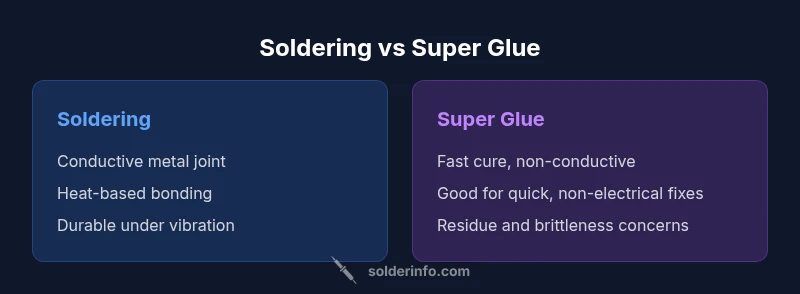
Soldering generally wins for electrical and durable joints; super glue excels at fast, non-electrical repairs.
For electronics and plumbing where conductivity and reliability matter, soldering is preferred. For quick, non-conductive fixes, glue offers speed and convenience. Always tailor the method to the use case and environmental conditions.
Quick Answers
Is soldering always better than using super glue?
No. The better method depends on the goal. If electrical conduction and long-term durability are required, soldering is usually superior. For quick, non-conductive fixes, glue offers speed and simplicity.
It depends on the job: for electrical joints, soldering is usually the better choice; for fast, non-conductive repairs, glue can work well.
Can I use solder on plastics or non-metal parts?
Soldering plastics is generally not recommended because heat can melt the material and compromise the bond. Use appropriate adhesives or mechanical fasteners instead.
Usually not. Soldering plastics can melt them, so consider glue or other methods.
Is super glue safe to use on electronics?
Most cyanoacrylate glues are insulating and may trap moisture or cause corrosion in circuitry. Use non-conductive, electronics-safe adhesives and keep joints clean.
Most glues are insulating; be careful near circuits and prefer electronics-rated adhesives.
Can I desolder a joint if needed later?
Desoldering is usually straightforward if you use proper technique, flux, and suitable tools. Glue joints are harder to reverse without damaging components.
Desoldering can be done with the right tools; glued joints are harder to reverse.
Are there conductive adhesives for mixed-use cases?
Yes, there are conductive adhesives, but they are specialized and may not match solder in reliability. Test before critical use.
There are conductive adhesives, but they’re not a universal substitute—test them first.
What safety steps should I follow when soldering or gluing?
Work in a well-ventilated area, wear eye protection, and follow flux and adhesive safety data sheets. Keep heat sources away from flammable materials and allow joints to cool before handling.
Ventilate the workspace, wear protection, and follow product warnings. Let things cool before touching.
Top Takeaways
- Define the bond goal: electrical vs non-electrical
- Prioritize conductivity and heat resistance for solder
- Choose glue for speed and non-conductive needs
- Prep surfaces and follow safety protocols
- Consider future disassembly and repairability
- Explore alternatives (epoxy, UV-curing) when appropriate