Conductive Glue vs Solder: A Practical Comparison
This analysis compares conductive glue and solder for electronics, jewelry, and plumbing, focusing on conductivity, durability, heat tolerance, and practical use cases.


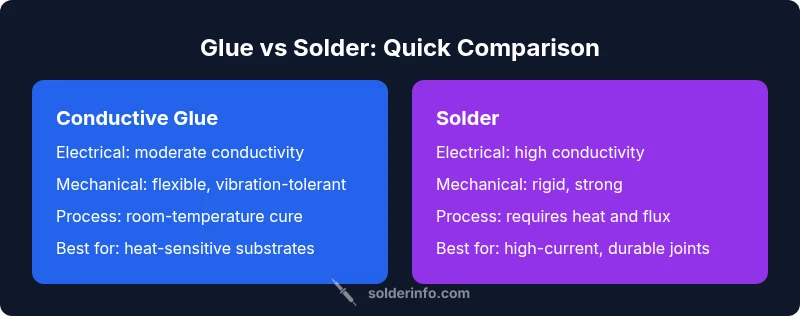
For electronics, solder often delivers high-conductivity, durable joints, while conductive glue serves as a quick, low-temperature alternative for flexible substrates or non-solderable surfaces. Conductive glue vs solder is a matter of context: use glue for rapid prototyping or delicate components, and solder for traditional, long-term reliability and higher current handling.
The Basic Concept: conductive glue vs solder
In the realm of bonds for electronics, jewelry, and plumbing, two distinct approaches coexist: conductive glue and solder. Conductive glue refers to adhesives filled with conductive particles (often silver or carbon) that harden to form an electrical path between surfaces. Solder, by contrast, is a metal alloy that creates a fusible joint when heated and solidifies to form a continuous metal connection. The key differences aren’t just material—they’re about temperature, mechanical performance, and substrate compatibility. When you compare conductive glue vs solder, you must weigh: can the joint carry the intended current without mechanical failure? Will repeated flexing or vibration threaten the bond? Is the substrate compatible with heat or chemical exposure? According to SolderInfo, the choice hinges on the substrates involved, the operating environment, and the desired lifecycle of the joint. This context informs decisions across electronics, jewelry, and plumbing projects.
The Chemistry of Conductive Adhesives
Conductive adhesives use a resin matrix (often epoxy) loaded with conductive fillers such as silver, carbon, or copper. The filler provides the electrical path, while the matrix provides the mechanical bond. Formulations vary from low-viscosity, room-temperature cure systems to high-performance, heat-cured blends. Anisotropic variants are designed to conduct primarily in one direction, reducing stray cross-conductivity. Humidity, UV exposure, and long-term aging can influence conductivity, so choosing the right formulation requires considering operating temperature, environment, and expected life. For hobbyists, pre-mixed, self-contained syringes offer cleanliness and convenience, while professional electronics often rely on controlled dispensing and cleanroom handling. The SolderInfo team notes that the best adhesive choice minimizes joint resistance while preserving substrate integrity and ease of rework.
Solder: Alloys, Flux, and Workflows
Solder remains the standard for many electronics applications due to its high conductivity, low resistance, and strong mechanical bonds after solidification. Modern lead-free solders—typically tin-based alloys—are designed to meet safety and environmental standards while delivering reliable joints. The workflow involves surface preparation, flux application, and controlled heating, usually via a soldering iron or reflow oven. Flux cleans oxides to improve wetting, then the molten alloy forms a metallurgical bond with copper and tin surfaces. Leaded variants historically offered lower melting points and easier wetting, but environmental regulations have steered most manufacturing toward lead-free formulations. For precise, high-volume work, automated soldering processes provide consistent results. Expert guidance from SolderInfo emphasizes clean surfaces, proper flux removal, and post-solder inspection to ensure joints meet required reliability levels.
Electrical Performance: Conductivity and Impedance
Electrical performance is the core differentiator between conductive glue and solder. Solder joints typically exhibit very low contact resistance and stable impedance across frequencies, making them suitable for signals and power delivery. Conductive adhesives, while capable of producing a measurable conductive path, usually show higher contact resistance and greater sensitivity to environmental conditions. Temperature cycling, humidity, and aging can cause adhesive joints to drift in resistance. For small, low-current connections (for example, sensor leads on plastic substrates or temporary prototypes), conductive glue can be sufficient, but for high-speed or high-current circuits, solder remains the safer choice. When assessing a glue-versus-solder decision, consider the worst-case operating current and the acceptable voltage drop across the joint.
Mechanical Performance: Flexibility vs Rigidity
A fundamental difference lies in how the joints respond to stress. Conductive glue bonds are generally more compliant than solder joints, absorbing mechanical strain and vibration without cracking fragile substrates. This flexibility is advantageous for electronics mounted on flexible circuits, curved surfaces, or components that experience movement. Solder joints, on the other hand, form rigid, metallic interfaces that provide excellent mechanical strength but are susceptible to stress cracking under repeated flexing or thermal cycling. The right choice balances the need for mechanical resilience with the substrate’s tolerance for heat and chemical exposure. Solder often wins in applications demanding long-term durability under mechanical load, while glue wins where flexibility and heat sensitivity dominate.
Thermal Considerations: Heat, Curing, and Service Temperature
Thermal behavior is a decisive factor. Conductive adhesives can cure at room temperature or with modest heat, enabling assembly on heat-sensitive substrates. However, their service temperature is generally lower than that of solder joints, which can withstand higher thermal loads when properly alloyed and flux-cleaned. adhesives are vulnerable to aging and moisture at elevated temperatures, which may alter conductivity over time. For high-temperature environments, soldered joints with appropriate lead-free alloys offer greater thermal stability, though pros and cons must be weighed for materials that cannot tolerate soldering heat. The decision should reflect expected thermal cycles, ambient conditions, and whether post-assembly heat exposure is likely.
Substrate Compatibility and Surface Preparation
Substrate compatibility is a major determinant in choosing between conductive glue and solder. Conductive adhesives excel on plastics, ceramics, and composite materials that aren’t solder-friendly; they usually require careful surface preparation, including cleaning and, in some cases, silane coupling agents to improve adhesion. Soldering requires metallized surfaces or copper traces; board finishes and component leads must be clean and oxide-free to ensure good wetting. Glue can be forgiving on irregular geometries but demands precise dispensing and cure control to achieve a consistent bond. Conversely, soldering demands heat management and proper flux to prevent oxidation during the join. In both cases, surface cleanliness and compatibility with solvents and cleaners will influence long-term performance.
Application Methods: Glue vs Solder Process
Glue-based bonding is typically a two-stage process: apply an appropriate conductive adhesive, align components, and cure under specified conditions (ambient temperature or a controlled heat source). Rework can be easier with glue, as joints may be separated with solvents or gentle debonding processes, though some adhesives create stronger bonds than intended. Soldering is a one-shot process requiring precise temperature control, flux application, and rapid cooling to prevent warping or tin whiskers. Rework in soldered joints is feasible but may risk damage to substrates, pads, or nearby components. In mixed-material assemblies, some designers use glue for initial hold-down and solder for critical electrical paths, balancing speed and reliability across the production flow.
Comparison
| Feature | Conductive glue | Solder |
|---|---|---|
| Electrical conductivity / impedance | Lower conductivity and higher resistance in typical adhesive joints | Very high conductivity and low resistance when properly soldered |
| Mechanical flexibility | More compliant; tolerates flexing and vibration | Rigid; best for stable mechanical interfaces |
| Cure / processing time | Room-temperature or fast-cure options; shorter cycle on some adhesives | Immediate bonding during reflow or hand-soldering; requires heat |
| Substrate compatibility | Works on plastics, ceramics, some metals; often needs surface prep | Best on metallized copper surfaces and PCB pads; needs oxide-free metal |
| Temperature tolerance | Lower service temperature; heat sensitivity considerations | Higher service temperature with proper alloy and flux |
| Reworkability | Easier to remove with solvents or debonding methods | More challenging to rework; risk of pad or trace damage |
| Cost per joint | Lower material cost per joint; equipment-free options | Higher upfront costs for materials and equipment; consumables |
| Best for | Low-current, rapid prototyping, non-heated substrates | Traditional electronics where reliability and current handling matter |
Advantages
- Low-temperature option preserves heat-sensitive substrates
- Fast prototyping and quick fixes for non-traditional assemblies
- Easily reworkable with proper adhesives and solvents
- Can bond diverse materials beyond metals and copper
Cons
- Higher contact resistance and potential aging effects
- Long-term reliability can be substrate- and environment-dependent
- Not ideal for high-current power connections
- Surface prep and curing conditions add process steps
Solder excels in high-conductivity, durable joints; conductive glue shines for flexible, low-current assemblies
For electronics that carry significant current or require long-term reliability, solder is the preferred method. Use conductive glue when substrates are heat-sensitive, shapes are unusual, or you need rapid prototyping and easy rework. The choice should align with current, mechanical stress, and environmental exposure.
Quick Answers
When should I use conductive glue instead of solder?
Use conductive glue when the substrate cannot tolerate heat or when rapid prototyping is needed. It’s also useful on flexible circuits or irregular geometries where soldering is impractical. Consider long-term reliability and environmental exposure before committing to glue for critical paths.
Use glue when you can’t heat the part or need fast prototyping; for critical joints, choose solder.
Is conductive glue as conductive as solder?
Typically not. Adhesive joints usually have higher resistance and can drift with aging and humidity. Soldered joints offer much lower resistance and greater stability, especially for power delivery and high-frequency signals.
Glue is generally less conductive and stable than solder.
Can conductive glue withstand high temperatures?
Most conductive adhesives cure at low temperatures but have lower service temperature ranges than solder joints. For high-temperature environments, solder with appropriate alloys provides better thermal resilience.
Most glues aren’t as heat-tolerant as soldered joints.
Are there safety or environmental concerns with glue joints?
Ensure proper ventilation for solvent-based adhesives and use lead-free solders to minimize environmental impact. Some conductive adhesives contain volatile components; follow manufacturer safety data sheets and local regulations.
Ventilate when using adhesives and follow safety guidelines.
Can I use glue to repair plumbing or structural joints?
For plumbing, epoxy-based conductive adhesives are often used for non-pressurized, non-wetted joints or patches. Do not rely on glue for high-pressure or critical plumbing joints—solder and appropriate fittings are typically required.
Glue can patch, but for critical plumbing you should solder or use proper fittings.
How do I decide between glue and solder for a project?
Assess current requirements, substrate compatibility, temperature exposure, and rework needs. If the joint must carry significant current or endure heat cycles, prefer solder. If substrate is heat-sensitive or a rapid prototype is needed, consider conductive glue.
Think about current, heat, substrate, and rework when deciding.
Top Takeaways
- Choose solder for high-current, durable electronics
- Choose conductive glue for flexible substrates and quick prototyping
- Surface prep and environmental conditions drive joint reliability
- Balance thermal exposure and substrate tolerance in design decisions