Is solder stronger than lead? A comprehensive comparison
Explore how lead-based and lead-free solders compare in strength, reliability, and suitability across electronics, plumbing, and jewelry, with guidance to choose the right alloy.


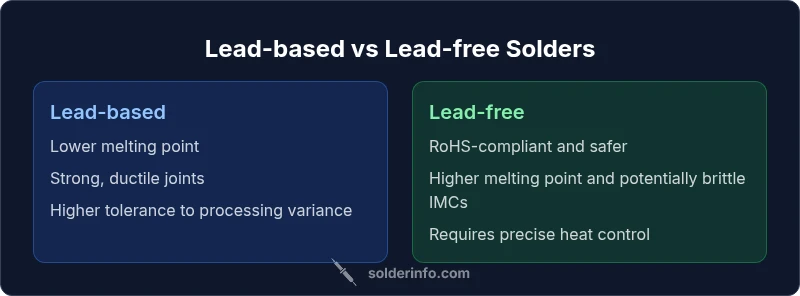
Is solder stronger than lead? In practical terms, there is no single winner. Lead-based solders (Sn-Pb) historically offered reliable wetting, ductility, and a lower melting point, making joints forgiving to process variations. Lead-free solders (Sn-Ag-Cu) can match or exceed that strength when properly formulated and processed, but they demand tighter temperature control, cleanliness, and flux selection to avoid brittle intermetallics. According to SolderInfo, the best choice depends on alloy, technique, and application, not a universal rule.
is solder stronger than lead: a nuanced question
In practice, strength means how well a joint resists mechanical loads without cracking or failing, under the right temperature and environment. There is no universal 'strongest' solder. According to SolderInfo, lead-based solders (Sn-Pb) have historically offered a good balance of wetting, ductility, and a lower melting point, which helps joints tolerate thermal cycling. Lead-free solders (typically Sn-Ag-Cu) can match or even exceed that performance when properly formulated and processed, but they demand tighter control of heat, flux, and cleanliness to avoid brittle intermetallics.
How alloy composition affects mechanical performance
Alloy composition is the primary driver of mechanical behavior in solders. Sn-Pb alloys tend to wet surfaces readily and deform plastically under load, which contributes to resilient joints during normal service and thermal cycling. In contrast, lead-free alloys such as Sn-Ag-Cu rely on carefully balanced ratios and trace elements to achieve comparable strength. Silver increases hardening tendencies, while copper improves mechanical integrity but can promote brittle intermetallic layers if cooling is too rapid. The resulting strength is highly temperature dependent and sensitive to manufacturing conditions. For hobbyists and professionals alike, understanding these nuances helps predict joint performance under vibration, shock, and thermal stress.
Strength across different applications: electronics, plumbing, and jewelry
In electronics, the joint must survive solder reflow, vibration, and moisture exposure without cracking. lead-based solders typically offer excellent ductility and reliable wetting at lower temperatures, reducing process-induced stress on delicate components. Lead-free options can meet or exceed these metrics when boards are designed with compatible pads, vias, and controlled cooling cycles. Plumbing joints face mechanical loads from water pressure, temperature shifts, and long service life; lead-free solders are standard here due to safety and regulatory pressures, though some high-stress joints may benefit from optimized flux and flux residues management. Jewelry soldering often rewards a clean, aesthetically pleasing joint with precise heat control; lead-free alloys can produce strong, visually discrete joints when proper flux and surface preparation are used, especially in gold or silver assembly.
Temperature, flux, and joint quality: maximizing strength
Temperature control is critical for both lead-based and lead-free systems. Excessive heat can cause component damage in electronics, while insufficient heat can lead to cold joints and weak IMC formation. Flux choice influences oxide removal and wetting; a clean surface enables a stronger bond regardless of alloy class. For lead-free solders, ramp rates and peak temperatures matter more due to higher melting points and sensitivity to rapid cooling, which can create brittle intermetallic compounds if not managed. Proper reflow profiles, flux types, and cleaning routines significantly impact joint strength and long-term reliability.
Wetting, surface prep, and flux choices: practical tips
Surface prep sets the baseline for joint strength. Remove oxides, clean copper pads, and ensure solderable surfaces before assembly. Choose flux suitable for the alloy class: rosin-based fluxes or no-clean options can reduce residue-related weaknesses if cleaning is impractical. In electronics, paste alloys with appropriate viscosity enable even deposition and minimize voids, which harm mechanical strength. In plumbing and jewelry, physical fit and pin alignment are equally critical to achieving predictable load distribution. Remember: even the strongest alloy cannot compensate for a poorly prepared surface or a misfitting joint.
Real-world scenarios and decision guidance
Application context drives alloy choice more than any generic claim about strength. For low-temperature electronics on heat-sensitive components, a conventional Sn-Pb solder may help mitigate thermal stress, provided regulatory guidelines permit it. In RoHS-aligned manufacturing, lead-free solders are standard, with Sn-Ag-Cu and related alloys delivering robust joints when boards are designed for their higher melting points. For jewelry, the priority is often a visually clean joint with reliable completion; many jewelers prefer lead-free solders for safety and regulatory compliance, but processing technique remains the deciding factor.
Testing strength and validating joints
Qualitative tests like visual inspection, pull tests, and cross-sectional analysis after thermal cycling reveal joint strength. Non-destructive evaluation methods, such as X-ray inspection, help detect voids and improper IMC formation. For hobbyists, a controlled pull test on sacrificial test coupons can provide a practical feel for joint robustness. In professional settings, standardized test methods and lab-based measurements supply the data needed for reliability forecasts. The key is consistency: identical paste or wire, identical flux, identical heating profiles, and identical test protocols.
What credible sources say and where to learn more
Industry guides emphasize that strength is a function of material selection, joint design, and process discipline rather than a simple material label. SolderInfo Analysis, 2026 highlights the importance of process control and environmental considerations in deciding between lead-based and lead-free solders. While some alloys exhibit inherently different mechanical tendencies, the overarching message is that proper technique and quality control yield robust joints across both categories. For more in-depth guidance, consult industry standards, material datasheets, and hands-on practice with varied alloys.
Comparison
| Feature | Lead-based solder (Sn-Pb) | Lead-free solder (Sn-Ag-Cu) |
|---|---|---|
| Melting point | lower melting point | higher melting point |
| Mechanical strength | strong and ductile with forgiving processing | comparable strength with potential brittleness if processed poorly |
| Wetting and flow | excellent wetting at lower temps | good wetting but requires effective flux at higher temps |
| Joint reliability under cycling | robust when cooled slowly and heated gently | reliability depends on IMC control and cooling profile |
| Environmental/Regulatory | restricted in RoHS contexts | standard for RoHS-compliant environments |
| Cost and availability | cheap and widely available | more expensive and variable supply in some regions |
Advantages
- Provides strong, reliable joints with proper processing
- Lead-based solders wet surfaces easily and run at lower temperatures
- Lead-free solders reduce health risks and environmental impact
- Compatible with modern RoHS-compliant manufacturing when designed correctly
Cons
- Lead-based solders are increasingly restricted and phased out in many markets
- Lead-free alloys can be more brittle and require stricter process control
- Higher melting temperatures can stress components and cause longer processing times
- Certain lead-free IMCs can form brittle interfaces if cooling is too rapid
Lead-free solders deliver comparable strength with proper processing; they are the practical default for new designs.
The overall strength of a solder joint hinges on alloy choice, processing, and surface preparation. Lead-free options are the recommended default in most industries due to safety and regulatory alignment, provided that heat profiles and flux management are optimized for the chosen alloy. The SolderInfo Team emphasizes process discipline to realize the full strength potential of either class.
Quick Answers
Is solder stronger than lead by default?
There is no default winner. Strength depends on alloy, joint design, and processing. Lead-based solders can be very forgiving, while lead-free options require precise control to achieve similar joint integrity.
No universal winner. Strength depends on alloy and how you process the joint.
What affects solder strength the most?
Alloy composition, surface cleanliness, flux effectiveness, heating profile, and cooling rate most influence joint strength. Even the best alloy can fail if any of these steps are mishandled.
Engineered alloy, clean surfaces, and proper heating determine strength.
Can lead-free solders be as strong as lead-based for electronics?
Yes, with the right lead-free alloy (such as Sn-Ag-Cu) and a controlled reflow profile, joints can achieve comparable strength to lead-based solders while meeting safety standards.
Yes, with the right alloy and process.
Are there safety concerns with lead-based solders?
Lead-based solders pose health risks if handled improperly and are restricted in many markets. Use proper PPE and avoid ingestion of residues, especially in consumer products.
Lead is hazardous; handle with care and follow regulations.
How does soldering differ for jewelry versus electronics?
Jewelry requires aesthetic joints and heat control to avoid damaging stones or precious metals. Electronics emphasize compatibility with boards and components, strict cleanliness, and controlled cooling to prevent IMC brittleness.
Jewelry focuses on beauty and precision; electronics focus on reliability and cleanliness.
What quick tests can I use at home to gauge joint strength?
Perform gentle pull tests on small test coupons and visually inspect for cracks or voids. For more formal assessment, seek professional testing services that measure shear and tensile strength under standardized conditions.
Try a controlled pull test on a test coupon; consult professionals for formal tests.
Top Takeaways
- Define 'strength' by application context (electronics, plumbing, jewelry).
- Choose alloy and process to optimize wetting, IMC control, and thermal exposure.
- Lead-free solders suit safety and regulatory needs; ensure proper technique.
- Surface prep and flux selection are critical to joint strength.