Is Solder Stronger Than Glue? A Practical Comparison
Explore the strengths and weaknesses of solder vs glue across electronics, jewelry, and plumbing. Learn when each bond performs best and how to maximize joint reliability.


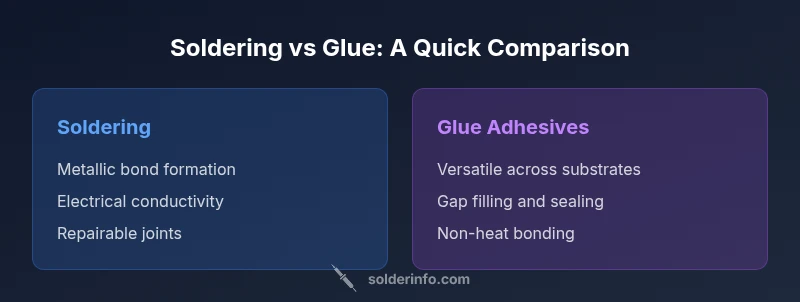
Is solder stronger than glue? In metal-to-metal joints and electronics assemblies, soldering typically provides a stronger, more reliable bond when surfaces are clean and flux is properly applied. Glue bonds offer excellent versatility for non-metal substrates and gap filling, but they rarely match solder for metal strength or electrical conduction. Choose solder for durability and conductivity; choose glue for versatility and non-metal parts.
Bonding Fundamentals: What Actually Happens
The question is often framed as a simple strength comparison, but the answer depends on the bonding mechanism behind each method. Soldering creates a metallurgical bond by heating a filler metal to its melting point and allowing it to alloy with the base metals as it cools. When done correctly, this yields a continuous, solid connection that can conduct electricity and transfer mechanical loads. Glue, by contrast, relies on adhesion and cohesion. The adhesive material forms bonds with microscopic surface features and fills micro-voids to distribute stress. The chemistry varies by adhesive family: cyanoacrylates cure rapidly on many substrates but can become brittle under flex; epoxies offer strong bonds and good temperature resistance but may be sensitive to moisture; silicone adhesives excel at sealing and flexibility but may not provide the highest shear strength. Practically, the criteria used by professionals include substrate type, load direction, environmental exposure, and the need for electrical continuity. The core question—"is solder stronger than glue"—does not have a universal answer; it depends on the specific joint and application.
Substrate Compatibility: Metals, Plastics, and Beyond
Bond performance is highly substrate-dependent. Soldering excels on clean metal surfaces such as copper, tin, and brass, where the molten filler metal can diffuse and form a robust alloyed joint. Plastics and polymers present a challenge for soldering unless compatible surface treatments or through-hole fixtures are used; many projects rely on mechanical fixtures or specialized low-temperature alloys to avoid damaging substrates. Glue adhesives, by contrast, offer broad substrate compatibility when the right formulation is chosen. Epoxies can grip metal, ceramic, glass, and some plastics; cyanoacrylates bond quickly to many rigid substrates but perform poorly on flexible or highly porous materials without primers; silicone adhesives provide excellent adhesion to smooth non-porous surfaces and offer strong sealing but may require longer cure times. In practice, select the method based on substrate type, surface preparation, and environmental exposure.
Mechanical Strength and Failure Modes
Strength is not a single number but a behavior under load. Soldered joints tend to distribute stress along a metallurgical plane, which can provide high shear resistance on metal assemblies. Poor preparation—oxidized surfaces, insufficient flux, or cold joints—creates weak spots that crack or lift. Glue bonds transfer loads through the adhesive layer, which can be excellent for uniform stress distribution on flat or irregular surfaces but may degrade with moisture, UV exposure, or repetitive flex. Some glues are formulated to handle shear well, while others excel in tensile strength or impact resistance. When evaluating a joint, consider load direction (shear, tensile, or peel), thermal cycling, and potential for substrate creep. The general takeaway is that soldering offers robust metal-to-metal strength and conductivity, while glues excel when adhesion across diverse substrates and gaps is paramount.
Temperature and Environment Considerations
Operating temperature and environmental exposure shape failure risks for both methods. Soldered joints rely on the integrity of the metal alloy and the flux-cleanliness; flux residues can corrode metals if not removed, and exposure to moisture can influence long-term reliability. Glue bonds respond to temperature changes based on the polymer matrix and curing chemistry; some adhesives soften or creep with heat, others resist aging but may degrade under UV light or chemical exposure. For electronics, soldered connections typically tolerate higher local temperatures during operation, while adhesives may offer moisture sealing but less electrical reliability. In jewelry or mechanical assemblies, temperature swings can cause differential expansion, challenging either method depending on the substrate and adhesive choice. Overall, expect solder to provide better high-temperature conductance in metal joints, with glues offering broader environmental sealing when selected appropriately.
Reworkability and Maintenance
Repairability is a practical consideration. Solder joints can be reheated, re-fluxed, and reworked with standard tools, making maintenance straightforward for electronics and metalwork. This reworkability comes with the caveat that repeated heating can embrittle metal joints or damage heat-sensitive components. Adhesive bonds vary: some glues are easy to debond with solvents or mechanical force, while others are designed to be permanent and may require cutting, grinding, or chemical stripping for removal. For hobbyists, the ability to recover or adjust a bond matters; for production environments, consistent process control and waste minimization are critical. The choice often hinges on whether future disassembly is anticipated and how substrate integrity will be preserved through cycles.
Electrical Conductivity and Insulation
A key differentiator is electrical behavior. Solder forms a conductive path, essential for electronics and metal assemblies where current must flow. Glue bonds are typically insulating unless a specialized conductive adhesive is used. Conductive adhesives do exist, but they require careful selection and testing, as their conductivity and thermal performance often lag behind solder in high-current applications. Besides conductivity, consider insulation needs, adhesive polarity, and the potential for moisture ingress that could undermine educational or professional equipment. In short, solder provides a reliable electrical bridge, while standard glues promote non-conductive sealing and insulation unless you opt into a niche conductive adhesive category.
Practical Use Cases Across Industries
Across electronics, jewelry, and plumbing, the solder-versus-glue decision maps to the job’s demands. In electronics, soldering is the default for joints that require low resistance, heat dissipation, and long-term reliability. Jewelry soldering emphasizes clean, hidden joints and alloy compatibility with precious metals, where flux and temperature control are critical. Plumbing often relies on solder for copper joints and mechanical speed builds (though lead-free formulations are important for safety). In non-metal scenarios—or where heat must be avoided—high-quality epoxy or silicone adhesives fill gaps and provide sealing. The best practice is to frame the bond around the substrate, environment, and functional requirements: conductivity, water resistance, thermal tolerance, and the potential for disassembly.
Surface Preparation and Best Practices
No bond succeeds without proper surface prep. For soldering, clean metal surfaces, correct flux choice, and non-oxidizing environments matter more than raw technique alone. Tinning, scrubbing with isopropyl alcohol, and ensuring dry, dust-free joints minimize the risk of cold joints. For glues, surface roughening, degreasing, and primer choices improve adhesion. If metal surfaces oxidize rapidly, mechanical abrasion or chemical etching may be required before applying solder; for plastics, consider temperature limits and primer compatibility before gluing. Finally, always verify joint quality with controlled tests—tug testing, visual inspection, and partial cycling—to ensure the bond will meet real-world demands.
When to Use Solder Over Glue and Vice Versa
Use solder for joints that require electrical conduction, mechanical strength under shear, and the ability to rework. Solder shines in electronics and metal-to-metal assemblies where long-term reliability is critical. Use glue when bonding diverse substrates, filling gaps, providing flexible supports, or when heat must be avoided to protect sensitive components. For mixed-material assemblies, a hybrid approach—glue for alignment and load distribution, solder for critical electrical paths—often yields the best results. In all cases, follow safety guidelines, particularly regarding flux residues and lead exposure with traditional solders; opt for lead-free formulations where possible to minimize health and environmental risks.
The Repair Mindset: Safety and Sustainability
Safety and sustainability drive modern bonding choices. Soldering involves heat and flux, with potential fumes and the need for proper ventilation and eye protection. Lead-free solders reduce health risks but still require good soldering practices to avoid tin whiskers and cold joints. Glue chemistries may emit volatile organic compounds during cure, so use in well-ventilated spaces and select low-VOC formulations when possible. From a sustainability angle, solder repairs extend the life of metal components and electronics, reducing waste; glues can enable repair where soldering is impractical, but disposal considerations differ by adhesive type. The overarching principle is to balance performance with safety and environmental impact, aligning your approach with guidelines from reputable sources and industry standards.
Authority references
- https://www.osha.gov/
- https://www.nist.gov/
- https://ieeexplore.ieee.org/
Comparison
| Feature | Soldering | Glue Adhesives |
|---|---|---|
| Bonding mechanism | Metallurgical bond through melting and alloying | Adhesive bonds via chemical/physical adhesion and cohesion |
| Substrate compatibility | Excellent on clean metals; plastics require surface prep or fixtures | Broad substrate versatility; performance depends on adhesive formulation |
| Mechanical strength and failure modes | High shear strength on metals when properly prepared; brittle if joints are cold or contaminated | Stress is transferred through the adhesive layer; performance varies with substrate and cure |
| Temperature/environment | Good high-temperature performance limited by metal alloys and flux cleanliness | Varies by polymer; some tolerate heat well, others degrade with moisture/UV |
| Reworkability | Easily reworked by reheating and fluxing | Often permanent; some can be debonded with solvents or mechanical removal |
| Electrical conductivity | Conductive path; solder is inherently conductive | Most glues are insulative; special conductive adhesives exist |
| Ease of application | Requires heat source, flux, and precision; skill matters | Simple application; cure times vary by adhesive type |
| Best for | Metal-to-metal joints, electronics, and repairable connections | Non-metal substrates, gaps, seals, and flexible applications |
Advantages
- Soldered joints offer strong, conductive bonds for metal parts when surfaces are prepared.
- Soldering enables repairable joints and repeatable results in electronics.
- Glue bonds excel at gap filling, sealing, and substrate versatility across metals, plastics, and composites.
- Adhesives require little specialized equipment and are effective for non-heat-sensitive assemblies.
Cons
- Soldering requires heat and flux, which can damage heat-sensitive parts and leave residue.
- Lead-containing solders pose health and environmental concerns (lead-free options exist).
- Adhesives can be non-conductive and may degrade under humidity or temperature cycling.
- Some glues are difficult to remove or repair and can creep under load over time.
Soldering is generally stronger for metal joints and conductivity; glue bonds excel where substrate versatility or gap filling matters.
Soldered metal joints offer reliability and electrical continuity, ideal for electronics and metalwork. Glue-based bonds provide flexibility across materials and sealing, best when heat or disassembly is a constraint.
Quick Answers
Is solder stronger than glue for electronics?
In electronics, soldering generally provides stronger, more reliable joints with electrical continuity, assuming proper surface preparation and flux removal. Glue offers insulation and vibration damping but rarely matches solder’s metallurgical bond for conductive paths.
For electronics, soldering usually wins on strength and conductivity, while glue is better for insulation or gap filling when metal isn’t involved.
Can glue replace solder on metal joints?
Glue can replace solder in some non-critical metal joints or where heat is risky, but it typically won’t match solder for load-bearing metal connections or electrical paths. Use glue for alignment, sealing, or non-conductive bonds where metal isn’t required.
Glue can replace solder in some cases, but for strong metal joints and electrical paths, solder is usually preferred.
What glues are best for electronics?
For electronics, epoxy and silicone adhesives are common choices, chosen for curing behavior, temperature resistance, and compatibility with components. Be mindful of solvent compatibility and cleaning requirements after curing.
Epoxy or silicone glues are common for electronics, but pick a formulation that suits your temperature and substrate needs.
Is it safe to solder plastics?
Soldering plastics is generally not recommended due to heat sensitivity and risk of deformation. If necessary, specialized low-temperature alloys or mechanical fastening with adhesive might be safer options.
Soldering plastics is usually avoided; consider low-temperature methods or other bonding approaches.
Can you solder copper pipes?
Yes, copper pipes are commonly joined by soldering or brazing, using appropriate flux and lead-free alloys. Ensure proper cleaning and pressure testing after joining.
Copper pipes are routinely soldered with the right flux and safe alloys.
How should I prep surfaces for soldering vs gluing?
For soldering, clean metal surfaces and use flux to prevent oxidation; for gluing, degrease and roughen surfaces as needed and follow adhesive curing guidelines.
Clean the metal, apply flux, and make sure surfaces are dry for soldering; for glue, prep by degreasing and roughening as needed.
Are conductive adhesives a better choice?
Conductive adhesives exist but are specialized; they can provide conductivity but may lag behind solder in reliability for high-current paths. They’re worth testing for specific, low-power designs.
There are conductive glues, but test them for your current needs first.
What about jewelry bonding—solder or glue?
Jewelry typically uses solder for visible joints and metal compatibility, with careful temperature and flux control to protect delicate metals. Glue is less common for structural bonds but can address specific settings or gaps.
In jewelry, solder is usually preferred for strong, clean joints; glue is for special cases.
Top Takeaways
- Assess substrate before bonding.
- Soldering provides metallurgical strength and conductivity.
- Glue offers versatility across substrates and gaps.
- Plan for safety and environmental impact with both methods.
- Prioritize surface prep and appropriate adhesives for best results.