Dry Film Solder Mask vs LPI: A Thorough Comparison
In this analytical guide, we compare dry film solder mask vs LPI to help PCB designers select the right masking technology for density, reliability, and manufacturability. Learn how materials, processing, and cost drive decisions.


Dry film solder mask vs LPI are two leading PCB masking technologies. Dry film relies on lamination of a thin film that is UV-exposed to define openings, while LPI uses a liquid coating that cures into a photochemically defined mask. Both aim to protect copper and control solder flow, but they differ in processing, resolution, and process maturity. According to SolderInfo, the choice between these options often determines yield and reliability on high-density boards.
Understanding the Basics of the Two Mask Technologies
When evaluating the landscape of solder mask technologies for printed circuit boards, the keyword dry film solder mask vs lpi often comes up. These two approaches share a common goal: protect copper traces, insulate pads, and define solderable regions with precision. Dry film solder mask is a laminated, photosensitive film that adheres to the board through heat and pressure, then is UV-exposed to create defined openings. LPI, or liquid photoimageable mask, is a liquid coating that is applied, pre-baked, then UV-exposed and developed to form the mask pattern. The SolderInfo team notes that the choice between these methods hinges on density, project scale, and equipment availability. In practice, boards that demand tight tolerances, sharp edges, and robust abrasion resistance tend to favor dry film, while those prioritizing flexible process flow and lower upfront capital may lean toward LPI. Understanding these fundamentals sets the stage for a deeper comparison of materials, processing, and performance.
Materials and Chemistry
The chemistry behind dry film solder mask vs lpi is fundamentally different. Dry film masks are solid, polymer-based films that carry a resist layer on their surface. They are laminated onto the copper, cured, and then patterned via exposure and development. LPI masks are liquid coatings composed of photopolymers that cure into a solid mask after exposure. The chemistry influences how the mask adheres to copper, how easily openings maintain integrity during soldering, and how the mask behaves during high-temperature cycles. From a reliability perspective, the resin system in dry film tends to offer excellent moisture resistance and reduced pinhole formation when properly laminated, whereas LPI relies on precise coating thickness and uniform exposure to avoid pattern loss. For designers, this chemistry translates into differences in shelf life, storage conditions, and handling requirements on the shop floor.
Processing Steps: Lamination vs Coating
The processing workflow is a major differentiator in the dry film solder mask vs lpi decision. Dry film requires lamination equipment, controlled heat and pressure, and careful alignment before UV exposure. Registration accuracy is critical, especially for boards with fine pitch or microvias. In contrast, LPI processing is a coating-and-exposure workflow: apply the liquid, pre-bake to cure solvents and improve adhesion, pattern via UV exposure through a photomask, and develop to reveal openings. LPI can be advantageous when process flexibility is needed, or when a facility already operates coating and UV exposure lines. However, coating uniformity, solvent management, and post-bake control are crucial for consistent results. The choice often reflects existing manufacturing capabilities and the desired balance between throughput and defect control.
Resolution and Pattern Fidelity
Resolution is a central theme in the dry film solder mask vs lpi comparison. Dry film masks can deliver highly defined edges and sharp lines due to the lamination process combined with UV exposure. This makes them particularly suitable for dense boards where trace lines and pad outlines approach the limits of feature size. LPI masks can deliver high-resolution patterns as well, but the quality depends on coating uniformity, surface energy, and exposure dose. In practice, designers working with fine-pitch components may prioritize dry film for edge fidelity, while those targeting intricate patterns with fewer lamination steps might favor LPI. The net result is a trade-off: dry film often wins on crisp definition; LPI can excel with flexible pattern design and rapid reticles for design iterations.
Physical Properties: Thickness, Coverage, and Wetting Behavior
Mask thickness and coverage affect solder paste behavior, stencil clearance, and moisture protection. Dry film masks are generally laminated to achieve a uniform thickness with excellent edge coverage and controlled openings. This consistency translates into predictable solder paste release and reduced bridging risk in harsh reflow environments. LPI masks rely on the thickness of the liquid coating and its subsequent cure, which can yield very uniform layers if the coating process is tightly controlled. However, coating irregularities or nonuniform bake can introduce variations in mask thickness, potentially impacting stencil alignment and solderability. For designers, this means considering how mask thickness interacts with stencil design, reflow profiles, and pad geometry in the final assembly.
Adhesion and Substrate Compatibility
Adhesion to the substrate is a practical failure mode to watch in both technologies. Dry film relies on surface prep and laminate adhesion; if melded correctly, it provides strong adherence to typical FR-4 or polyimide substrates. LPI adhesion depends on coating chemistry and surface energy, which means substrate compatibility and proper pre-treatment are essential. In some systems, LPI can be more forgiving of minor surface contaminants, but poor surface prep can lead to adhesion loss or edge lifting. For most electronics applications, following IPC guidelines for surface prep, cleanliness, and bake schedules helps ensure reliable performance across both technologies, but the exact requirements differ. The SolderInfo team emphasizes validating adhesion with representative boards under expected thermal cycling to avoid surprises in production.
Reliability under Temperature Cycling and Rework
Durability under temperature cycling is a key reliability factor when comparing dry film solder mask vs lpi. Dry film masks often show excellent resistance to abrasion and solvent exposure and can maintain mask integrity through multiple rework cycles, provided the lamination quality is high. LPI masks can perform well but may be more susceptible to mask delamination if exposure or bake steps are not tightly controlled. Rework scenarios, such as pad repair or mask removal, may also differ: dry film can resist mechanical abrasion during removal better in some cases, while LPI masks can be more forgiving if rework steps trigger only minor changes to coating. Engineers should plan for thermal profiles, flux exposure, and mechanical stress to gauge long-term reliability.
Manufacturing Throughput, Equipment, and Workflow
Equipment and workflow implications strongly influence the dry film solder mask vs lpi choice. Dry film projects require lamination equipment, accurate alignment, and a laminator capable of handling film thickness and board size. Throughput can be high once the process is optimized, but setup times and lamination quality can affect yield in early runs. LPI lines rely on coating stations, pre-bake ovens, UV exposure units, and development baths. If a facility already operates a coating line for other products, integrating LPI can be cost-efficient and allow rapid changeovers between mask patterns. Conversely, facilities with robust lamination capabilities and strict pattern requirements may prefer dry film for its mature, high-yield track record.
Cost, Supply Chain, and Availability
Cost considerations in the dry film solder mask vs lpi decision are heavily influenced by equipment and material availability. Dry film masks typically entail higher upfront capital for laminators and registered handling, but ongoing material costs per board can be predictable due to standard films and batch processing. LPI masks may lower initial equipment investment if a plant already supports coating and UV exposure, yet liquid materials can have tighter shelf-life and handling requirements, which may affect waste and procurement. Supply chain stability and vendor support for a given formulation play a larger role in scheduling and long-term planning, particularly in high-mix, low-to-mid volume environments. The goal is to align mask choice with supply reliability, volume projections, and maintenance expectations.
Design Considerations for High-Density Boards
In boards with dense traces and small pad pitches, the design team must consider how the mask choice interacts with pad geometry and copper density. Dry film solder mask vs lpi often reveals a trade-off: dry film can offer superior edge fidelity and reduced blistering at tight lines, while LPI can support rapid iteration and flexible masking for complex patterns. For extreme density, designers may implement both strategies selectively, using dry film in areas requiring the sharpest edges and LPI where patterns demand rapid changes or reduced equipment footprint. IPC-standards-compliant mask thickness and exposure control remain critical for maintaining consistent artwork transfer and solder mask performance across the board.
Testing, Quality Assurance, and Common Defect Modes
Quality assurance for dry film solder mask vs lpi includes a suite of tests designed to catch pattern defects, delamination, or pinholes. For dry film, QA often focuses on lamination pressure distribution, tape-off integrity, and edge-cut quality, as well as post-exposure alignment. For LPI, QA emphasizes coating uniformity, exposure dose accuracy, and reproducibility of the developed pattern. Common defects include edge lift in dry film and pattern loss or excessive pinholes in LPI if surface energy, cleaning, or exposure conditions are not optimal. Building a test plan that covers adhesion, dielectric integrity, and solder mask reflow behavior is essential for identifying weaknesses before full-scale production.
Decision Framework: How to Decide Between Dry Film and LPI
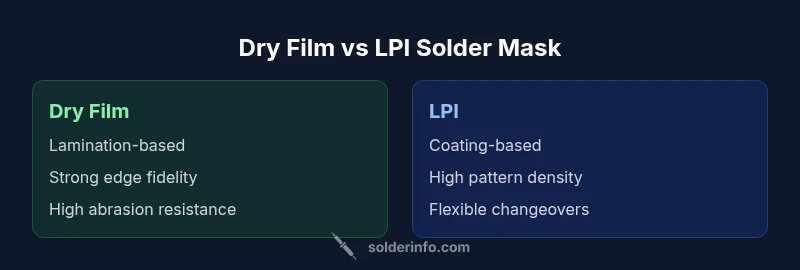
Choosing between dry film solder mask vs lpi requires a structured decision framework. Start with board density, the required edge fidelity, and the expected rework rate. If edge definition and abrasion resistance are critical, dry film often provides the best reliability. If production flexibility, lower upfront capital, and quick changeovers are prioritized, LPI may be preferable. Consider facility constraints—whether lamination equipment is available and maintained, or if coating lines are already in place for other products. Finally, run pilot boards to measure yield, rework needs, and tolerance to environmental stress, then re-evaluate the mask choice for future revisions. The goal is to balance performance with cost and throughput, always validated by real-world data from your processes.
Comparison
| Feature | Dry Film Solder Mask | LPI Solder Mask |
|---|---|---|
| Process Type | Lamination with UV exposure | Coating + UV exposure |
| Maximum Pattern Resolution | Excellent edge definition; tight lines possible | Very high-res patterns with careful coating and exposure control |
| Mask Thickness Control | Very uniform via lamination | Thickness depends on coating formulation and process control |
| Adhesion to Substrate | Strong if surface prep is correct | Good with proper surface energy and bake conditions |
| Solderability & Wetting | Robust barrier; reduced solder wicking | Good control of solder mask wetting when properly cured |
| Process Complexity & Equipment | Lamination line; alignment-critical | Coating line + exposure + development; versatile |
| Cost & Throughput | Higher capital; excellent repeatability at scale | Lower upfront cost if coating line exists; variable per run |
Advantages
- Helps engineers predict trade-offs between density, cost, and reliability
- Dry film offers thickness uniformity and edge fidelity
- LPI provides high-resolution masking with flexible changeovers
- Both technologies improve board reliability when properly implemented
Cons
- Dry film requires lamination equipment and can add setup time
- LPI is sensitive to coating uniformity and exposure accuracy
- Mask selection can constrain future rework or design changes
- Materials shelf-life and handling add procurement considerations
Dry film typically yields the best edge fidelity for ultra-dense boards, while LPI shines in flexibility and lower upfront cost.
For boards with tight tolerances and a high likelihood of rework, dry film is generally preferred. If production flexibility, lower capital expenditure, and faster changeovers dominate, LPI is the practical choice. The final decision should be grounded in pilot data and alignment with manufacturing capabilities.
Quick Answers
What is the fundamental difference between dry film solder mask and LPI?
Dry film solder mask uses laminated sheets that are UV-exposed to define openings, giving strong edge fidelity. LPI is a liquid coating that cures after UV exposure, offering high resolution but requiring precise coating and bake control. The choice depends on density, tolerance, and manufacturing capabilities.
Dry film is laminated and patterned with UV light to get sharp edges; LPI is a liquid that you coat, bake, and expose to pattern.”
Which technology is better for fine-pitch pads?
For ultra-fine pitches, dry film often provides crisper outlines and less risk of pattern loss during lamination. LPI can handle fine features too, but success depends on coating quality, exposure dose, and process control.
Fine-pitch boards usually favor dry film for edge clarity, though LPI can work with careful process control.
Is dry film compatible with lead-free solder?
Both dry film and LPI masks can be compatible with lead-free solder when designed and processed correctly. Ensure material chemistries meet IPC requirements and that reflow profiles do not degrade the mask integrity.
Both masks can work with lead-free solder if you follow proper materials specs and process controls.
What equipment is required for each process?
Dry film requires a lamination line, heat press, and alignment tools. LPI requires coating equipment, pre-bake ovens, UV exposure units, and development baths. Each path has unique maintenance and waste handling needs.
Dry film needs laminators; LPI needs coating and UV exposure gear.
How does mask thickness affect solder paste deposition?
Mask thickness influences paste release and stencil-to-pad clearance. Too thick a mask can impede paste transfer; too thin may expose copper. Both technologies rely on controlled thickness to maintain consistent solder joints.
Mask thickness matters for paste spread; keep it within the board design specs.
Can I switch mask types mid-project?
Switching mid-project is uncommon and can require rework or redesign of boards. If planning flexibility is essential, choose a mask type early and validate with pilot runs before ramping production.
It’s usually best to pick one mask type early and validate with pilots.
Top Takeaways
- Prioritize edge fidelity for dense boards with dry film
- Leverage LPI when rapid design changes and lower capex matter
- Balance throughput and equipment availability in the decision
- Validate with pilot runs to quantify yield and defects
- Plan for QA to catch pinholes, delamination, or pattern loss