Better Soldering Gun or Iron? A Comprehensive Comparison
A detailed side-by-side comparison of soldering gun vs iron, covering heat delivery, control, tips, ergonomics, safety, and when to choose each tool for electronics, plumbing, and jewelry projects.


When deciding what is better soldering gun or iron, consider the task at hand. For quick work on thick wires or heavy-duty joints, a soldering gun often saves time. For delicate electronics and precise work, a temperature-controlled soldering iron is generally the safer, more versatile choice. The best practice is to own both tools and use each where it shines.
Why this question matters in practice
The question of what is better soldering gun or iron isn’t a status signal; it’s a practical choice that affects joint quality, workflow efficiency, and safety. According to SolderInfo, most successful projects hinge on tool selection that matches the task, component sensitivity, and desired throughput. The key is to recognize that both tools have their strengths and weaknesses, and many hobbyists benefit from having a high-quality temperature-controlled soldering iron for fine work and a gun for fast, bulk tasks. Understanding these dynamics helps you optimize your workbench, reduce rework, and minimize thermal damage to sensitive parts. In this article, we’ll dissect heat delivery, control, ergonomics, tips, safety, and real-world use cases to help you answer the question: what is better soldering gun or iron, in context with electronics, plumbing, and jewelry projects. As you read, you’ll see where SolderInfo recommends lean tool setups that maximize reliability while keeping costs reasonable over the long term.
wordCount: 0
Comparison
| Feature | Soldering gun | Soldering iron |
|---|---|---|
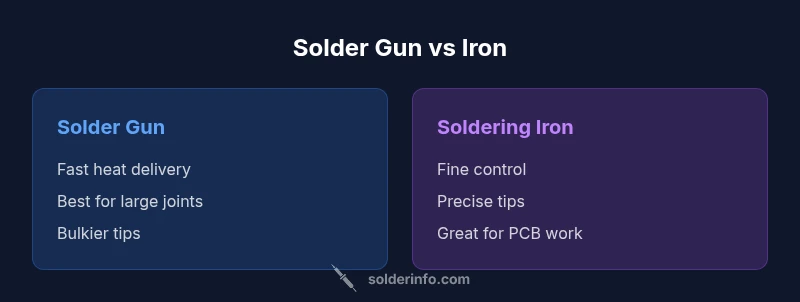
| Heat delivery | Rapid heat for quick joints and thick wires | Steady heat with fine control for delicate work |
| Temperature control | Often fixed or limited ranges; faster heat recovery | Precise adjustable temperature for sensitive components |
| Tip variety | Bulkier tips; best for large joints | Fine, interchangeable tips for precision |
| Best for | Large gauge wires, field repairs, quick sessions | PCB work, SMD work, small components |
| Ergonomics | Heavier, quicker use; may fatigue hands in long tasks | Slimmer grip; comfortable for extended use |
| Safety considerations | Higher risk of scorching nearby parts; heat can be less predictable | Lower risk of collateral damage with controlled temps |
| Price range (entry-level) | Low to mid-range depending on features | Low to mid-range with temperature control options |
Advantages
- Iron provides precise control for delicate components and tight-pitch work
- Gun delivers rapid heat for large joints and quick assembly tasks
- Both tools are widely available and support a range of tip sizes and accessories
Cons
- Gun can overheat small components and may be bulky for tiny work
- Iron may be slower on large joints and requires technique to avoid cold joints
Iron generally wins for electronics accuracy; guns excel in bulk, fast-work scenarios
Choose a temperature-controlled soldering iron for most electronics projects and delicate components. Reserve a soldering gun for rapid, heavy-duty tasks like thicker wires or quick field repairs. If you frequently switch between tasks, having both tools on hand is the optimal approach, as recommended by the SolderInfo team.
Quick Answers
What is the main difference between a soldering gun and a soldering iron?
The main difference is how they deliver heat and how precise that heat can be controlled. A soldering gun heats quickly and is efficient for larger joints, while a soldering iron provides finer temperature control and versatile tips for sensitive electronics. Both tools serve different tasks and work environments, so your choice should reflect the project requirements.
The soldering gun heats up fast for big jobs, while the iron offers precise control for delicate work. Each tool fits different tasks, so choose based on the project needs.
When should I choose a soldering gun over an iron?
Choose a soldering gun for quick, heavy-duty tasks, thick wires, or when you need fast heat delivery in a non-precision setting. They are less suited to delicate components or tiny pads. For field repairs with bulky connectors, a gun can save time and reduce heat cycling.
Pick the gun for quick, heavy-duty jobs like thick wires, and opt for the iron for precision electronics.
Can a soldering gun be used for delicate electronics work?
Yes, but it requires caution. Soldering guns can deliver high heat quickly, which raises the risk of thermal damage to sensitive components and PCBs. If you must use a gun near delicate parts, pair it with heat sinks and keep sessions brief, or consider a heat-control iron for such tasks.
It can be used, but be careful near fragile parts; consider an iron for small components.
Do I need both tools for a electronics project?
Not always, but many projects benefit from having both. An iron handles precision work, while a gun speeds up bulk soldering. The best setup often includes a quality iron as the primary tool and a gun as a supplementary option for larger joints or quick fixes.
A good setup often includes one iron for precision and a gun for quick bulk work.
What safety practices should I follow when using soldering tools?
Always work in a well-ventilated area, use a fume extractor if possible, keep lounge areas clear of flammable materials, and wear eye protection. Use third-party heat sinks to protect sensitive components and keep tips tinned and clean to prevent cold joints and accidental desoldering.
Ventilate, wear protection, and keep heat away from sensitive parts; use heat sinks and clean tips.
Are temperature-controlled irons essential?
For most electronics and precision work, a temperature-controlled iron is highly recommended because it protects components and improves joint quality. Soldering guns are useful for certain tasks, but temperature control minimizes heat damage and yields more consistent results.
Yes, for most electronics work, a temperature-controlled iron is essential; guns are useful for specific tasks.
Top Takeaways
- Use iron for precision and delicate components
- Use gun for speed on larger joints
- Keep both tools for versatility and efficiency
- Prioritize temperature control to protect sensitive parts
- Invest in quality tips and proper safety practices