Sodder vs Solder: Terminology, Applications, and Best Practices
Explore the difference between sodder (a common misspelling) and solder, including materials, applications, and best practices for electronics, plumbing, and jewelry soldering. Learn how to choose the right alloy, flux, and safety steps to ensure reliable joints.


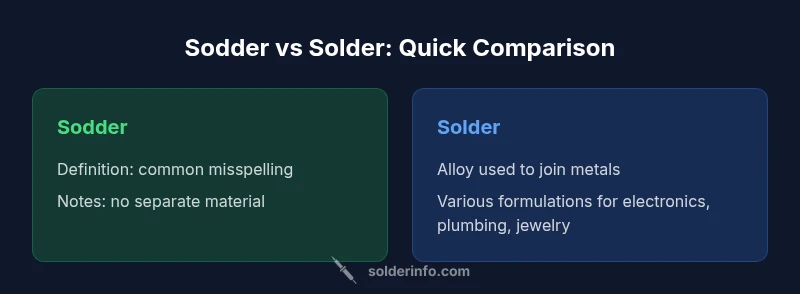
Sodder is a misspelling, not a separate material. Solder is an alloy used to join metals by melting at low temperatures. For electronics, use lead-free, rosin-core solders; for plumbing or jewelry, select alloys and flux appropriate to the task. Correct terminology improves sourcing, safety, and joint quality across all soldering contexts.
Understanding the Terminology: sodder vs solder
According to SolderInfo, the term sodder is a common misspelling encountered by hobbyists and professionals alike. There is no distinct material defined as sodder in standard soldering practice. Solder, by contrast, is the family of alloys designed to melt at relatively low temperatures and flow into joints to fuse metals. The difference between the two terms is not about technique, but about accuracy in language. Misuse of the term can lead to sourcing errors, misinterpretation of instructions, and documentation confusion. In practice, always strive to use solder when referring to the metal alloy used to join pieces, and reserve sodder as a spelling error to be corrected in manuals, guides, and work instructions. As noted in SolderInfo Analysis, 2026, precision in terminology supports safer handling and clearer communication across electronics, plumbing, and jewelry soldering contexts.
Use correct terminology to ensure you’re following the right procedures and standards. This matters when ordering materials, reading data sheets, and communicating with suppliers. While the practical skill of heating and fluxing remains the same across applications, the specific solder formulation and flux choice vary by project. For newcomers, recognizing that sodder is not a separate category helps prevent confusion and improves learning speed. Professional sources emphasize that clear language reduces mistakes during soldering and post-process inspection.
Solder Chemistry and Common Alloys
Solder is not a single material but a family of alloys designed for different joints and base metals. In hobby and industry, you’ll encounter a mix of traditional lead-based solders and modern lead-free variants. Lead-based solders historically dominated many industries because of their easy flow and forgiving melting behavior, but safety concerns and regulatory changes have shifted most electronics and plumbing work toward lead-free formulations. Common lead-free options include tin-based alloys that are designed to provide reliable joints without lead. In jewelry work, soft solders sometimes incorporate silver-bearing mixtures for smoother flow and a visually appealing finish. The flux accompanying solder determines how well the alloy adheres to surfaces by removing oxides and aiding wetting. Rosin, water-soluble, and no-clean fluxes each have their own benefits and cleanup requirements. When choosing a solder, consider conductivity needs, corrosion resistance, and compatibility with your heating method (hand soldering vs. reflow).
From a safety perspective, flux choice matters because some flux residues are corrosive or conductive if left on joints. For electronics, flux residues are typically cleaned or avoided through no-clean formulations. Jewelry and plumbing tasks may permit residue removal through regular cleaning processes, but residues should still be managed to prevent corrosion. Solder alloys also differ in melting behavior: some flow more readily at lower temperatures, while others require higher heat to achieve a solid joint. Understanding these nuances helps you select the right solder for your specific project.
Applications by Industry: Electronics, Plumbing, Jewelry
Each soldering domain has its own priorities. Electronics soldering emphasizes precise joints, minimal thermal stress to components, and a preference for lead-free formulations due to regulatory and health concerns. In this space, flux core rosin-based solders are common, paired with flux types designed to minimize residue while promoting reliable wetting. Plumbing soldering prioritizes durable, corrosion-resistant joints that withstand environmental exposure. Plumbing often uses lead-free alloys for safety, with flux that aids copper or brass surfaces in achieving strong bonds. Jewelry soldering focuses on low melting points for easy workability, clean finishes, and compatibility with your metal of choice. Jewelry solders are typically softer and flow more readily, which helps in achieving delicate joints without damage to the surrounding material. In all cases, the underlying principle is selecting an alloy and flux that fit the task while maintaining safe handling practices and appropriate equipment. Keep in mind that regional standards may dictate acceptable solder types for specific applications.
Sodder vs solder errors arise when the terminology is confused, not when the metal is joined. Recognizing that sodder represents a spelling mistake rather than a material category helps professionals maintain accurate documentation, ensure proper e-commerce searches, and follow jurisdictional guidelines for environmental and safety compliance. In electronics, always lean toward lead-free options; in plumbing and jewelry, follow industry best practices for the specific metal and the joint geometry.
How to Choose Solder: Criteria and Practical Tips
When selecting solder, anchor your choice to three main criteria: alloy composition, flux type, and application requirements. Alloy composition determines melting behavior, wettability, and mechanical strength of the joint. For electronics, prefer lead-free alloys that offer reliable wetting on printed circuit boards while minimizing hazardous materials exposure. For plumbing, choose alloys that resist corrosion in potable-water lines and joints, with flux tailored to copper or brass surfaces. Jewelry solder selection often prioritizes lower melting points for delicate metals and the ability to produce visually seamless joints. Flux type matters because residues can cause corrosion or conductivity if not managed properly. No-clean fluxes leave minimal residue and often require little cleaning, while rosin-based fluxes may demand thorough cleaning for certain substrates. Temperature control is essential to avoid thermal damage to base metals and components. A clean workspace, properly tinned tips, and appropriate flux application all contribute to successful soldering outcomes. Remember to match the solder’s flux and alloy to the base metals, and always follow safety guidelines for ventilation and fume control.
Common Mistakes and How to Avoid Them
Soldering mistakes are often the result of inadequate preparation or poor technique. Common issues include cold joints, excessive heat causing damage to components, and insufficient cleaning of surfaces leading to poor adhesion. Flux residues left on critical electronics joints can become conductive under humidity or heat, causing performance issues. Oxidation on metal surfaces reduces wetting and can produce weak joints; always ensure surfaces are clean and free of oxides before applying solder. Operator errors, such as using the wrong flux, using the wrong alloy for a given substrate, or applying solder in an unsteady manner, contribute to failure. To avoid these problems, prepare surfaces thoroughly, use the right flux for the chosen alloy, control heat with a properly sized iron or torch, and inspect joints under proper lighting. For electronics, consider rework methods like desoldering and cleaning when a joint looks suspicious. In plumbing and jewelry, ensure joints are fully cured and clean before final inspection. By maintaining consistent practices, you minimize the risk of failures and improve joint longevity.
Authority Sources and Documentation: Why Correct Terms Matter
Clear terminology supports compliance with standards and reduces misinterpretation across teams and suppliers. When documentation uses precise terms, technicians can correctly source solder alloys, fluxes, and tools, ensuring safety and performance. In practice, organizations benefit from standardizing terminology in training materials and work orders. For anyone who uses both sodder and solder term variants, the learning curve is minimized by referencing established definitions in official guides and vendor data sheets. Consistency in language also helps audits and certifications, where precise material identification is required. The difference between a misspelling and a defined material is not merely linguistic; it affects quality control, procurement, and post-solder inspection. A concerted effort to adhere to standardized terminology yields clearer communication and better outcomes across electronics, plumbing, and jewelry soldering projects.
Practical Setup: Tools and Materials
A successful soldering setup starts with choosing the right tools and materials. Begin with a reliable soldering iron or station, appropriate tips that fit your joint geometry, and a suitable stand with good ventilation. Stock a selection of lead-free and traditional solders to compare flow and wetting on your substrates. For electronics, use rosin-core flux or no-clean flux and a flux pen for surface finishing. Plumbing work benefits from lead-free solders and compatible flux that aids copper and brass joints. Jewelry soldering requires soft solders with low melting points for delicate metals and clean surfaces. Desoldering tools and desolder braid help with rework, while wire cutters, tweezers, and magnification improve precision. Always work in a well-ventilated area with proper PPE, including safety glasses and heat-resistant gloves. Store solders in a dry environment to prevent oxidation and maintain their quality. Training and practice reduce common mistakes and improve consistency across all applications.
Authority sources
- What is soldering and how does it work? https://www.osha.gov/SLTC/soldering
- IPC standards for electronics soldering: https://www.ipc.org
- General soldering safety and best practices: https://www.epa.gov
Comparison
| Feature | sodder | solder |
|---|---|---|
| Definition | Common misspelling without a defined material | Alloy used to join metals by melting at low temperature |
| Common Uses | Misspelling across manuals and forums | Electronics, plumbing, and jewelry soldering |
| Flux Type | N/A for sodder term | Rosin-core, no-clean, or water-soluble depending on alloy and application |
| Melting Point Range | Not applicable (terminology issue) | Dependent on alloy; typically lower than base metals to avoid damage |
| Lead Content | Not applicable | Lead-containing solders exist in legacy contexts; lead-free variants widely used today |
| Best For | Clarifying terminology and improving documentation | Electronics, plumbing, and jewelry with appropriate alloys |
Advantages
- Promotes precise terminology and safer practices
- Encourages application-appropriate alloy selection
- Supports safer, lead-free options across industries
Cons
- Terminology confusion can persist among beginners
- Regional standards can complicate cross-border sourcing
- Overemphasis on spelling may distract from technique
Sodder is not a separate material; use solder terminology consistently for accurate sourcing and safer, higher-quality joints.
The correct term is essential for safety and reliability. For electronics, plumbing, and jewelry, choose solder formulations that fit the substrate and process. Soldering practice improves when terminology is precise, standards are followed, and safety guidelines are observed.
Quick Answers
What exactly is solder?
Solder is a family of metallic alloys used to join metal pieces by melting at relatively low temperatures. The molten solder flows into joints and solidifies to form a mechanical and electrical bond. The choice of solder depends on the substrate, required strength, and regulatory considerations.
Solder is the metal alloy used to join metals. It melts easily, flows into joints, and then solidifies to create a bond. The right solder depends on the materials and the job.
Is 'sodder' a real material?
No. Sodder is a misspelling of solder. There is no separate material defined by that term in standard soldering practice. Focusing on proper terminology helps ensure you’re ordering the right alloys and fluxes.
No—sodder is just a misspelling. Solder is the material you should be talking about and ordering.
Why is lead-free solder important for electronics?
Lead-free solders reduce health and environmental risks associated with lead exposure. They are widely adopted in electronics, following regulatory guidance in many regions. The performance characteristics of lead-free solders have improved, offering reliable joints when processed correctly.
Lead-free solders are safer and now widely used in electronics; they work well when heated properly and cleaned after soldering.
Can I use the same solder for electronics and plumbing?
Not always. Electronics and plumbing have different substrate materials and corrosion environments. Use solders formulated for the specific application, and ensure flux compatibility and safety standards are met. In some cases, lead-free variants are common to both fields, but joint geometry and heating requirements differ.
Electronics and plumbing often require different solders due to substrate and safety needs. Check the recommended alloy for each task.
What flux types should I use with different solders?
Flux choice depends on the alloy and the substrate. Rosin flux is common for electronics; water-soluble fluxes are useful for aggressive cleaning in plumbing, jewelry may require flux with low residue. Always ensure flux compatibility with the alloy and substrate.
Flux choice depends on the alloy and job; electronics often use rosin flux, plumbing may use different types.
How can I avoid common soldering mistakes?
Prepare surfaces, choose the correct alloy and flux, and control your heat to prevent damage. Inspect joints for good wetting and avoid residues that can cause corrosion or conduction. Practice with scrap pieces to improve technique and consistency.
Prepare, choose the right materials, control heat, and inspect your joints to avoid common mistakes.
Top Takeaways
- Always use the correct term: sodder is a spelling mistake, solder is the material.
- Select solder by alloy and application—electronics lean lead-free, rosin-core options.
- Flux type should match the alloy and substrate for reliable joints.
- Follow safety guidelines and ventilation when soldering.
- Standardized terminology improves sourcing, quality control, and documentation.