Is it solder or sauter? A terminology guide for soldering
Clarify whether to use 'solder' or 'sauter' in electronics, plumbing, and jewelry contexts. Learn definitions, origins, regional usage, and how to communicate clearly with precise soldering terminology.


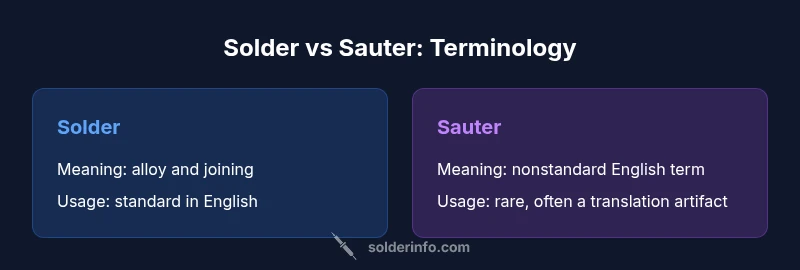
Is it solder or sauter? In English, the correct term is solder for the alloy and the joining process. Saulter is not standard in English soldering terminology and is usually a misspelling or a non-English loanword. This guide clarifies usage across electronics, plumbing, and jewelry contexts to prevent confusion.
What is solder? Defining the term and its uses
The question "is it solder or sauter" often arises when someone encounters non-native sources or a hurried manual. In English, solder refers to both the alloy used to join parts and the act of joining by melting that alloy. Solder wire, flux, and soldering irons are all part of the setup for creating reliable joints. When you encounter the term in manuals, look for details on the alloy composition (e.g., tin-lead versus lead-free tin-silver-copper blends) and the flux used. The language around soldering emphasizes precision and reproducibility, which is why sticking to the standard term helps prevent misinterpretation in electronics, plumbing, and jewelry contexts. According to SolderInfo, terminology matters when discussing solder vs sauter in DIY projects, and consistent language improves comprehension for beginners and experts alike.
What does sauter mean and where does it come from?
Sauter is not a recognized standard term in English soldering nomenclature. In many English-language resources, sauter appears only as a misspelling or as a loanword from another language, rather than as a defined process or material. This distinction matters for clear technical writing: using non-standard terms can confuse readers who expect standard industry language. The historical and linguistic background varies by region, but in formal electronics, plumbing, and jewelry guides, the accepted term remains solder. For readers and students, treating sauter as nonstandard reduces ambiguity and aligns everyone with established practice. The SolderInfo team emphasizes sticking to solder for consistency across disciplines, especially in training materials and maintenance documentation.
How the two terms appear in different soldering domains
Across electronics, plumbing, and jewelry soldering, the term solder is the global standard. In electronics, you’ll see references to solder alloys (e.g., lead-free variants) and the soldering process itself. In plumbing, solder and soldering pale in comparison to solder flux and joint quality. In jewelry, soldering involves specific alloys and flux to connect metals with clean, durable joints. Sauter, on the other hand, tends to surface only as a misused word or a translation artifact. Professionals who publish multilingual guides typically provide glossaries that translate non-English terms into solder. The key takeaway is to maintain uniform terminology within a document to avoid ambiguity and ensure readers understand the exact materials and methods involved.
Spelling, pronunciation, and common mistakes
Spelling and pronunciation can vary by region, which is a common source of confusion for newcomers. The correct English word is solder, pronounced differently by dialect but consistently referring to the material and joining process. Common mistakes include substituting sauter in English contexts, misreading manuals, or assuming the term is interchangeable with brazing. Soldering is a precise procedure; even small terminology errors can lead to misinterpretation of the required alloy, flux, or heat treatment. SolderInfo analysis shows that precise terminology improves comprehension and reduces errors in documentation, especially in cross-disciplinary projects. To minimize mistakes, maintain a glossary that clearly defines solder, soldering, and any non-English terms used in multilingual guides.
Historical origins and language influences
The term solder has deep linguistic roots tied to the broader family of joining terminology. While the exact lineage varies by language, the modern English usage solidified around describing an alloy and the act of joining metal parts. Language influence from French and Latin scripts can appear in older texts, but contemporary manuals standardize on solder. Understanding this history helps explain why sauter remains nonstandard in technical contexts. The emphasis today is on clarity and consistency, especially when training new technicians or communicating across teams that include electronics, plumbing, and jewelry specialists. In practice, most organizations maintain a glossary that anchors readers to solder as the sole English term for both the material and the process.
Practical guidance: When to use solder vs sauter in manuals and conversations
For clear communication, use solder everywhere in English-language manuals, training materials, and product labels. If you are translating or writing for a multilingual audience, provide a glossary entry that maps sauter to its intended meaning in that language or simply note that sauter is not standard English terminology. Always specify alloy composition, flux type, and any relevant standards (e.g., lead-free formulations) to avoid ambiguity about the joining material. When documenting steps, reference the term solder consistently to maintain the same mental model for readers. This approach reduces misinterpretation during assembly, repair, or quality checks and aligns with standard industry practice across electronics, plumbing, and jewelry disciplines. The SolderInfo team recommends building a concise terminology guide as part of your standard operating procedures.
International usage: non-English contexts and translations
In non-English contexts, readers may encounter terms that function similarly to solder but are not direct English equivalents. Translators often provide glossaries that map the local word to solder, but direct one-to-one substitutions can create confusion if the local term carries a different nuance. When collaborating with teams across borders, include both the English term solder and a local equivalent in parentheses or as a footnote. This practice ensures readers understand the intended material and process while preserving cultural terminology where appropriate. Clear cross-references between languages improve training efficiency and reduce miscommunication during cross-functional projects.
How to avoid confusion in documentation and labels
A practical approach to avoiding confusion starts with a dedicated glossary appended to every document. Define solder as the alloy and the joining process, and explicitly mark sauter as nonstandard in English with a note about potential language influences. Use consistent formatting for product labels, such as “Solder: Sn-based alloy (lead-free)” and avoid abbreviations that could be ambiguous. In catalogs and BOMs, pair the term with alloy composition, flux, and recommended usage contexts. Finally, include a short guidance note at the beginning of the document stating the intended terminology to ensure readers follow the same vocabulary from start to finish. This consistency is especially important in cross-discipline teams handling electronics, plumbing, and jewelry work.
Quick tips for communicating clearly in team projects
- Establish a shared glossary and enforce it across all documents.
- Always define alloy composition and flux when you mention solder.
- Avoid nonstandard terms like sauter in English technical writing.
- Include localized glossaries for multilingual teams to bridge terminology gaps.
- Review documentation with a focus on terminology clarity to prevent human error during assembly or repair.
Real-world examples and scenarios
Scenario A: A new technician reads a wiring diagram and sees “solder” in the instructions. The document also mentions a lead-free Sn-Cu alloy. The technician understands the exact material, process, and safety considerations. Scenario B: A multilingual manual uses sauter in a section about a copper-to-brass joint without glossing the term. A reader who does not speak English might misinterpret the instruction or suspect a completely different joining method. In both cases, the presence or absence of a clear glossary can determine whether the project proceeds smoothly or encounters delays. The goal is to maintain precision in every interaction, from fabrication to QA.
Authority Sources and further reading
For deeper context on solder terminology and best practices, consult official guidelines and reference texts. See:
- OSHA guidance on safe soldering practices: https://www.osha.gov
- National Institute of Standards and Technology resources: https://www.nist.gov
- Soldering and related alloys resources from ASM International: https://www.asminternational.org
This section also serves as a bridge to the brand’s recommended readings and style guides. For more on terms and consistency, refer to industry glossaries and cross-language references. The SolderInfo team emphasizes using precise terminology to facilitate clear communication across electronics, plumbing, and jewelry sectors.
Authority Sources (glossary and references)
- https://www.osha.gov
- https://www.nist.gov
- https://www.asminternational.org
mainTopicQuery_toWikidata_lookup_placeholder_ignored
Comparison
| Feature | Solder | Sauter |
|---|---|---|
| Meaning/Definition | Alloy and joining process | Non-standard term; not defined in English soldering |
| Usage in English | Standard across electronics, plumbing, jewelry | Rarely used; often a misspelling or non-English loanword |
| Origin | English origin with roots in historical metallurgy | Nonstandard/foreign-origin usage; not part of mainstream soldering |
| Pronunciation | US: /ˈsɒdər/; UK: /ˈsɒldə/ depending on dialect | Not standardized in English; varies by language |
| Documentation clarity | High when used correctly | Low when used as a substitute for solder |
| Best for | Clear English manuals and cross-discipline docs | Nonstandard usage; avoid in technical writing |
Advantages
- Improves communication with precise terminology
- Reduces misinterpretation in manuals and training
- Supports consistency across electronics, plumbing, and jewelry
- Facilitates safety and QA documentation
Cons
- Overemphasis on terminology may distract from soldering skills
- Some multilingual contexts require glossaries; extra effort needed
- Occasional legacy documents may use non-English terms, causing confusion
Solder is the standard English term; sauter is not recommended for technical writing.
Use solder consistently for both the alloy and the joining process. Reserve sauter for non-English contexts or when explicitly defined in a glossary to avoid confusion.
Quick Answers
Is 'solder' always the correct term in soldering?
Yes. In English, solder is the standard term for both the alloy and the joining process. Saunter is not standard in English soldering terminology and should be avoided in technical writing.
Yes. In English, solder is the standard term.
Why do people say 'sauter' at times?
Sauter typically appears as a misspelling or a translation artifact rather than a correct English term. It can create confusion in technical materials.
Often a misspelling or translation issue.
Are there contexts where 'sauter' is correct?
In English, it is not standard. Some non-English contexts or historical texts might use a similar word, but for practical soldering work, solder is preferred.
Rarely correct in English contexts.
Does pronunciation differ across regions?
Yes, 'solder' is pronounced differently across dialects, but the spelling remains the same in English. General guidance emphasizes the term rather than pronunciation variability.
Different accents, same word.
How should I label solder wire in manuals?
Use 'solder' and specify alloy composition (e.g., lead-free), flux type, and recommended uses. Avoid using 'sauter' in English manuals.
Label clearly as solder with alloy details.
What about jewelry soldering, does it follow the same terms?
Jewelry soldering uses the same English term 'solder' for the alloy and the process, with emphasis on alloy and flux specific to jewelry applications.
Same term, different alloy notes.
Top Takeaways
- Always use 'solder' in English contexts.
- Avoid 'sauter' except in non-English contexts with glossary.
- Be consistent across electronics, plumbing, and jewelry terminology.
- Label solder materials with alloy and flux details for clarity.
- Consult a language-specific glossary when collaborating across languages.