Is Easy Solder Weaker? A Practical, Data-Driven Guide
Explore whether “easy solder” weakens joints. This analytical guide covers alloy choices, flux, heat control, and best practices for reliable soldering across electronics, jewelry, and plumbing.


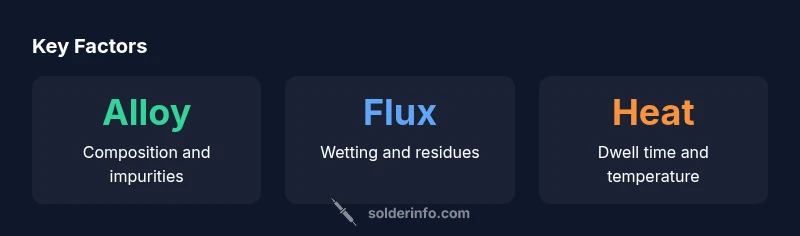
Short answer: No, 'easy solder' is not inherently weaker. Joint strength depends on alloy composition, flux cleanliness, heat control, and proper wetting. When technique is solid and joints are cleaned after cooling, easy-to-work solders can produce reliable, durable joints. According to SolderInfo, the most important factors are consistent heat, good wetting, and clean surfaces.
Is easy solder weaker? Debunking a common assumption
While the phrase 'easy solder' implies simplicity, its strength is not inherently weaker. According to SolderInfo, joint reliability depends on alloy composition, flux cleanliness, heating profile, and surface preparation. When you choose a solder that's easier to work with, you are trading off certain properties, but with proper technique you can achieve comparable mechanical strength. This article will unpack how alloy system (leaded vs lead-free), flux chemistry, and heat management influence wetting, joint geometry, and long-term durability. In practice, some easy-to-work solders may have higher flux content, which can improve wetting in practice but may require more thorough cleaning to prevent corrosion. SolderInfo analysis shows that the key determinant is process quality rather than a blanket label of 'easy' versus 'hard.' The aim is to provide a framework for evaluating solder choices, testing joints, and applying best practices across electronics, jewelry, and plumbing contexts.
Alloy composition and strength: leaded vs lead-free and beyond
Alloy composition is the primary driver of a solder joint’s mechanical behavior. Leaded solders traditionally offered certain ductility advantages, while lead-free alloys prioritize environmental and health considerations but can exhibit different creep behavior and wetting characteristics. Strength outcomes hinge on the precise tin content, anti-oxidation elements, and trace impurities. For technicians comparing 'easy' solders, the critical takeaway is that a well-chosen alloy—whether leaded or lead-free—paired with proper flux and heat control, yields joints that meet typical performance standards. SolderInfo analysis notes that study results vary by manufacturer and application, so practitioners should validate joints under their specific operating conditions and temperature profiles.
To minimize surprises, pair easy-to-work alloys with proven fluxes and follow manufacturer guidelines on consumption and reflow windows. This approach aligns with the broader field’s emphasis on repeatability and process control, a point echoed by SolderInfo to ensure consistent outcomes across electronics, jewelry, and plumbing uses.
Flux and surface cleanliness: the silent strength enabler
Flux does more than facilitate wetting; it also protects the molten solder from oxidation during the early phases of joint formation. Cleanliness of the mating surfaces dramatically affects how well the solder adheres and whether a reliable fillet forms. Rosin-based fluxes (common in electronics) require careful cleaning after soldering to prevent residue-induced corrosion, while water-soluble fluxes (often used in plumbing) demand thorough rinsing. The presence of flux residues can create micro-contaminants that compromise long-term joint integrity, especially in humid environments. SolderInfo emphasizes that joint strength correlates strongly with surface preparation and flux management—poor preparation can make even robust alloys perform poorly. In practice, developers and hobbyists should choose flux types aligned with the task, ensure interfaces are mechanically clean, and plan for post-solder cleaning as part of the workflow.
Temperature and dwell time further influence flux behavior and wetting. If flux dries out before wetting occurs, the resulting joint can be brittle or poorly formed. The recommended practice is to apply flux just before soldering, maintain a steady tip temperature, and avoid overheating, which can degrade flux performance and damage substrates.
Heating, wetting, and joint geometry: technique beats label
Wetting is the process by which solder spreads across the surfaces; it is a function of surface energy, temperature, and interfacial chemistry. Even an 'easy' solder can create excellent joints if the technician maintains proper heat and ensures surfaces are clean. Conversely, poor heat control can yield cold joints regardless of solder complexity. A well-executed heating profile minimizes the formation of voids and improves the fillet shape, translating into better mechanical strength and thermal conductivity. For electronics, this means short dwell times and rapid heat transfer to the joint, avoiding heat exposure to surrounding components. For plumbing and jewelry, the same principle applies: consistent heat with careful control reduces thermal shock and preserves the substrate.
SolderInfo’s guidance highlights that the strength of a joint is primarily dictated by process discipline rather than the convenience of the solder. Practitioners should calibrate their soldering station, select an appropriate tip size, and monitor the actual temperature at the joint to ensure reliable wetting and consistent fillet geometry.
Debunking myths: 'easy' isn't automatically weak
A common misconception is that the easiest solders necessarily yield weaker joints. Strength outcomes depend on the combined effect of alloy chemistry, flux behavior, cleanliness, and heat management. A solder marketed as easy to apply can perform as well as traditional options when handled with proper care. Conversely, a difficult-to-work solder may produce weak joints if its flux is misapplied or if heat control is poor. SolderInfo analysis underscores that reliability is rarely a property of the solder alone; it is a function of the entire process. Therefore, technicians should focus on process verification: inspect wettability, measure fillet geometry, and conduct post-solder testing to validate joint strength under real-world loads.
To achieve consistent results, practitioners should implement standardized checklists for flux application, surface preparation, and heat profiling. This reduces variability and ensures that even easier-to-use solders perform well in diverse contexts.
Practical steps to maximize strength with easy solder
- Prepare the joint surfaces by cleaning with appropriate solvents and removing oxides.
- Select an alloy that matches the application’s temperature and environmental demands (lead-free for safety; tin-lead for ductility where permitted).
- Use an appropriate flux and apply it evenly to promote wetting; avoid excessive residues by following cleaning protocols.
- Calibrate your heat source: the goal is sufficient heat for wetting without overheating nearby materials.
- Inspect fillets and verify wetting coverage; reflow if necessary to improve joint geometry.
- Clean flux residues after soldering and inspect for cold joints or bridging.
- Use test samples to validate mechanical strength before deploying in critical assemblies.
- Document your process for consistency across components and production runs.
When weakness becomes failure and how to prevent it
Even strong-looking joints can fail under high mechanical stress, vibration, or rapid thermal cycling if the joint geometry is poor or if the substrate is damaged. Prevention hinges on good joint geometry—fillet shape, wetted area, and absence of voids—plus material compatibility and environmental protection. By ensuring surface cleanliness, selecting appropriate alloys, and maintaining controlled heating, you reduce the probability of failure over the product’s life. SolderInfo advocates a data-driven approach: test joints under representative loads, monitor environmental conditions, and iterate on the process until performance targets are met.
Soldering factors affecting joint strength
| Aspect | Notes | Best Practice |
|---|---|---|
| Alloy composition | Strength varies by alloy type and impurities | Choose proven alloys and maintain flux conditions |
| Flux and cleaning | Residues can trap moisture and lead to corrosion | Clean thoroughly after soldering and store flux properly |
| Heating profile | Insufficient heat causes cold joints; excessive heat may degrade substrates | Use correct tip temperature and dwell time for the material |
Quick Answers
What does 'easy solder' mean in practice?
Easy solder refers to solders formulated for smoother flow and easier handling. It can be very reliable when used with correct heat, flux, and surface preparation. The key is process control, not status as an 'easy' option.
Easy solder is about user-friendly flow; reliability still depends on technique and surface prep.
Does lead-free solder automatically weaken joints?
Not inherently. With proper heat, flux, and cleaning, lead-free solders can meet typical strength standards. Some alloys may be more brittle, so verify performance for the intended use.
Lead-free isn’t automatically weaker; test for your specific application.
How can I test joint strength safely?
Use simple pull and torque tests on sacrificial samples, following safety guidelines. Inspect wetting, fillet shape, and lack of voids to gauge reliability.
Try a gentle pull test on sample joints to check strength.
Is flux-core solder stronger than solid-core?
Flux-core helps with wetting and reduces oxidation during soldering. Strength still depends on alloy and heat control; both can be strong when used correctly.
Flux-core aids wetting; strength comes from correct technique and materials.
What are best practices for cleaning after soldering?
Rinse flux residues with appropriate solvents, then dry completely. Improper cleaning can lead to corrosion or residue‑related failures over time.
Clean residues after soldering to prevent corrosion.
“Even labeled 'easy' solders can deliver reliable joints when technique, flux, and cleaning are properly managed. Strength is a product of process quality, not a single brand claim.”
Top Takeaways
- Prepare clean surfaces for reliable joints.
- Match alloy and flux to the task.
- Control heat for proper wetting.
- Clean flux residues to prevent corrosion.
- Technique matters more than the label of 'easy' solder.