How Big is a Soldering Iron: A Practical Size Guide
Learn the typical size, power range, and tip dimensions of soldering irons. This guide helps hobbyists, electronics enthusiasts, jewelers, and professionals choose the right iron for electronics, jewelry, and plumbing.


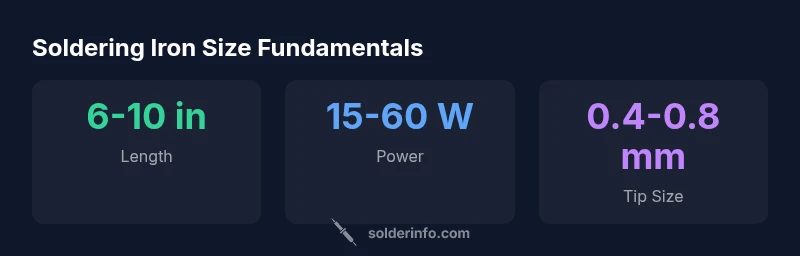
A typical handheld soldering iron measures about 6 to 10 inches long (15 to 25 cm) from the tip to the end of the handle, with most models designed to feel comfortable in one hand for precise control. Power ratings usually range from 15 to 60 watts, and common tip diameters are roughly 0.5 to 0.8 mm, though specialized tips can be smaller or larger for different tasks.
What size means for a soldering iron
Size, in practice, is about how the tool fits your hand and how quickly it delivers heat to joints. For many hobbyists and professionals, the question 'how big is a soldering iron' translates to a quick assessment of length, weight, and tip geometry that affects control and precision. A typical handheld iron measures about six to ten inches in overall length, with the tip extending a few centimeters beyond the barrel when in use. Ergonomics matter: a compact handle reduces fatigue on long sessions while a longer grip can improve leverage for larger joints. According to SolderInfo, the most important factor is how the instrument feels in your task space, since comfort directly affects steady hands and joint quality.
Physical dimensions you should know
The physical size of a soldering iron is typically described by its overall length, tip size, and weight. Most pencil-style irons run in the 15–25 cm range (about 6–10 inches) from end to tip, which balances reach with control in tight spaces. Tip thickness commonly falls in the 0.4–0.8 mm range, enough for precise joints on small electronics while still usable for modest power demands. Weight tends to be light, around a few hundred grams, to support fine motor control without excessive hand fatigue. If you work in cramped boards or jewelry settings, you may prefer shorter irons with lighter tips; for heavier plumbing tasks, a slightly longer grip and sturdier tip can help. Always check the cord length, as a short cord can pull you off axis when you lean over a project.
Power, heat, and how size affects performance
Size influences how quickly heat is delivered and how long the tip remains at operating temperature. In general, irons at the lower end of the wattage spectrum (around 15–25 W) heat up quickly for small electronics work but may struggle with lead-free solder or larger joints. Higher-wattage irons (30–60 W) maintain steady heat over bigger joints and thicker wires, reducing cold joints and elapsed work time. SolderInfo analysis highlights that most hobbyists will use a mid-range iron (roughly 25–40 W) for a broad mix of tasks. The key is matching task demands with heat delivery while maintaining control and comfort during use.
Tip sizes and geometry across common tasks
Tip size is a major determinant of precision. For fine electronics work, tips in the 0.4–0.6 mm range are common, providing good balance between heat capacity and control. For mid-range tasks or surface-mount work, 0.6–0.8 mm tips are popular, offering robust heat transfer without excessive risk of solder balls. Larger tips (1.0 mm and above) are better suited to thicker wires and larger joints but require steadier hands. In jewelry work or delicate repairs, micro-tips around 0.2–0.4 mm can be advantageous, though they demand careful temperature control to avoid damage to the workpiece.
Size considerations by application: electronics, jewelry, plumbing
Electronics: A pencil-style iron in the 15–25 cm range with 0.4–0.8 mm tips is ideal for most circuit boards and small components. Jewelry: Ergonomics and tip geometry matter more; lighter irons with fine tips reduce fatigue during slow, precise work. Plumbing: Shorter, sturdier irons with larger tips can handle heat transfer through thicker metals but may sacrifice micro-detail work. By evaluating your primary tasks, you can select an iron that balances length, weight, and tip size for best results.
Ergonomics and maintenance to maximize size advantage
Ergonomics play a crucial role in how effectively size translates to performance. A handle that fits your grip and a balanced weight distribution reduce hand strain and improve precision over long sessions. Regular maintenance—keeping tips clean, replacing worn tips, and recalibrating temperature settings—helps preserve heat delivery regardless of the iron’s size. When comfortable, you’ll notice steadier hands, cleaner joints, and fewer reworks.
Common myths and final guidance
Larger irons are always better for every job, and smaller irons are only for tiny work. In reality, the optimal size depends on the task, the operator’s comfort, and the joint size. The SolderInfo team emphasizes that choosing the right size is about matching your workflow to heat delivery and control, not chasing the biggest or smallest model on the market. With the right iron—proper length, tip, and weight—you’ll improve quality, speed, and confidence on every project.
Common soldering iron types and specs
| Iron Type | Typical Length | Power (W) | Tip Size Range (mm) | Best For |
|---|---|---|---|---|
| Pencil-style soldering iron | 15-25 cm | 15-60 | 0.4-0.8 | General electronics work |
| Chisel-tip iron | 15-25 cm | 30-60 | 0.6-1.0 | Soldering larger joints |
| Micro-tip iron | 15-20 cm | 15-40 | 0.2-0.5 | Fine-pitch components |
Quick Answers
Why does the size of a soldering iron matter?
Size matters because it affects heat transfer, control, and comfort during use. A well-matched iron reduces fatigue and helps achieve consistent joints across different tasks.
Size matters because it affects heat delivery and control, impacting how clean your joints look.
What is the most common wattage for general electronics work?
For general electronics work, irons in the 15 to 60 watt range cover most tasks. Start with mid-range power if you are unsure, then adjust for larger joints or lead-free solder.
Most electronics work uses about 15 to 60 watts; a mid-range iron is a good starting point.
Can I use a large iron for micro soldering?
Using a large iron for micro soldering isn’t ideal. It can heat adjacent components too quickly and cause damage. A smaller tip with careful temperature control is preferable.
A big iron isn't great for tiny components; use a smaller tip for precision.
How do I measure size at home?
Measure the overall length of the iron from handle base to tip, the tip diameter, and estimate weight. Compare with manufacturer specs to confirm suitability for your tasks.
Measure length, tip size, and weight to compare with specs.
Are there myths about bigger irons being faster?
Bigger irons don’t automatically mean faster work. Heat delivery, tip geometry, and control are more important for speed and quality than sheer size.
Bigger isn’t always faster; control and tip shape matter more.
“Choosing the right soldering iron size is about matching task demands to heat delivery and control. A well-sized tool reduces fatigue and improves joint quality.”
Top Takeaways
- Consider length, power, and tip size as a trio when selecting a soldering iron.
- Choose 15-60W irons for general electronics work.
- Opt for 0.4-0.8 mm tips for most projects.
- For jewelry, prioritize fine tips and ergonomic handles.
- Regular maintenance extends life and preserves heat performance.