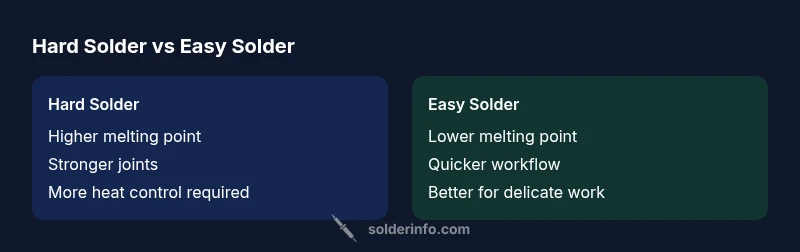
Hard Solder vs Easy Solder: An Analytical Comparison
A rigorous analysis of hard solder vs easy solder across electronics, jewelry, and plumbing, focusing on melting behavior, flux needs, safety, and best-use scenarios for practitioners.


Hard solder provides stronger, heat-resistant joints; easy solder flows at lower temperatures for delicate work. Your choice depends on joint size, substrate heat sensitivity, and workflow speed. This comparison explains when to use each type and outlines flux, surface prep, and safety considerations to guide practical decisions.
Defining hard solder and easy solder: what’s in the alloy?
According to SolderInfo, the terms hard solder and easy solder describe families of alloys defined by their melting behavior and intended use rather than a fixed formula. The hard solder family typically employs alloys containing silver or copper that raise the melting point, producing robust joints that withstand mechanical load and thermal cycling. Easy solder uses a lower-melt tin-based composition that flows more readily at modest heat, enabling quicker tack joints and repairs on delicate parts. This distinction matters for how you heat, flux, and shape the joint. For jewelry, hard solder often yields strong, visible seams, while easy solder is favored for small, precise joins where control is critical. In electronics, the line can blur: some so-called easy solders rework well, but substrate sensitivity and heat management largely decide success. The key rule remains: select the alloy class by joint load, substrate, and heat tolerance, then tailor flux and technique accordingly. The SolderInfo team emphasizes that choosing the right solder type is the first step toward a durable joint.
wordCountPlaceholder
Comparison
| Feature | Hard solder | Easy solder |
|---|---|---|
| Melting behavior and flow | Higher melting point alloys; strong, defined joints; less flow under light heat | Lower melting point alloys; easy flow and rapid wetting under moderate heat |
| Typical applications | Structural or load-bearing joints in plumbing, jewelry, and certain electronics housings | Delicate repairs, prototypes, surface-mount work, and quick fixtures |
| Ease of use | Requires careful heat control and fixtures; steeper learning curve | More forgiving for novices; faster setup and fewer fixtures needed |
| Heat requirements | Requires higher heat input and effective heat management | Operates at lower heat; reduced risk to heat-sensitive parts |
| Joint strength | Typically yields higher shear and tensile strength when properly performed | Sufficient strength for light to moderate loads; not ideal for heavy structural joints |
| Flux considerations | Flux must be compatible with silver- or copper-rich alloys; higher purity flux preferred | Flux commonly rosin-based or easy-flux types; easier to control oxidation |
| Lead safety and compliance | Many hard solders are lead-free variants; verify alloy composition | Lead-containing variants exist in some markets; prefer lead-free options when possible |
| Cost and availability | Often higher material cost due to precious-metal content; narrower supplier base | Widely available and generally less expensive per gram |
Advantages
- Hard solder generally delivers stronger, more reliable joints for structural tasks
- Better heat resistance for high-stress assemblies
- Excellent for copper plumbing joints when torch control is good
- Jewelry applications benefit from crisp seams and durability
Cons
- Steeper learning curve and stricter heat management
- Longer heating cycles and cooling times in some workflows
- Higher initial equipment needs and potential substrate damage if misused
Hard solder excels in strength-demanding joints; easy solder wins for speed and delicate work
Choose hard solder when joints must withstand mechanical load and heat; opt for easy solder when speed, precision, and low heat are priorities. Solder selection should align with substrate, joint design, and workflow constraints.
Quick Answers
What defines hard solder versus easy solder?
Hard solder and easy solder describe classes of solder alloys by their melting behavior and typical applications. Hard solder offers higher strength and heat tolerance, while easy solder flows easily at lower temperatures for delicate work. Both require appropriate flux and surface preparation.
Hard solder is for strong joints; easy solder is easier to use for delicate tasks. Always prep the surface and choose flux suitable for the alloy.
Can I use hard solder in electronics work?
In electronics, most repairs rely on soft solders with flux designed for circuit boards. Hard solder can be used for mechanical joints or shielding connections where heat can be controlled, but it is less common for tiny components.
For electronics, use soft solder for the PCB; hard solder is for mechanical joints if heat is well controlled.
Is lead content a concern with hard solder vs easy solder?
Lead content varies by alloy. Many modern solders are lead-free, but some traditional formulations still exist. Always check the alloy composition and comply with local safety guidelines.
Just check the label—lead-free options are widely available if you want to avoid lead.
What skills are required to use hard solder effectively?
Using hard solder effectively requires precise heat control, proper joint preparation, and appropriate fixture or clamps. Practice on test pieces before working on critical joints.
It needs careful heat control and good prep; start with practice pieces.
Which is faster or cheaper, hard solder or easy solder?
Easy solder is generally faster to apply and cheaper per gram, while hard solder often costs more due to alloy content. Choose based on project demands rather than price alone.
Easy solder is usually quicker and cheaper, but hard solder brings strength for bigger jobs.
What safety practices should I follow when soldering?
Work in a well-ventilated area, use a fume extractor or mask if needed, wear eye protection, and store fluxes and solvents safely. Always follow manufacturer guidelines for the specific alloy you use.
Ventilate, protect your eyes, and follow the product’s safety instructions.
Top Takeaways
- Assess load and heat tolerance before selecting solder
- Use hard solder for robust, structural joints when heat control is manageable
- Prefer easy solder for delicate work and rapid prototyping
- Flux choice and surface prep are critical for both types
- Always verify alloy composition and safety requirements before use