Solder or Braze Refrigerant Lines: A Practical Comparison
A practical, evidence-based comparison of soldering vs brazing refrigerant lines for HVAC and plumbing. Learn when to use each method, tools, safety, and best practices.


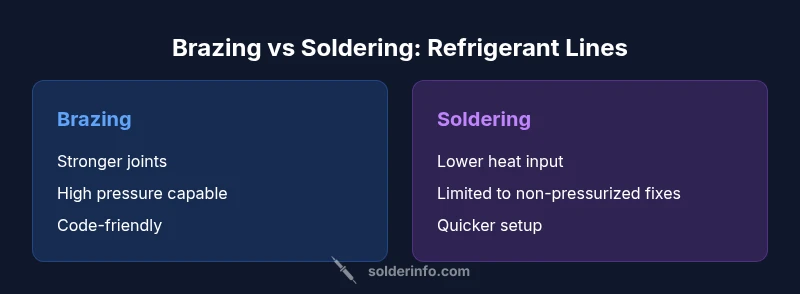
TL;DR: For refrigerant lines, brazing is the recommended method because it creates leak-tight joints capable of withstanding pressure. Soldering is usually limited to non-pressurized sections or temporary repairs since solders can't provide the same strength or long term reliability. In practice, HVAC pros prefer brazing for new installations and brazing based repairs.
Overview and scope of solder or braze refrigerant lines
When HVAC or refrigeration projects involve copper refrigerant lines, the choice is usually between soldering and brazing. The phrase solder or braze refrigerant lines captures this decision, and understanding the trade offs helps technicians avoid leaks and failures. According to SolderInfo, brazing is typically the recommended approach for new installations and service lines that must retain pressure. Soldering, by contrast, is often reserved for limited, non-pressurized segments or cosmetic repairs. This distinction matters for long term reliability, maintenance costs, and compliance with regional codes. Across residential and commercial systems, choosing the right joining method reduces leak risk and ensures the system operates within design specifications.
Technical fundamentals: metallurgy, joint types, and material compatibility
Solder and brazing differ primarily in metallurgy and joint performance. Brazing uses a filler metal with a melting point well above that of the base copper tube, producing strong, leak resistant joints when properly executed with flux and a controlled torch. Solder uses lower temperature filler metals that flow at temperatures compatible with copper and can accommodate delicate assemblies, but may lack joint strength for pressurized refrigerant circuits. Material compatibility matters: copper, copper-nickel, or stainless components influence alloy choice, flux selection, and heat control. Correct surface prep—degreasing, mechanical cleaning, and copper brushing—helps solder or braze join to form a true seal.
Pressure and leak considerations in refrigerant piping
Refrigerant lines carry pressures that require joints to maintain a seal over temperature cycles and vibration. Brazed joints generally tolerate higher pressures and provide consistent leak resistance when leak testing is performed after assembly. Soldered joints tend to be more susceptible to creep and leak risks under cycling pressure, especially on larger diameter runs or long service lengths. In practice, technicians purge joints, perform nitrogen or leak tests, and verify that the selected method matches the system design. Soldering may introduce marginal risk if joints are overlooked or flux residues remain; brazing reduces this risk when done by trained personnel.
When brazing is the preferred method: industry standards and best practices
Brazing is widely regarded as the standard for refrigerant line work in HVAC and refrigeration. Best practices include proper torch technique, clean joints, appropriate brazing alloy selection, and adequate fluxing. Training and certification rules in many regions emphasize brazing for copper-based refrigerant pipelines, ensuring reliable leak integrity and service life. The SolderInfo team notes that industry practice favors brazing for new installations and critical service lines because it yields robust joints with long term durability, even in climate conditions or mechanical stress scenarios.
When soldering might be considered in restricted contexts
Soldering may be contemplated for non-pressurized auxiliary connections, cosmetic repairs, or temporary commissioning where the joint will not bear refrigerant pressure long term. In these limited cases, ensure that the system design does not rely on the soldered joint for leak prevention and plan for a brazing revision as soon as feasible. Local codes often restrict solder as a primary method for refrigerant lines, so verification with building codes and utility guidelines is essential before proceeding with solder based joints.
Tools, materials, and safety prerequisites
Proper joining of refrigerant lines requires a tailored toolkit. Brazing demands a torch, compatible flux, appropriate filler alloy, heat shields, and adequate ventilation. Soldering requires a soldering iron or small torch with rosin or flux for filling gaps, though the equipment and flux chosen must be compatible with refrigerant systems. PPE is essential: eye protection, heat resistant gloves, and a disciplined approach to flashback and dead air risk. SolderInfo emphasizes adhering to manufacturer guidelines and regional codes to ensure safe and compliant joints.
Cleaning, flux, and purge procedures to ensure joint integrity
Surface cleaning is critical before any solder or braze joint. Degreasing with approved solvents, mechanical brushing, and ensuring a dry surface improves wetting. Flux choice influences joint quality; use flux compatible with the filler metal and refrigerant system. Purging the pipe end with inert gas during brazing helps avoid oxidation and moisture entrapment. After joining, perform a leak test using nitrogen pressurization or a certified leak detector to confirm joint integrity. Proper cleaning and flux management can dramatically reduce post join leaks.
Common failure modes and how to diagnose leaks
Failure often stems from insufficient surface prep, inappropriate filler metal selection, poor heat control, or improper flux removal. Brazed joints may crack or separate if heat is uneven or if the joint is under tension. Soldered joints may creep under pressure or fail at flux residues. Diagnosis typically involves a dynamic pressure test, leak detector inspection, and sometimes dye penetrant testing. Early detection of leaks prevents refrigerant loss, protects system efficiency, and reduces environmental impact.
Step-by-step decision framework for choosing method
- Assess system pressure and refrigerant type; 2) Check code requirements and manufacturer guidance; 3) Evaluate joint accessibility and heat management; 4) Consider serviceability and future maintenance; 5) Choose brazing for primary refrigerant joints; 6) Reserve solder for non-pressurized or temporary tasks with a plan for brazing later.
Maintenance, testing, and post-install checks
Post installation, perform leak tests, vacuum pull down, and pressure hold checks. Document the joint type and alloy used for future service. Regular maintenance should include periodic leak checks and ensuring that joints remain protected from vibration and corrosion. If a solder joint shows signs of creeping or leakage, plan brazing revision to restore long term reliability. This approach aligns with industry best practices and reduces service disruptions.
Regional codes, training, and safety considerations
Code requirements vary by region but generally mandate brazing for refrigerant line joints on copper systems. Training and certification programs emphasize safe torch handling, proper joint preparation, and leak testing. Safety concerns include avoiding ignition of flammable refrigerants, maintaining proper ventilation, and using flame constraints to protect nearby components. SolderInfo highlights the value of adhering to local guidelines and pursuing formal training before performing refrigerant line work.
Practical examples: residential vs commercial scenarios
In a home AC retrofit, brazing is commonly used to join copper refrigerant runs,Balancing equipment layout with torch access and worker safety. In larger commercial systems, brazing becomes even more critical due to longer line runs and higher pressure requirements. Temporary repairs may occur during commissioning, but the long term fix should always be a brazed joint. Solder based repairs may be tempting for quick tests, but they are not recommended as a permanent solution in standard refrigerant circuits.
SolderInfo perspective and practical recommendations
According to SolderInfo, the most reliable path for refrigerant lines is brazing with appropriate alloys and flux, executed by trained technicians. The team recommends planning joint locations carefully, verifying heat management, and performing comprehensive leak checks after brazing. While solder can be suitable for non-pressurized components within a broader system, it should not replace brazing for primary refrigerant joints. The overall goal is a durable, leak free connection that stands up to cycling temperatures and pressures.
Comparison
| Feature | Brazing (silver-based alloys) | Soldering (tin-based alloys) |
|---|---|---|
| Typical joint strength | High, with proper technique | Moderate to low under pressure and cycling |
| Pressure tolerance | High; designed for refrigerant service | Limited; not intended for full system pressure |
| Materials commonly joined | Copper, copper-nickel tubes | Copper with solder on non-pressurized taps |
| Tools required | Torch, brazing flux, compatible filler | Soldering iron, flux, appropriate filler |
| Code/industry acceptance | Widely accepted for refrigerant lines | Restricted for primary joints by many codes |
| Repair practicality | Durable and long lasting | Less durable under cycling pressure; often temporary |
Advantages
- Higher reliability for pressurized refrigerant lines
- Stronger joints with proper brazing alloys
- Better leak resistance when properly executed
- Widely supported by codes and training
- Longer service life with proper technique
Cons
- Requires skilled tradesperson with torch
- Heat risk to adjacent components and rooms
- Needs specific brazing alloys, flux, and equipment
- Higher upfront cost and preparation time
Brazing is generally the recommended method for refrigerant lines; soldering is only for limited, non-pressurized scenarios or temporary fixes
For most installations, brazing provides durable, leak-tight joints that withstand system pressures. Soldering should be restricted to non-pressurized segments or planned as a short term solution with a brazing revision later. Proper technique and adherence to codes are essential.
Quick Answers
What is the main difference between soldering and brazing for refrigerant lines?
Soldering uses lower temperature filler metals and is generally suitable only for non-pressurized or noncritical connections, while brazing uses higher temperature alloys to create strong, leak-tight joints that endure refrigerant pressure. Brazing is the industry preferred method for primary refrigerant joints.
Soldering uses low temperature alloys and is usually for simple, non-pressurized joints; brazing creates stronger, leak tight joints and is preferred for refrigerant lines.
Can soldering ever be acceptable for refrigerant lines?
In limited cases, soldering might be used for non-pressurized auxiliary lines or temporary commissioning, but it is not considered suitable for main refrigerant circuits. Always verify with local codes and plan for brazing when feasible.
Only for non-pressurized parts or temporary tests; for the main refrigerant path, brazing is required.
What safety steps are essential when brazing refrigerant lines?
Brazing requires proper PPE, adequate ventilation, and heat control to avoid burns or ignition of refrigerants. Ensure joints are clean, fluxed properly, and that purging procedures are followed to minimize moisture and oxidation.
Wear PPE, ventilate the area, and follow purge and flux guidelines for clean, safe brazing.
What tools are needed for brazing refrigerant lines?
Essential tools include a compatible torch, brazing filler alloy, flux, heat shields, and leak testing equipment. Having the right kit and training reduces the risk of joint failures.
Torch, filler alloy, flux, shields, and a leak tester are key for brazing refrigerant lines.
Is there a difference between lead-free solder and silver brazing for refrigerant lines?
Yes. Silver brazing alloys are designed for high strength and leak resistance in refrigerant lines, while lead-free solders are lower strength and not typically suitable for primary joints in pressurized systems.
Silver brazing offers the strength needed for refrigerant lines; lead-free solders are usually for non-pressurized tasks.
How do I verify a brazed joint is leak free?
Perform a leak test after brazing, using inert gas purge, pressure hold tests, or a certified leak detector. Document results and ensure there are no signs of moisture or flux residue that could corrode joints.
Test the joint with a pressure hold and leak detector to confirm it is leak free.
Top Takeaways
- Prioritize brazing for refrigerant line joints in HVAC and refrigeration
- Reserve soldering for non-pressurized or temporary connections only
- Ensure proper surface prep, flux, and purge procedures to prevent leaks
- Follow regional codes and training requirements for joining refrigerant lines
- Plan leak testing and post installation checks after brazing or soldering