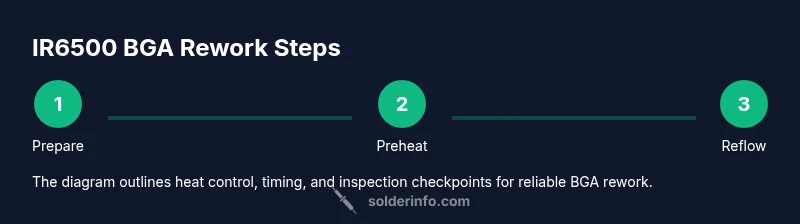
IR6500 BGA Rework Station: A Practical Guide
Explore how to use the IR6500 BGA rework station for safe, precise BGA rework. This guide covers setup, step-by-step procedures, safety, and troubleshooting for reliable solder joints.


The ir6500 bga rework station enables precise removal and reattachment of BGA components with controlled heat, uniform preheat, and accurate alignment. This guide walks you through setup, a step-by-step rework workflow, safety considerations, and troubleshooting strategies to ensure reliable joints. According to SolderInfo, mastering heat control and careful handling reduces the risk of pad lift and solder bridges when using an IR6500 BGA rework station.
What is the IR6500 BGA rework station and why it matters
The IR6500 BGA rework station is a compact, temperature-controlled tool designed to reflow solder on BGA components without excessive mechanical force. For electronics hobbyists and professionals, it provides a focused IR heat source, adjustable preheat, and a stable platform for precise placement. The IR6500 system helps minimize thermal shock to neighboring pads, which is critical when dealing with multi-layer boards. According to SolderInfo, success with BGA extraction or reattachment hinges on uniform heat distribution, proper nozzle selection, and careful board handling. When used correctly, the IR6500 BGA rework station enables reliable joint formation and reduces the risk of lifted pads. This guide uses the IR6500 as the reference point but the principles apply to similar rework stations, including preheat strategies, thermal profiles, and safe work practices.
Core Features and How They Benefit BGA Rework
Modern BGA rework relies on consistent heat control, and the IR6500 BGA rework station delivers that through an adjustable infrared heat source, precise temperature control, and a dedicated preheat stage. With programmable temperature curves, technicians can ramp temps gradually to avoid board warpage and tombstoning. The system’s nozzle options and stand-off height support controlled heat focusing on the BGA ball grid while protecting surrounding components. From the SolderInfo perspective, repeatable thermal profiles are the backbone of reliable rework outcomes, especially for high-density boards. Practically, this means shorter rework times, fewer failed joints, and clearer post-rework inspection. The IR6500’s ergonomics—touchscreen control, stable platform, and quick-change nozzles—map directly to real-world repair workflows in electronics manufacturing, hobby labs, and jewelry electronics projects.
Safety, ESD, and Workspace Setup for Precision Rework
Safety first. Always work with an ESD-safe mat and grounding strap to prevent latent damage to sensitive components. Ensure you have adequate ventilation; even with IR heating, flux fumes can accumulate. The IR6500 BGA rework station should be mounted on a vibration-free bench, with a stable stand and a heat-resistant mat. Keep solvents away from the hot zone, and wear protective eyewear when applying flux or cleaning residues. SolderInfo emphasizes establishing a clean, organized workstation so you can track heat exposure and avoid accidental bridging. Label and store nozzles by size, and plan accessory placement to minimize hand movement during critical steps.
Preparation: Tools, Materials, and Preheating Strategy
Before you begin, gather the essential tools and materials to support a smooth BGA rework with the IR6500 BGA rework station. A dedicated soldering station, tweezers, magnification, and isopropyl alcohol should be within arm’s reach. Prepare flux and paste appropriate to your board’s metallurgy. Set up test coupons or dummy boards to practice your reflow profiles. Establish a preheat strategy: warm the board to a gentle, uniform temperature before concentrating energy on the BGA itself. According to SolderInfo, starting with preheat reduces thermal shock and helps the BGA balls reflow evenly, minimizing bridging and pad lift. This preparation stage saves time and improves success rates in electronics repair projects.
Authority Sources and Best Practices from Rework Experts
Here are the authoritative guidelines you should consult when learning to use the IR6500 BGA rework station. OSHA provides general soldering safety practices and ventilation guidance that apply to hobbyists and professionals alike. NIST materials science resources emphasize consistent thermal handling and contamination control for solder joints. IEEE publications offer in-depth studies on rework techniques and joint reliability. By following these sources, you’ll align your workflow with established safety and quality standards while applying the IR6500 rework station to challenging boards.
Troubleshooting Common Issues During BGA Rework
Even with a capable IR6500 BGA rework station, issues can arise. If bridges form, back off heat and adjust flux amount; ensure adequate preheating. If a BGA pad lifts, rework with a smaller heat focus and re-tack the joint slowly. If there is insufficient wetting, consider increasing solder paste volume or cleaning the pads more thoroughly. Misalignment can be corrected by re-mounting the component, then reflowing. Let the board cool gradually to avoid thermal shock, then inspect with a loupe or microscope to confirm joint integrity. SolderInfo watchers emphasize controlled reflow profiles and careful inspection to avoid repeating mistakes.
Maintenance and Longevity of the IR6500 BGA Rework Station
To keep the IR6500 performing well, regularly inspect nozzles for wear, clean the nozzle tips after use, and verify that infrared emitters are evenly heating. Calibrate temperature readings against a thermocouple to ensure accuracy. Store nozzles in labeled cases and avoid leaving flux residues inside the nozzle assembly. Periodic maintenance reduces drift, prolongs sensor life, and preserves rework quality. SolderInfo recommends documenting your heat profiles and nozzle use to optimize future rework sessions.
Tools & Materials
- IR6500 BGA rework station(Main unit; ensure proper ventilation and grounding)
- Set of hot air nozzles (various sizes)(Critical for nozzle-specific heat focus)
- Solder paste or BGA preform(For reflow under BGA balls)
- Solder flux (no-clean preferred)(Improves wetting and reduces bridges)
- Solder wick (desoldering wick)(Cleaning joints and pads)
- Tweezers and pick set(Precise component placement)
- Isopropyl alcohol 99%(Cleaning residues after rework)
- ESD-safe mat and wrist strap(ESD protection during work)
- Magnification tool or loupe(Inspect joints at high zoom)
- Safety goggles(Eye protection during hot work)
Steps
Estimated time: 60-90 minutes
- 1
Prepare the PCB and components
Identify the target BGA, inspect neighboring components, and remove any obstructing parts. Clean the area with isopropyl alcohol to ensure good flux adhesion and prevent contamination. This step reduces the risk of solder bridges during reflow.
Tip: Double-check orientation marks on the BGA and PCB before removing any existing solder. - 2
Secure the board and set heat presets
Mount the board on a heat‑resistant, vibration-free surface. Select an initial heat profile suitable for your board thickness and solder alloy, and save it as a reusable preset to speed future work.
Tip: Use a heat shield and minimize airflow near the work area to prevent pad damage. - 3
Preheat the board evenly
Activate the preheat stage to bring the board to a moderate temperature across the entire area. Uniform preheating reduces thermal shock when you apply targeted heat to the BGA.
Tip: Aim for a slow ramp to the preheat setpoint—too fast can warp the PCB. - 4
Align the BGA precisely over pads
Place the BGA with alignment marks, ensuring that all balls align with the PCB pads. Use magnification to verify centering before applying heat.
Tip: Keep the component clamped lightly to prevent drift during initial contact. - 5
Apply heat and reflow
Gradually apply infrared heat to melt the BGA solder balls into the pads. Monitor the temperature curve closely to avoid overheating adjacent lands.
Tip: If solder bridges form, pause, rework with lower heat, and reflow from the edges inward. - 6
Inspect and verify joints
Once reflow occurs, inspect each joint with a loupe for proper wetting, ball shape, and alignment. Look for any cold joints or bridging.
Tip: Use a bright light and a 5–10x loupe for definitive visual checks. - 7
Cool and clean residues
Allow the board to cool gradually. Clean flux residues with isopropyl alcohol and inspect pads again after cleaning.
Tip: Avoid rapid cooling which can introduce stress or micro-cracks. - 8
Test the board and document results
Power up the board and perform functional tests. Record heat profiles and outcomes for future consistency.
Tip: Create a brief log of the BGA rework session for future reference.
Quick Answers
What is the IR6500 BGA rework station best used for?
The IR6500 BGA rework station is best for precise removal and reattachment of BGA components, enabling controlled heat application, precise alignment, and reliable joint formation.
The IR6500 BGA rework station is ideal for precise BGA removal and reattachment with controlled heat and alignment.
Is the IR6500 suitable for reworking BGAs on all boards?
It is suitable for many high-density boards, but success depends on solder alloy, stencil quality, and board integrity. Always test on a sacrificial board before working on a critical assembly.
It works on many boards, but test first on a spare board to verify compatibility.
What safety precautions are essential when using the IR6500?
Use ESD protection, ensure proper ventilation, and wear eye protection. Keep flammable materials away from the hot zone and follow standard soldering safety practices.
Wear protection, ventilate, and keep hot zones away from flammables.
Do you always need a preheat step with the IR6500?
Preheating reduces thermal stress and helps even solder flow. Skipping preheat increases the risk of pad lift and non-uniform joints.
Preheating helps avoid warping and ensures even solder flow.
How can I avoid pad lift and tombstoning?
Control heat ramp, use adequate flux, and ensure good alignment. Cool gradually and verify pads before final reflow.
Control heat and flux, align well, and cool gradually to prevent pad damage.
What maintenance does the IR6500 require?
Regularly inspect nozzles, clean residue, and verify heat distribution with a thermocouple. Document profiles for future use.
Check nozzles, clean residues, and keep heat readings accurate.
Watch Video
Top Takeaways
- Plan and prep before heating to reduce mistakes.
- Use uniform preheat to minimize thermal stress.
- Aim for precise alignment and controlled reflow.
- Inspect thoroughly and document results for future work.
- Follow safety and ventilation guidelines to protect yourself.