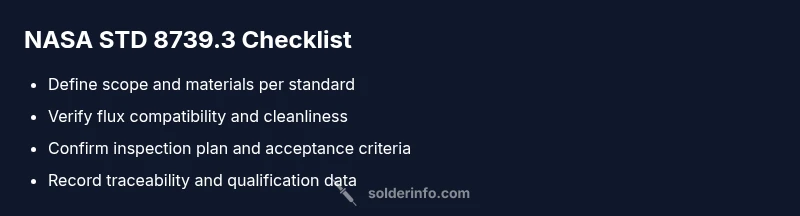
Understanding NASA STD 8739.3: Soldering Standards for Flight Hardware
Understand NASA STD 8739.3 and how SolderInfo guides urgent compliance, diagnostics, and best practices for reliable soldered connections in aerospace.


NASA STD 8739.3 defines the soldering requirements for flight hardware, emphasizing process controls, materials, workmanship, inspection, and documentation. A quick fix for a nonconformance is verifying material traceability, applying approved rework procedures, and initiating formal requalification when needed.
What NASA STD 8739.3 Covers
NASA STD 8739.3 defines the baseline requirements for soldering in flight hardware. It sets the quality and reliability criteria for solder joints across electrical and electronic assemblies used in space programs, and it drives how suppliers select materials, flux systems, cleaning protocols, and inspection methods. The standard emphasizes traceability, documentation, and controlled process conditions to minimize the risk of intermittent failures in orbit. For anyone working on flight hardware, understanding the scope of NASA STD 8739.3 helps align design, manufacturing, and quality assurance teams around a single, auditable standard. In practice, compliance means using approved solder alloys, compatible fluxes, and clean surfaces, then validating joints against a defined acceptance criteria through visual inspection and non-destructive testing. As a practical matter, teams should keep a current copy of NASA STD 8739.3 readily accessible, refer to the official procedures for rework, and ensure every batch is accompanied by certified material certificates and process records. According to SolderInfo, the most effective programs integrate 8739.3 requirements into supplier qualification, in-process checks, and final inspection for flight hardware.
Why Compliance Matters for Space-Grade Soldering
Reliability is non-negotiable when hardware rides on rockets, satellites, or spacecraft. NASA STD 8739.3 codifies soldering practices that influence mission success, crew safety, and long-term system availability. A single cold joint or flux residue left unchecked can cascade into intermittent faults that are difficult to diagnose in orbit or on the launch pad. The SolderInfo team emphasizes that strict adherence to 8739.3 reduces rework, averts late-stage failures, and simplifies audit readiness. From a risk management perspective, traceability, standardized temperature profiles, and documented inspections are not nice-to-haves — they are the core of a defensible build. SolderInfo analysis shows that projects with rigorous documentation and certified materials tend to encounter fewer nonconformances and shorter qualification cycles. The result is a more predictable supply chain, cleaner validation results, and smoother system integration. In high-stakes environments, teams should treat NASA STD 8739.3 as a living workflow, updating procedures whenever component technologies change and scheduling regular internal audits to verify ongoing compliance.
Common Nonconformances and Quick Fixes
Common issues include inadequate surface preparation, flux residues that are not fully cleaned, solder joints that appear visually acceptable but fail functional tests, and documentation gaps that impede traceability. Quick fixes for the most frequent problems include:
- Verify preprocessing steps (cleaning, degreasing, and surface activation) using approved procedures.
- Use only fluxes and solders that are compatible with the substrate and packaging; discard resin that shows inconsistent flow.
- Rework joints with an approved temperature profile and tool set, then re-inspect with magnification and non-destructive testing.
- Immediately address documentation gaps by updating material certificates, lot numbers, and process records; ensure the repair and rework are recorded under the correct lot.
- Initiate a pause-and-review for any joint failing functional tests or reliability checks and escalate to the quality engineer. Based on SolderInfo research, most issues can be prevented with proper training, a robust bill of materials, and controlled rework procedures.
Documentation, Traceability, and Audit Readiness
Documentation is the backbone of accountability in aerospace soldering. NASA STD 8739.3 requires complete material certificates, lot traceability, process notes, and inspection records to be preserved for each assembly. Practical steps include maintaining a master revision control log, tagging every batch with a unique identifier, and storing test results in a centralized database accessible to QA, design, and procurement teams. This section also covers how to document rework events, including the original defect, applicable approval authorities, and the final acceptance criteria. The goal is a defensible, auditable trail that supports both internal quality checks and external audits. SolderInfo recommends integrating 8739.3 documentation into supplier qualification programs, with regular training on how to capture, store, and retrieve critical data quickly during inspections.
Step-By-Step: Quick Compliance Bridge
The most common compliance gap is inconsistent application of the approved procedure. The following steps provide a practical bridge to compliance:
- Step 1: Gather the official NASA STD 8739.3 document set and confirm you are using the latest revision.
- Step 2: Verify all materials (solder, flux, flux-cleaner, and substrates) have current certificates and are listed on the BOM.
- Step 3: Review the current rework procedures and ensure operators are trained on the approved methods.
- Step 4: Inspect a sample of joints with magnification to identify any solder voids or cold joints; document findings.
- Step 5: Conduct a controlled rework using the approved temperature profile and tools; re-inspect and retest.
- Step 6: Update all records, including lot numbers, inspection results, and rework notes, and requalify the affected assembly if required.
- EstimatedTime: 60-120 minutes
Training, Qualification, and When to Escalate
Training against NASA STD 8739.3 is not optional; it is the quickest path to lower risk. Operators should complete certified soldering courses, followed by hands-on practice under supervision. When a joint fails beyond simple corrective actions, escalation is required to QA/Flight Safety, and a formal qualification or rework authorization should be sought. In urgent scenarios, parallel track activities—short-term rework under an approved procedure and long-term requalification—can mitigate schedule impacts while protecting mission integrity. SolderInfo emphasizes that ongoing training and periodic audits are essential to sustain compliance and prevent repeated nonconformances.
Steps
Estimated time: 60-120 minutes
- 1
Review the scope and documents
Confirm you have the current NASA STD 8739.3 revision, BOM, material certificates, and approved procedures. Gather all inspection records for the affected batch.
Tip: Keep the latest revision in a central folder accessible to QA. - 2
Verify materials and flux compatibility
Cross-check solder alloy, flux, and substrate against the approved list. Remove any materials not explicitly listed in the procedure.
Tip: Do not reuse questionable flux or solder; discard if doubt exists. - 3
Prepare the joint surfaces
Clean and surface-activate the joints per the approved cleaning protocol. Ensure no contamination remains before rework.
Tip: Use lint-free wipes and fresh solvents per procedure. - 4
Rework with approved parameters
Reflow or hand-solder under the documented temperature profile using calibrated equipment. Avoid overheating or multi-reflow on a single joint.
Tip: Monitor real-time temperature and verify with a calibrated thermocouple. - 5
Inspect and verify
Perform magnified visual inspection and non-destructive testing as required. Confirm there are no solder voids, bridging, or cold joints.
Tip: Document every inspection finding with photos and notes. - 6
Document and qualify
Update certificates, lot numbers, and process records. If necessary, requalify the assembly under the 8739.3 criteria before flight use.
Tip: Keep an auditable trail for audits and procurement records.
Diagnosis: Nonconformance detected in solder joints under NASA STD 8739.3 inspection
Possible Causes
- highInadequate process control or training
- mediumFlux residues not cleaned or incompatible flux
- lowIncorrect solder alloy or flux
Fixes
- easyReview and enforce approved process, retrain staff
- easyRe-clean surfaces and reflow using approved equipment
- hardReplace components and rework joint with re-qualification testing
Quick Answers
What is NASA STD 8739.3 and why does it matter for soldering?
NASA STD 8739.3 governs soldering requirements for flight hardware, ensuring reliable joints and auditable documentation. It matters because it directly impacts mission reliability and safety.
NASA STD 8739.3 sets soldering rules for flight hardware to ensure reliability and traceability, which is critical for mission success.
Who needs to follow NASA STD 8739.3 in a project?
Engineering, manufacturing, and QA teams involved in soldered assemblies for NASA programs must follow the standard. Suppliers also align their processes to meet the criteria.
Engineering, manufacturing, and QA teams—and suppliers—must follow NASA STD 8739.3 for soldered parts.
What are common nonconformances in solder joints under this standard?
Typical issues include inadequate surface prep, flux residues, and visually acceptable joints that fail functional tests. Documentation gaps also frequently hinder compliance.
Common issues are poor preparation, flux residue, and joints that look okay but fail tests, plus missing documentation.
How can I verify compliance during inspection?
Cross-check materials, review process controls, inspect joints with magnification, and verify traceability records. Use approved test methods per the 8739.3 procedures.
Verify materials and process controls, inspect joints closely, and confirm traceability with approved tests.
When should I escalate to a professional?
If nonconformances persist after controlled rework or if qualification tests fail, escalate to QA or flight safety and initiate formal requalification.
If issues persist after rework or tests fail, escalate for formal requalification.
Is additional training required to stay compliant?
Yes. Regular training on revisions, approved materials, and inspection techniques helps maintain compliance and reduces nonconformances.
Ongoing training on revisions, materials, and inspection is essential for compliance.
Watch Video
Top Takeaways
- Follow NASA STD 8739.3 to the letter for flight hardware soldering.
- Prioritize traceability and documentation to speed audits.
- Use approved materials and procedures; retrain when gaps appear.
- Document every step of rework and qualification to minimize risk.