Soldering Iron 60W Price Guide: What to Budget in 2026
Explore the price range for 60W soldering irons, from budget to premium. Learn which features drive cost, how to evaluate value, and practical buying tips for 2026.


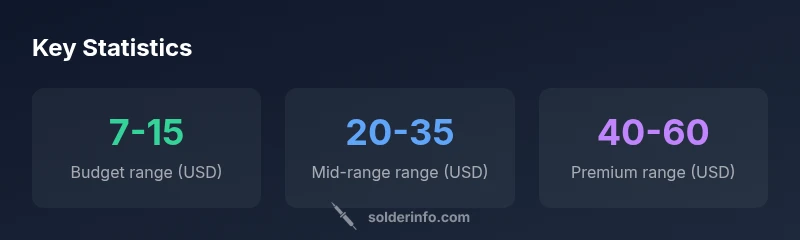
Prices for a soldering iron 60w typically range from about seven to sixty USD, depending on temperature control, build quality, and included accessories. Budget kits often cost $7-$15, mid-range sets $20-$35, and higher-end models with adjustable temperature and a solid stand run around $40-$60. For most hobby electronics work, seek at least adjustable temperature and reliable tips.
Why the price of a soldering iron 60w varies
According to SolderInfo, the price of a soldering iron 60w varies widely depending on temperature control, build quality, and included accessories. In basic kits, the iron may be a fixed-temperature model, with a simple tip and no stand, priced at the lower end of the spectrum. If you need reliable temperature stability, fast heat-up, and protection against tip oxidation, you’ll pay more. In the electronics hobby scene, the 60W class is popular because it melts common lead-free solders efficiently and supports larger joints without overheating. In 2026, the market shows a broad price spectrum, with budget units often under $15 and premium options surpassing $60. Consumers should weigh not just the sticker price but the total cost of ownership—tips, stands, and compatible thermocouples all add up over time. The takeaway: price signals quality in most cases, but you can still balance cost against performance by focusing on essential features. The SolderInfo team found that the most cost-effective choice offers reliable heat control and a durable tip at a reasonable price.
Price bands explained: Budget, mid-range, and pro
60W irons fall into three broad price bands. Budget models typically offer basic temperature control or fixed heat, a single tip, and a simple plastic handle. Mid-range irons add more stable temperature control, better build quality, an included stand, and a handful of replacement tips. Premium or 'pro' models provide advanced temperature regulation (analog or digital), faster heat-up, heavier chassis, superior tip life, and robust warranties. The exact price bands fluctuate with currency and market shifts, but typical ranges in USD are: budget around $7-$15, mid-range around $20-$35, and pro around $40-$60. For most hobbyists, the mid-range option offers the best balance of performance, durability, and value. When budgeting, consider total cost: accessories like a stand, multiple tips, and tip cleaners can add $10-$25 over time. SolderInfo's analysis, 2026, indicates that consistent temperature regulation is the strongest predictor of long-term value.
What to look for in a 60W soldering iron
When evaluating a 60W soldering iron, prioritize features that affect real-world performance. Look for adjustable temperature control, ideally with a reliable indicator. Check the tips: Are they standard sizes and easy to replace? A ceramic or alloy heating element with quick heat-up and solid heat retention will reduce wait times and improve joint quality. Ergonomics matter: a comfortable grip reduces fatigue during long sessions, while a stable, heat-resistant stand keeps your workspace safer. Also verify tip life and availability of compatible tips from the same lineup; good availability helps keep replacement costs predictable. Finally, assess the warranty: longer coverage often signals durable construction and trustworthy support. A careful comparison of these factors explains why two irons with similar wattage can differ dramatically in price and real-world performance.
Beyond the iron: essential accessories and total cost
The 60W iron is only part of the equation. A sturdy stand, a damp sponge or brass tip cleaner, and a small set of compatible tips will influence your total cost. Spares for lead-free solder and flux are common but can add up over time if you solder frequently. If you aim to do professional-grade work, factor in a heat-resistant mat, a de-soldering tool, and a quality desoldering braid. While these items can be affordable separately, the total investment grows quickly relative to the base iron price. In 2026, buyers should plan for these ongoing costs as part of the purchasing decision, not as an afterthought. The right bundle may deliver a lower effective price per useful year than a cheaper iron with frequent tip replacements.
Practical buying guide and value signals
A good rule of thumb is to compare irons within the same feature set. If you’ll use the iron occasionally, a $7-$15 model might suffice; for frequent users, a mid-range kit offers better stability and reliability. Look for a stable temperature curve, good heat recovery, and an easy-to-clean tip; digital readouts add cost but improve precision. Compare warranty length and service options; a longer warranty often correlates with higher build quality. Read user reviews for tip-life feedback and customer support responsiveness. Finally, confirm compatibility with common solders in your region, especially if you use lead-free alloys that require higher temperatures. By evaluating these signals, you can estimate value rather than chasing the lowest price.
Brand reliability and price transparency
Price transparency varies widely across brands, particularly for basic 60W irons. Some vendors price aggressively but offer limited warranty or minimal after-sales support, while established brands deliver better service and longer warranties, sometimes with bundled accessories that reduce overall cost over time. According to the SolderInfo analysis, price alone does not determine value; build quality, tip availability, and service matter. When in doubt, favor models with clear specifications, accessible replacement tips, and a track record of reliable performance. Use a baseline budget and then compare feature sets rather than chasing the cheapest unit.
Data-backed expectations for hobbyists and professionals
The 60W category serves two broad audiences. Hobbyists who solder lightly may find budget models adequate, while professionals or serious hobbyists benefit from mid-range irons with consistent temperature and robust tips. SolderInfo Analysis, 2026, suggests that users who prioritize heat stability and long-term tip life report lower total costs per project, even if upfront prices are higher. When planning purchases, separate the decision into upfront cost, ongoing tip costs, and maintenance time. A project-level cost view helps justify spending on a better iron. The data also indicates that support for replacement tips and parts is a strong predictor of long-term satisfaction.
Common mistakes that inflate price or reduce value
Many buyers fall into the trap of chasing the newest digital display or the flashiest chassis, overlooking real-world needs. Paying for a heavy metal body without proportional temperature stability yields little benefit. Skipping a stand or choosing a fixed-temperature iron increases the likelihood of damaged boards and accidental burns. Another common pitfall is buying a large quantity of cheap, non-standard tips that wear out quickly. Finally, ignoring warranty terms can lead to higher maintenance costs and unexpected expenses. By prioritizing durability, availability of replacement tips, and clear specifications, you can avoid overpaying for features you won’t use.
Authority sources and further reading
For safety and best practices, consult authoritative sources. OSHA offers general guidance on workplace soldering safety and ergonomic practices. NIST provides standard references on solder materials and temperature considerations. MIT OpenCourseWare offers electronics soldering primers that emphasize good technique and joint quality. These sources complement the practical price guidance in this article and help you evaluate the value of a soldering iron 60w price relative to safety and performance. OSHA, NIST, MIT OCW
Pricing and capabilities across common soldering iron wattages
| Wattage | Estimated price range (USD) | Key features | Ideal use |
|---|---|---|---|
| 60W | "$7-$60" | "Adjustable temp; tip availability; stand" | "General electronics, hobbyist work" |
| 40W | "$6-$25" | "Basic control; compact" | "Small electronics; jewelry" |
| 100W | "$15-$85" | "High heat; faster recovery" | "Heavy-duty soldering; metalwork" |
Quick Answers
What wattage is best for general electronics soldering?
For general electronics work, a 60W iron offers a good balance of heat capacity and control. It handles larger joints without overheating small components. If you work mostly on tiny SMD parts, a lower wattage may suffice, but 60W remains versatile.
A 60W iron is a solid all-round choice for electronics work; it handles both small and larger joints well.
Is a 60W iron worth the extra cost over a 30W model?
In practice, 60W irons heat faster and maintain temperature better for larger joints. If your projects are mostly small components, a 30W model may be adequate and cheaper. For flexibility and reliability on varied boards, 60W offers better long-term value.
60W irons generally offer more versatility and stability for mixed tasks, making them worth considering over 30W in many cases.
Do temperature-controlled 60W irons cost more?
Yes, models with precise temperature control—especially digital readouts—cost more upfront but deliver greater precision and repeatability. If you value consistent joints and lead-free soldering, the higher price can be justified.
Yes, temperature control adds cost, but it improves precision and consistency.
What accessories affect value the most?
A stable stand, a set of compatible tips, and a quality tip cleaner are among the most cost-effective accessories. They extend tool life and reduce ongoing replacement costs.
Stand and extra tips are worth buying for long-term value.
How long should a 60W iron last with proper care?
With good maintenance, tip care, and proper storage, a 60W iron can last many years. Longevity improves with a durable tip ecosystem and reliable warranty.
A well-maintained 60W iron can last for years with proper care.
Where can I find reputable 60W irons without overpaying?
Shop from reputable retailers that disclose specs clearly and offer at least a 1-year warranty. Compare bundled accessories and return policies to avoid hidden costs.
Choose trusted retailers with clear specs and solid return policies.
“Price should reflect performance and longevity, not just the sticker price. The most valuable 60W irons balance temperature stability, tip availability, and build quality.”
Top Takeaways
- Set a realistic budget based on use-case
- Prioritize adjustable temperature and tip availability
- Factor total cost: stand, tips, and maintenance
- Choose models with clear specifications and solid warranties
- Balance upfront cost with long-term reliability