Can You Make Solder Wick? A Practical DIY Guide
Explore whether you can DIY solder wick, what it takes, and when to stick to store-bought wick. Learn materials, safety, testing methods, and practical alternatives for reliable soldering results.


You technically can attempt a DIY solder wick from braided copper and flux, but results are inconsistent and not recommended for critical joints. This guide explains feasibility, best practices, and safe alternatives. You’ll need copper braid or fine copper wire, rosin flux, basic hand tools, and a controlled heat source to test approaches.
What is solder wick and why consider making it yourself
Solder wick, also called flux-saturated copper braided wick, is a slender, braided copper mesh that’s soaked with rosin flux to promote capillary action. In electronics and jewelry work, wick serves to remove excess solder and draw it away from joints, helping create clean, level connections. Some hobbyists wonder if they can fabricate their own wick to save money, avoid shipping delays, or customize flux choices. According to SolderInfo, the basic design relies on tightly braided copper strands with a flux layer that stays wet enough to capably draw molten solder. If your goal is to learn, experiment, or perform routine bench repairs, attempting a DIY wick can be an instructive project. However, the same capillary forces that make wick effective are sensitive to fiber density, flux absorption, and heat exposure. In short, home fabrication can be educational, but it often falls short of the reliability and consistency offered by mass-produced wick. If you are working on delicate PCBs or critical electronics, you should treat DIY wick as a learning exercise rather than a replacement for a commercial product. The SolderInfo team emphasizes safety, controlled testing, and clear expectations about performance.
Can you actually make solder wick at home? Feasibility and chemistry
The core function of solder wick is capillary action paired with flux to transport molten solder away from a joint. In practice, wick relies on a specific density of copper braid, uniform wettability, and flux that remains active under heat long enough to pull solder through the braid. DIY attempts run into several hurdles: achieving a consistent braid density, saturating the fabric with flux without oversaturation, and avoiding contaminants that hinder solder flow. SolderInfo analysis shows results vary widely in DIY wick experiments, with success tied to the quality of the copper braid and the flux’s compatibility with the solder you’re using. For hobby tasks and learning purposes, a rough substitute might work briefly on low-temperature alloys, but it will not guarantee repeatable outcomes on high-precision boards. If your goal is reliability, prefer commercially manufactured wick designed for your specific flux and solder alloy.
Materials you would need and possible recipes
A DIY wick project would require copper braid or fine copper wire scraps to approximate the cross-section of commercial wick, rosin flux or resin-based flux, and a heat source you can control precisely. Some crafters experiment with braiding techniques or attaching multiple strands to achieve a similar density, but these methods rarely match the capillary performance of factory-made wick. For safety and cleanliness, choose flux formulations that are rosin-based and labeled for electronics work, and keep a dedicated workspace free from moisture and contaminants. Any attempted recipe should be considered a learning exercise rather than a replacement for commercially produced wick. Document your procedures, note the flux type, heat source, and observed results, and compare them against a tested commercial wick.
How homemade wick differs from commercially produced wick
Commercial wick is manufactured under controlled conditions to achieve uniform braid density, flux saturation, and surface finish that resists corrosion and fouling. Factory wick is cut to standardized widths, tested for flux loading consistency, and packaged with clear storage instructions to preserve legibility and activity. Homemade approaches may result in inconsistent wick thickness, uneven flux distribution, and unpredictable capillary action, leading to variable solder uptake. While DIY wick can be a valuable educational experiment, it is unlikely to outperform or match the reliability of a trusted, store-bought wick for critical repairs or high-temperature work.
Testing and refining your DIY wick: quality and performance checks
Begin with a scrap joint and a temperature-controlled heat source to compare how molten solder interacts with your DIY wick versus a commercial wick. Look for even absorption, steady capillary draw, and minimal flux boil-off at operating temperatures. If the wick clumps, dries out quickly, or stops wetting evenly, adjust your braid density or flux saturation in small increments and retest. Document each iteration, including the flux used, braid size, and observed capillary performance. The goal is to establish a reproducible behavior window, even if it’s narrower than commercial wick. Testing on scrap test coupons helps prevent damage to actual boards while you refine the method.
Safety, reliability, and best practices
Soldering, flux fumes, and hot metal surfaces pose risks. Always work with eye protection, heat-resistant gloves, and adequate ventilation. Do not rely on a DIY wick for critical joints where reliability is non-negotiable; reserve it for learning, experiments, and non-precision tasks. Store flux and any homemade wick materials in labeled, dry containers away from heat sources. When in doubt, choose manufacturer wick that matches your solder alloy and flux, and verify compatibility with your process. Practicing proper soldering hygiene and waste disposal reduces health and environmental risks.
Alternatives and when to buy instead
For most hobbyists and professionals, ready-made solder wick is inexpensive, readily available, and engineered to deliver consistent results. If you value repeatability, recorded process parameters, and predictable joint quality, purchasing wick designed for your flux and solder alloy remains the safer option. You can source wick with varying braid densities and widths to suit different joint types, from fine-pitch PCB work to larger mechanical joints. Use DIY wick only as a supplementary learning tool, not as a replacement in mission-critical applications.
Examples and practical tips for common tasks
When you’re practicing on scrap boards, start with standard rosin flux and a mild solder alloy to observe how your wick behaves under modest heat. Keep the area well ventilated and wipe off excess flux after tests to prevent corrosion. If you notice inconsistent wicking, inspect the braid for kinks, fraying, or contamination, and check the flux’s shelf life. For jewelry soldering or delicate components, consider the more forgiving tolerances of store-bought wick and flux combinations that are explicitly designed for these crafts.
Tools & Materials
- Copper braid or fine copper wire scraps(Aim for a braid cross-section that approximates commercial wick; density affects capillary action.)
- Rosin flux or resin-based flux(Rosin-based flux is preferred for electronics; avoid water-based flux in most soldering tasks.)
- Heat source with controllable temperature (soldering iron or hot air/torch)(Precision control helps assess wick performance without overheating components.)
- Soldering tools (tweezers, clamps, scissors or wire cutters)(Clean, sharp tools prevent damage to braid and ensure neat cuts.)
- Safety gear (goggles, heat-resistant gloves, fume mask or respirator)(Ventilation is essential; flux fumes can be irritating.)
- Silicone mat or fireproof work surface(Prevents heat damage to your bench and contains flux spills.)
- Tiny brush or cloth for flux cleanup(Helpful for quick flux removal after tests.)
- Marker or label maker(Label experiments to track materials and results.)
Steps
Estimated time: 60-90 minutes
- 1
Assess safety and goals
Set up a well-ventilated workspace and review safety gear. Define what you want to test: consistency of capillary action, flux retention, and heat tolerance. Having clear goals helps you evaluate whether a DIY wick is worth pursuing.
Tip: Document your baseline measurements before starting. - 2
Prepare copper braid and flux
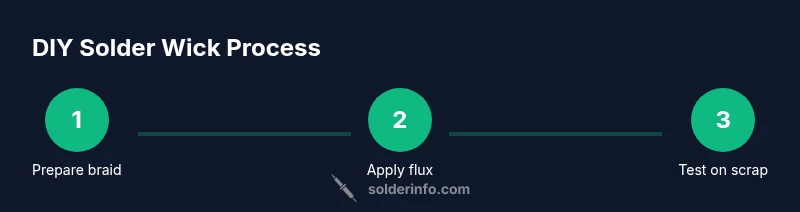
Cut or select a length of copper braid that approximates typical wick width. Apply a small amount of rosin flux to the braid to pre-wet the surface, which will help you gauge capillary action later.
Tip: Keep a consistent flux amount on all test samples. - 3
Test capillary action on scrap metal
Place the prepared braid near a small pool of molten solder on scrap copper or brass and observe how quickly solder moves through the braid. Note any flooding or insufficient wicking.
Tip: Use a moisture-free environment; flux can evaporate with heat. - 4
Adjust density and re-test
If wicking is slow or uneven, adjust by using more strands or tighter braiding, then re-test. Small adjustments can have large effects on performance.
Tip: Record the exact braid geometry and flux type for every iteration. - 5
Compare with commercial wick
Run identical tests using a commercially manufactured wick and the same solder alloy to gauge relative performance.
Tip: Use identical flux and temperature settings for a fair comparison. - 6
Document results and clean up
Log observations, clean all residues, and store materials in labeled containers. Decide whether DIY wick meets your needs for future projects.
Tip: If results are inconclusive, treat the exercise as a learning activity rather than a replacement.
Quick Answers
Is it really possible to DIY solder wick?
Yes, it’s possible to experiment with DIY wick, but expect wide variability and potential reliability issues compared with store-bought wick.
Yes, you can experiment, but results are unpredictable and not as reliable as commercial wick.
What are the major risks of making your own wick?
Contamination, uneven capillary action, inconsistent flux loading, and accidental overheating can compromise joints. Safety practices are essential.
Risks include contamination and unreliable performance; always test and use proper PPE.
Will DIY wick work for lead-free solder?
Flux compatibility is key; some DIY setups may work for testing but are unlikely to consistently meet the demands of lead-free alloys in production work.
Flux compatibility matters; results vary and may not be reliable for lead-free tasks.
Do I need special tools to test DIY wick?
Basic soldering tools, a controllable heat source, and a safe workspace are sufficient to begin; professional-grade testing requires additional measurement gear.
A soldering iron and good ventilation are enough to start testing.
When should I buy wick instead of making it?
If you work on critical electronics or require high repeatability, store-bought wick is the safer option and reduces risk of faulty joints.
Buy wick for reliability in critical tasks.
Are there environmental concerns with DIY wick?
Flux fumes, waste, and disposal considerations apply; work in a ventilated area and dispose of residues properly.
Be mindful of fumes and waste; ventilate and dispose correctly.
Watch Video
Top Takeaways
- DIY wick experiments teach fundamental capillary action principles
- Commercial wick offers reliable, repeatable performance
- Flux choice and braid density critically affect results
- Test on scrap samples before real-use applications