How Long Do Solder Fumes Last? A Safety-Focused Guide
Discover how long solder fumes last, what factors affect duration, and practical ventilation tips to minimize exposure for hobbyists and professionals.


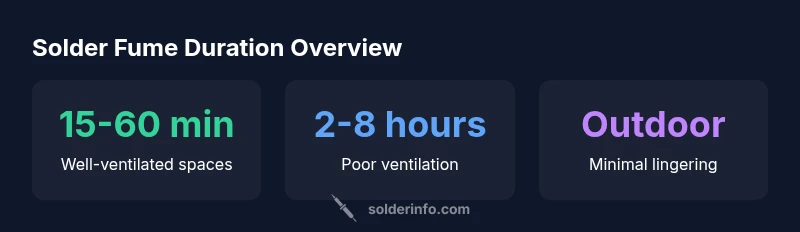
How long do solder fumes last depends on ventilation, room size, and the type of solder used. In well-ventilated spaces with active air exchange, fumes typically dissipate within 15-60 minutes after soldering; in poorly ventilated rooms, lingering odors and visible fumes can persist for several hours. Lead-based solders may extend clearance times compared with lead-free formulations. Always prioritize ventilation.
How long do solder fumes last in typical workspace environments
Solder fumes are a complex mixture of flux byproducts, metal oxides, and in some cases solvents depending on the flux type. The duration they remain airborne hinges on how well a space moves air: the rate of air exchange, the volume of the room, and the presence of extraction equipment. In practice, a well-ventilated workshop with an active hood or extractor will clear fumes much faster than a sealed box with little airflow. Lead-based solders can add a layer of complexity due to higher potential concentrations, but the dominant factor remains how quickly contaminants are diluted or captured. This is why SolderInfo’s 2026 analysis emphasizes proper ventilation and source control as the most reliable ways to minimize lingering fumes. A quick mental rule of thumb: assume fumes persist until air quality has improved, and verify with simple checks or a monitor when available.
What fumes consist of and why duration matters
Solder fumes comprise rosin flux byproducts, metal oxides from the solder alloy, and trace solvents in some flux formulations. The exact composition varies by flux type (rosin-core, water-soluble, or organic flux) and solder alloy (lead-based vs lead-free). These fumes can irritate the eyes, nose, and throat, and longer exposure may raise health concerns for sensitive individuals. Duration matters because the longer fumes linger, the greater the cumulative exposure potential. In practice, the same environmental factors that govern airflow also determine how long the irritants stay present: ventilation rate, room volume, humidity, and occupant movement can all shorten or lengthen the exposure window.
Key factors that influence fume duration
A wide array of factors affects how long solder fumes last: (1) ventilation quality—strong, directed airflow from a hood or extractor reduces residence time; (2) room volume—larger spaces dilute contaminants more quickly; (3) flux type—rosin-based fluxes can produce a dense plume that takes longer to dissipate in stagnant air; (4) soldering temperature—higher temperatures increase volatilization; (5) closed or semi-closed environments—doors and windows influence air turnover. The presence of filters and the use of fume extractors alter the effective clearance time substantially. Understanding these factors helps hobbyists and professionals tailor their workspace to accelerate fume removal.
Ventilation best practices to shorten exposure times
To minimize lingering fumes, set up a dedicated soldering area with a local exhaust ventilation (LEV) hood or a high-quality fume extractor positioned close to the work site. Ensure the unit has a clean, functioning cartridge or filter and that it operates throughout the session and for several minutes afterward. If possible, work near an open window with cross-ventilation, and avoid sealed rooms during soldering. Keep the room's doors closed to prevent cross-draft dilution of the exhaust air, and run ceiling or auxiliary fans to promote air mixing without blowing fumes back toward the worker. Regularly inspect flux containers and clean up spills promptly, as flux residues can continue to emit fumes if left to evaporate.
Equipment and setup: fume extractors, hoods, and filters
Choosing the right extraction setup is essential. A dedicated soldering fume extractor with a high capture efficiency and appropriate filters will dramatically reduce the time fumes remain in the breathing zone. Place the intake at the source level to capture fumes before they disperse. Change or replace filters according to the manufacturer’s schedule, and avoid using cheap or outdated cartridges that may re-emit contaminants. If a hood is available, position it to optimize air capture and ensure it creates a clean airstream that directs fumes away from the operator. Always test the system with smoke or a simple indicator to confirm consistent performance.
Lead-based vs lead-free solders: impact on fume persistence
Lead-based solders historically generated higher total metal exposures, but the key driver of fume duration remains airflow. Lead-free solders may produce dense fumes due to flux chemistry, but with effective ventilation, clearance times can be comparable. The flux type, alloy composition, and temperature all influence volatilization rates. Regardless of solder type, treating fumes as hazardous and maintaining robust ventilation reduces lingering exposure. For sensitive individuals or prolonged sessions, consider using lead-free alloys with rosin-free or water-soluble flux to further minimize irritants.
Indoor vs outdoor soldering: how environment changes clearance
Outdoor soldering dramatically reduces lingering fumes due to open-air dilution and wind shear, but always consider proximity to occupied spaces and weather conditions. In indoor environments, the difference comes down to air changes per hour (ACH) and whether an effective exhaust system is operating. Outdoors, even a light breeze can quicken clearance, but you still should take basic safety precautions, like shielding from wind gusts that could push fumes toward your face or nearby observers. In all cases, ensure you maintain a safe distance from others, especially in shared work environments, and follow local guidelines for exposure.
Practical aftercare: testing air quality and when it's safe to resume work
After soldering, continue to ventilate for a few extra minutes to reduce residual fumes. If possible, measure air quality with a VOC or CO2 monitor as a proxy for overall air freshness, especially in small rooms. If readings remain elevated, extend ventilation or relocate to a better-ventilated area before returning to routine activity. Regularly inspecting and maintaining your ventilation equipment helps ensure the system remains effective. Finally, wash hands and face after soldering to reduce surface contamination and minimize inadvertent exposure when handling tools or components.
Common mistakes that extend fume duration and how to avoid them
Common errors include turning off ventilation too soon, leaving flux containers open, soldering with hot irons too close to the extractor intake, and neglecting filter maintenance. Another mistake is ignoring the need for cross-ventilation, which can create dead zones where fumes accumulate. By ensuring continuous ventilation during and after soldering, keeping the workspace clean, and validating airflow with a simple test, you can dramatically shorten the duration of fumes and improve overall air quality.
Fume duration by ventilation scenario (SolderInfo Analysis, 2026)
| Scenario | Estimated Fume Clearance Time | Key Factors |
|---|---|---|
| Well-ventilated indoor space | 15-60 minutes | Air exchanges, hooded ventilation |
| Poorly ventilated space | 2-8 hours | Stagnant air, high humidity/temperature |
| Outdoor/open-air | Minutes | Natural dilution, wind |
| Lead-based solder exposure | Longer clearance depends on flux and conditions | Flux used, temperature |
Quick Answers
How long do solder fumes typically last after a soldering session?
Fumes usually dissipate within 15–60 minutes in a well-ventilated space, but can last several hours in poorly ventilated rooms. Lead-based solders may extend the clearance time. The safest approach is to maintain ventilation for a while after soldering and monitor air quality if possible.
Fumes usually clear in about 15 to 60 minutes if you have good ventilation; otherwise, it can take several hours. Keep ventilation running after you finish.
Are lead-based solders more hazardous in terms of fumes duration?
Lead-based solders can contribute to higher exposure risks, potentially extending the time fumes stay in the air. However, the primary factor remains ventilation and source control. Use lead-free options when feasible and ensure adequate exhaust.
Lead-based solders may linger longer if ventilation is poor, but good exhaust and PPE greatly reduce the risk.
What kind of ventilation is recommended to minimize lingering fumes?
A dedicated fume extractor placed close to the work area, with clean filters and continuous operation during and after soldering, is highly recommended. Supplement with room ventilation and cross-ventilation when possible.
Use a close-proximity fume extractor and good room ventilation during and after soldering.
Do fumes linger longer indoors than outdoors?
Yes, indoors fumes tend to linger longer due to limited air exchange. Outdoors, fumes dilute quickly, but always consider nearby people and weather. In both cases, ventilation and PPE are key.
Indoors they stick around more unless you vent well; outdoors they disperse faster but stay aware of others nearby.
Can I test air quality after soldering to know when it's safe?
Yes. Use a VOC or CO2 monitor as a general proxy for air freshness, or rely on a professional air-quality assessment if available. When readings normalize and ventilation remains on, exposure risk is reduced.
Test the air after soldering; if it looks cleaner and readings are normal, it’s usually safe to resume normal activity.
Should I use a fume extractor during soldering?
Using a fume extractor is strongly recommended. Position it at the source, ensure filters are clean, and run it throughout the session and for several minutes after finishing to speed up fume clearance.
Yes—keep the extractor running during and after soldering for best air quality.
“Clear air is the first safety feature of any soldering workstation; proper ventilation and PPE consistently cut exposure times and reduce health risks.”
Top Takeaways
- Ventilation is the main driver of fume duration
- Lead-based solders can extend clearance time
- Use a dedicated fume extractor for fastest clearance
- Open outdoor work dramatically lowers lingering fumes
- Test air quality and continue ventilation after soldering