Soldering Projects for Beginners: Easy Start Guide
Discover easy soldering projects for beginners with essential tools, safety tips, and step-by-step guidance to build confidence in electronics, jewelry, and plumbing.


With soldering projects for beginners, you will learn to set up a safe workspace, heat joints correctly, and complete simple circuits. You will start with a basic LED/resistor circuit, then progress to small protoboards and wire joins. The key requirements are a temperature-controlled iron, lead-free solder, flux, and safety gear to prevent burns and fumes.
Why Soldering Projects for Beginners Jumpstart Your Skill
Soldering is a hands-on skill that rewards patience, precision, and practice. For beginners, choosing the right beginner projects matters almost as much as the technique itself. Starting with small, forgiving circuits helps you learn heat control, flux application, and joint cleanliness without risking sensitive parts. According to SolderInfo, successful beginners focus on consistent technique, safe workspace setup, and deliberate practice. By completing modest projects you build the confidence and muscle memory needed for more ambitious work in electronics, jewelry, or plumbing. In this article, you'll find a curated path from essential tools to simple projects and then toward more complex assemblies. The goal is not speed but reliability: every joint should look and perform as a dependable connection.
Essential Tools and Safety Gear for Beginners
To build solid foundations, assemble a compact, safe toolkit before you start. A temperature-controlled soldering iron helps manage heat, preventing damage to delicate parts. Use lead-free rosin-core solder for safer handling and better reliability. Flux reduces oxidation and improves wetting, while a sturdy stand and a brass sponge keep the iron clean. Protect your eyes with safety glasses, and handle fine components with precision tweezers. Keep wire cutters, a desoldering wick, and a small prototyping board on hand for practice. Finally, work in a well-ventilated area and always unplug the iron when not in use. These basics set the stage for productive, safe soldering sessions.
Starter Projects: Simple, Safe, and Quick
Beginners can gain confidence by tackling small, forgiving projects that reinforce core skills. Start with a basic LED with a current-limiting resistor on a perfboard: this teaches circuit planning, correct resistor sizing, and reliable joints. Next, practice tinning wires and making a simple wire-to-board connection to improve heat control and joint cleanliness. A tiny hobby PCB or a tactile switch circuit offers a second project that reinforces component placement and multi-joint soldering. Each project should emphasize a clean joint, minimal solder on the contact pads, and proper flux use. Completing 2–3 of these projects builds a solid foundation for more complex electronics or jewelry soldering.
Soldering Techniques to Practice
Mastery comes from focused practice. Begin with tinning the iron tip and tinning wires before joining them, so the solder flows smoothly. Maintain steady heat and avoid moving parts too soon to prevent cold joints. Apply flux or use rosin-core solder to improve wetting, then visually inspect joints for a shiny, concave fillet with a clean cut-off tail. Practice reflow by reheating joints to fix bridges or dull joints, and always clean copper surfaces before soldering. Recording your session times and outcomes helps you monitor progress and identify which techniques need more attention.
Common Pitfalls and How to Fix Them
Common beginner mistakes include cold joints, overheating delicate components, and excessive solder causing short circuits. To fix cold joints, reheat the joint with a steady touch, add a bit more solder, and ensure the pad or lead is still. If heat is too aggressive, pause, re-establish contact, and re-apply flux to improve heat transfer. Bridges between pads are often caused by too much solder or touching neighboring pads; remove excess solder with wick and reflow the joint carefully. Always unplug and let components cool before handling them to prevent thermal shock.
How to Track Progress and Move to More Complex Projects
Progression comes from structured, incremental challenges. After completing 3–4 basic projects, try a small multi-component circuit on a breadboard or perfboard, including a few diodes, LEDs, and resistors. Increase difficulty by incorporating surface-mount components or a simple PCB, then graduate to wiring harnesses or plumbing joints with proper flux. Maintain a learning log: note which joints look perfect, which failed, and what adjustments helped. Regular practice, plus a willingness to revisit fundamentals, accelerates mastery and confidence in soldering across electronics, jewelry, and plumbing domains.
Tools & Materials
- Temperature-controlled soldering iron(Choose 25–60W for electronics; adjustable temperature is ideal.)
- Lead-free rosin-core solder(Diameter around 0.6–0.8 mm is comfortable for beginners.)
- Rosin-based flux (or flux pen)(Improves wetting and joint quality.)
- Soldering stand and cleaning sponge or brass wool(Keeps the tip clean and safe when not in use.)
- Safety glasses(Protection from hot solder splashes.)
- Fine-point tweezers(Handling small components precisely.)
- Wire cutters/strippers(For preparing leads and wires.)
- Protoboard or perfboard(Practice boards to assemble quick circuits.)
- Desoldering braid (wick) or a desoldering pump(Helpful for correcting mistakes.)
- Multimeter (optional but recommended)(For verifying continuity and resistance.)
Steps
Estimated time: Total: 60-90 minutes
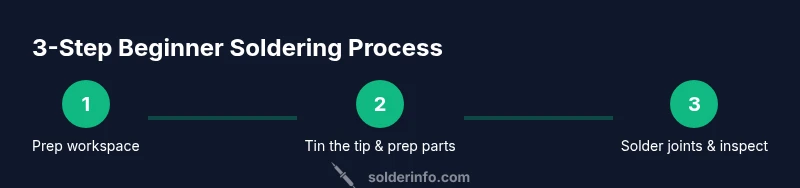
- 1
Prepare workspace and gather tools
Set up in a well-ventilated area. Arrange iron, solder, flux, stand, tweezers, and a small prototyping board within reach. Clear the workspace of flammable materials and ensure power is off when plugging in the iron.
Tip: Keep a water bottle handy and work in stages to avoid heat buildup on components. - 2
Tin the tip and prep the components
Clean and tin the iron tip on the sponge or brass wool. Pre-tin the wire ends or small pads you’ll solder so solder wets quickly when you join pieces.
Tip: A tinned tip helps heat transfer and reduces warping of delicate leads. - 3
Position components and apply flux
Place the LED and resistor or other components on the protoboard. Apply a thin layer of flux to the contact areas to improve solder flow and reduce oxidation.
Tip: Flux first; it dramatically improves joint quality and reduces required heat. - 4
Apply heat and form the joint
Touch the soldering iron tip to the joint briefly, then feed solder into the opposite side until a clean, shiny fillet forms. Remove heat and let the joint cool undisturbed.
Tip: Avoid moving the joint while the solder cools to prevent cracks and weak joints. - 5
Inspect, test, and clean up
Check for shiny, conical joints with no bridges. If needed, reflow and adjust. Use a multimeter to verify continuity. Clean the board with isopropyl alcohol after soldering.
Tip: If a joint looks dull or has a blob, rework it carefully rather than adding more solder.
Quick Answers
What is the easiest soldering project for beginners?
A simple LED with a resistor on a perfboard is ideal for beginners. It teaches heat control, correct resistor sizing, and reliable joints without risking sensitive parts.
A simple LED with a resistor on a perfboard is a great first soldering project.
Which tools are essential for starter projects?
A temperature-controlled soldering iron, lead-free solder, flux, a stand, safety glasses, tweezers, wire cutters, and a prototyping board are essential. A desoldering wick is helpful for mistakes.
Essential tools include a temperature-controlled iron, lead-free solder, flux, and safety glasses.
How can I avoid cold solder joints?
Keep the joint heated evenly, avoid moving components while the solder cools, and ensure the tip is clean and properly tinned before making contact.
Keep the joint hot and don't move components until the joint cools.
Is lead-based solder safe for beginners?
Lead-free solders are generally recommended for safety and ease of handling, especially for beginners working in shared spaces. Work in a well-ventilated area.
Lead-free solders are safer for beginners.
How long should I practice before attempting more complex projects?
Practice regularly in short sessions and gradually increase project complexity as your confidence grows. Track your progress to know when you're ready for a new challenge.
Practice regularly, gradually increasing difficulty.
Can I practice soldering without electronics?
Yes. You can practice tinning wires, cleaning joints, and rehearsing heat control on simple metal pieces or test-circuits to build muscle memory before working on real electronics.
Yes, practice can happen with simple metal pieces to build muscle memory.
Watch Video
Top Takeaways
- Learn core soldering steps with safe, simple projects.
- Build confidence through consistent practice and clean joints.
- Use flux and a properly heated iron to ensure reliable results.
- Progress gradually to more complex circuits and applications.