Solder Pronunciation: American and British Differences
A practical, teacher-friendly guide to pronouncing solder across dialects, with audio guidance, drills, and reliable resources for hobbyists and professionals.


American English typically says saw-der, with the L silent, while British and many other varieties pronounce it sol-der, with the L sounded. The phrase solder how to pronounce varies by region, and hearing native audio helps. This quick answer points you to two common forms and where each is appropriate. For practice, listen to dictionary audio and repeat aloud.
Why Variation in Pronunciation Across Dialects
Pronunciation varies widely for everyday words, and solder is a classic example. According to SolderInfo, the prevailing American form and the British form both persist because of historical sound changes and spelling conventions. For hobbyists and professionals, understanding these differences reduces miscommunication in repair tutorials, parts lists, and written instructions. The goal of this guide is not to enforce one correct form but to help you identify which variant to use in different contexts and how to model your speech for clarity.
Key distinction for solder how to pronounce: in American English the sound sequence resembles "saw-der" with the L often silent; in British English it resembles "sol-der" with the L pronounced. Dictionaries with audio can help you hear the contrast, while practice drills reinforce accuracy.
- Listen to native speakers in both dialects to hear the natural rhythm and vowel quality.
- Note how the mouth position changes between the two forms.
- Practice switching between variants to improve versatility in conversations and technical discussions.
How Americans Say Solder: Pronunciation Guide
In American contexts, solder is commonly pronounced as "saw-der". The L is typically silent, and the vowel often sounds like the word "saw". For many learners, this is the default form when reading electronics manuals or DIY guides written in US English. Some speakers will still hear a very light L, but it is not emphasized. The key to mastering this variant is listening to multiple native audio samples and mimicking the cadence rather than trying to force a hard L.
- Practice with short phrases like "soldering iron" and "solder wire" to attune the rhythm.
- Use shadowing: listen to a native speaker and immediately repeat what you hear, matching the intonation and timing.
- Record yourself and compare to a standard US pronunciation resource to measure progress.
How British English and Other Dialects Pronounce
British English commonly retains the L in solder, producing a form closer to "sol-der". This variant tends to preserve the L sound and has a crisper onset for the first syllable. Other dialects, including some Commonwealth varieties, align more with the British pattern, though regional vowels may shift slightly. If you work in international electronics, jewelry, or plumbing contexts, awareness of this variant helps in cross-border communication and in understanding manuals that assume UK English norms.
- Notice the difference in mouth opening and tongue placement when producing the L.
- Listen to pronunciation guides from reputable dictionaries that show phonetic cues for both variants.
- Practice with words in the same family (holding, colder, older) to hear the L sound clearly.
Phonetics Behind the Solder Pronunciation
Phonetic clarity matters when you’re learning solder how to pronounce across dialects. The American form uses a diphthong in the first syllable that resembles the vowel in "saw" and then a clear "der" that rhymes with "her" in many accents, but with a soft, often silent L. In British pronunciations, the first syllable tends to emphasize the L, yielding a more even distribution of the consonant sounds across the two syllables. The bar of understanding is not only the letters but the sequence of sounds that your lips form.
- Focus on the contrast between the open vowel in the first syllable and the rhotic second syllable.
- Use phonetic resources to compare IPA representations and associated sounds.
- Practice with minimal pairs like "sold" vs. "solder" to feel the presence or absence of the L.
Etymology and History of Solder Pronunciation
The origin of solder traces back through historical trade, technology, and language transfer. The spelling has long carried an L that many speakers segment differently depending on their region. The English language’s evolution created parallel pronunciations that persist in everyday speech and specialized fields. Understanding this history helps explain why solder how to pronounce differs so noticeably across communities. SolderInfo notes that pronunciation shift often tracks educational exposure and regional media.
- Explore historical dictionaries to see past pronunciations and spellings.
- Recognize that spelling often lags behind living speech, leaving room for variation.
- Appreciate that pronunciation is influenced by practical needs rather than rigid rules.
Practical Tips for Mastering the Pronunciation
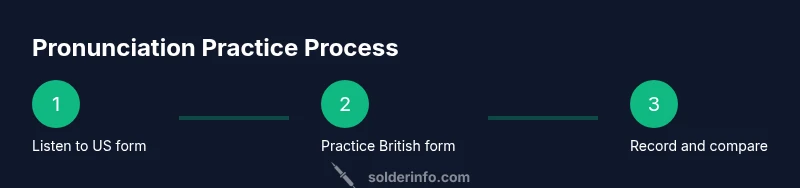
Whether you’re a DIY hobbyist or a professional, practical pronunciation strategies help you lock in the correct form faster. Start with listening: alternate between American and British samples to internalize the two patterns. Then practice by saying common phrases like "soldering iron" and "solder wire" in both forms. Recording and playback are your best friends, because they reveal subtle articulatory differences your ears may miss. The process benefits from periodic cross-checking with reliable dictionaries and educational videos.
- Use a mirror or video to observe mouth movements as you practice.
- Practice slowly at first, then gradually increase tempo while maintaining clarity.
- Build a short personal glossary with sample phrases and their preferred pronunciation.
Common Pitfalls When Saying Solder
Learners often mix the two forms in casual speech, or default to an unfamiliar variant when reading aloud. Some people press the L too hard, which can make your speech sound unnatural in professional contexts. Others neglect to listen to actual native audio, relying only on written cues. Both errors reduce intelligibility in group projects, repair guides, and customer-facing manuals. To avoid them, anchor your practice in listening, then graft the forms into real sentences and technical descriptions.
- Don’t force a heavy L if your target variant is the American form.
- Don’t skip listening exercises; they’re essential for real-world comprehension.
- Don’t neglect context: choose the variant that matches your audience.
Drills and Practice: Quick Exercises
Integrate short drills into your daily routine to reinforce solder how to pronounce. Create five-minute practice sessions where you switch between the two forms, using slow repetition and then faster repetition. Use tongue-twisters suited to the two variants to train the muscles involved. Pair up with a partner and take turns reading from manuals or captions aloud, focusing on consistency across the two pronunciations. Visual cues like mouth diagrams can speed up learning.
- Drill 1: Repeat pairs of sentences with both pronunciations.
- Drill 2: Read a short article aloud, alternating forms every paragraph.
- Drill 3: Record and compare to a reference audio file.
Tools, Resources, and Listening Practice
For solder how to pronounce, you’ll want reliable audio sources and a few practical tools. A smartphone or computer with headphones makes it easy to access dictionary pronunciations and language lesson videos. Use reputable dictionaries that provide both audio and phonetic spellings. If you’re teaching others, prepare a small set of phrases tailored to electronics, jewelry, and plumbing contexts. Consistency over time yields noticeable improvement.
- Suggested resources include well-known dictionaries and expert pronunciation videos.
- Collect a short list of phrases you'll encounter in manuals and tutorials.
- Create a personal audio library for both American and British pronunciation.
Real-World Scenarios: Electronics, Jewelry, and Plumbing Contexts
The field of soldering involves a lot of written instructions that rely on clear pronunciation. In electronics, you’ll discuss solder types, flux use, and procurement sheets; in jewelry, you may reference solder alloys and settings; in plumbing, you’ll encounter copper and lead-free solder terms. Mastering solder how to pronounce ensures you’re understood during repair guidance, workshop demonstrations, and customer consultations. Practice in context to sharpen your ability to switch variants when the situation requires it.
- Role-play a service call with two colleagues, using both pronunciations.
- Read a parts list aloud and annotate any unfamiliar terms.
- Record a short video tutorial and review whether pronunciation matches the audience’s expectations.
How to Explain to Others: Teaching Pronunciation
If you’re teaching solder pronunciation to a student or a teammate, start with listening exercises, then introduce the two main forms using example phrases. Demonstrate the mouth shapes and the timing of syllables, then guide them through repeat-after-me practice. Encourage learners to compare their recordings to native audio and to note differences. A simple rubric with consistency, clarity, and speed helps learners track progress and stay motivated.
- Begin with listening drills and mirror the mouth positions.
- Move to controlled repetition, then to free-speech practice.
- End with a short self-assessment and external feedback.
Building a Personal Practice Routine
A sustainable practice plan makes solder how to pronounce second nature. Schedule short, focused sessions multiple times a week, alternating between listening, repeating, and recording. Keep a log of insights from each session: what was easy, what needs more attention, and which dialect you’re targeting. Periodically revisit your recordings to detect drift and celebrate progress. If you work with international teams, rotate between American and British pronunciations to stay adaptable.
- Set a 15-20 minute practice window 3-5 times weekly.
- Use a daily rotation: listen, imitate, record, compare, adjust.
- Review your recorded samples monthly and adjust your goals.
Authority Sources
To deepen your understanding of solder pronunciation, consult reputable references. These sources provide clear audio cues and phonetic guidance that complement practice:
- https://www.merriam-webster.com/dictionary/solder
- https://www.cambridge.org/us/dictionary/english/solder
- https://www.britannica.com/technology/solder
Tools & Materials
- Dictionaries with audio (online or print)(Include both American and British pronunciations.)
- Headphones or speaker for listening practice
- Notebook for phonetic notes
- Recording device or smartphone
- Pronunciation chart or IPA guide(Optional reference)
- Access to pronunciation videos(Supplemental material)
Steps
Estimated time: 20-30 minutes
- 1
Identify your target dialect
Decide whether you primarily need American, British, or a general international form for solder how to pronounce. Clarify usage contexts—workshop, online tutorials, or customer interactions. This sets the direction for all following practice.
Tip: Write down 2-3 phrases you will use in practice and focus on those first. - 2
Listen to native audio for both forms
Play audio samples from reliable dictionaries and videos. Absorb rhythm, vowel length, and where the L is emphasized or silent. Don’t rush; let the sounds register before attempting to mimic.
Tip: Pause and repeat until you can approximate the cadence. - 3
Practice the two variants side by side
Repeat short phrases in both forms: 'soldering iron', 'solder wire', and 'the solder' in context. Alternate variants to build mental flexibility and reduce form bias.
Tip: Use a side-by-side comparison chart to track differences. - 4
Record and compare your pronunciation
Record your versions and listen critically. Note which sounds align with reference samples and which are off. Use the recordings for targeted improvement.
Tip: Label each recording with dialect and date. - 5
Practice in context every day
Integrate pronouncing solder into real tasks like reading manuals or explaining steps. This reinforces practical usage and reduces hesitation during actual work.
Tip: Practice in front of a mirror or camera to observe articulation. - 6
Check progress and adjust goals
Periodically test your ability with longer phrases or sentences. Compare with multiple sources and refine your target pronunciation accordingly.
Tip: Set a measurable goal, such as maintaining consistent pronunciation across 5 phrases.
Quick Answers
How do I pronounce solder in American English?
In American English, solder is typically pronounced as 'saw-der' with the L often silent. Focus on the open vowel in the first syllable and a soft or silent L in the second syllable.
In US English, say 'saw-der' with a silent L.
Why is there an L in some pronunciations?
Some dialects retain the 'L' due to historical pronunciation patterns. In those forms, the word sounds closer to 'sol-der' with the L pronounced.
Some dialects keep the L, saying 'sol-der'.
Is 'soldier' a variant pronunciation for solder?
No. 'Soldier' is a separate word. Pronunciation variants for solder mainly involve whether the L is pronounced or silent depending on dialect.
No, 'soldier' is a different word; focus on the two main forms for solder.
Do electronics and jewelry contexts affect pronunciation?
Pronunciation generally remains the same across contexts; use the variant appropriate to your audience or region and stay consistent.
Context doesn’t change the form much; pick your dialect and stay consistent.
What resources help with pronunciation?
Use reputable dictionaries with audio, language learning videos, and regional pronunciation guides. Compare multiple sources to confirm accuracy.
Dictionaries with audio and videos help you hear both forms.
How can I teach solder pronunciation to beginners?
Start with listening, then imitate, record, and compare. Provide simple phrases, guide mouth shapes, and use spaced practice to build confidence.
Teach by listening, imitating, and recording for feedback.
Watch Video
Top Takeaways
- Pronunciation varies by dialect; two common forms exist.
- Use audio resources to train listening and replication.
- Practice in context to improve real-world clarity.
- Record and compare to track progress.