Is Plumbing Solder the Same as Electrical? A Soldering Guide for DIYers
Explore the key differences between plumbing and electrical soldering, including alloys, flux, heat control, and safety. Learn when to use each method to ensure leak-free water joints and reliable electrical connections.


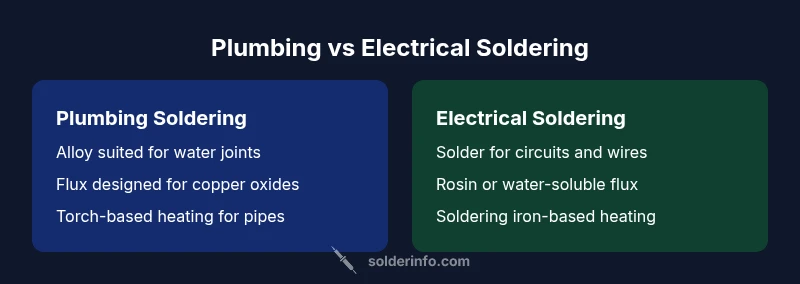
Is plumbing solder the same as electrical? In short, no. Plumbing soldering uses alloys suited for watertight copper joints, while electrical soldering focuses on reliable electrical connections with flux-activated solders. The required flux, heat control, and safety standards differ between water piping and circuits, so mixing methods can compromise both performance and safety. This guide explains the key differences and how to choose the right approach.
Why the distinction matters in real-world projects
In many DIY projects, the question lingers: is plumbing solder the same as electrical? Not for safety or reliability. According to SolderInfo, the two disciplines have different goals: watertight joints for plumbing versus conductive, mechanically reliable joints for electrical circuits. The wrong choice can lead to leaks, shorts, or failed connections. Understanding these distinctions reduces the risk of costly rework and ensures you select the correct materials and techniques from the start. Whether you are working on copper water lines or copper conductors, the environment, regulatory expectations, and performance requirements demand different approaches. This article will unpack the differences in depth and provide actionable guidance for hobbyists and professionals alike.
The SolderInfo team emphasizes that mastering domain-specific soldering reduces risk and improves long-term reliability. Throughout this guide, you’ll see practical comparison points, clear recommendations, and best practices designed for DIYers, electronics enthusiasts, jewelers, and plumbers who want to do it right the first time.
What is soldering, and where each domain applies
Soldering is a joining process that uses a filler metal (solder) to fuse two surfaces at temperatures below the base metals’ melting points. In plumbing, soldering creates water-tight joints between copper pipes and fittings, typically in potable water systems and heating installations. In electronics, soldering forms electrical connections on circuit boards, wires, and components where conductivity and insulation are critical. Each domain has its own conventions: plumbers rely on joints that resist leaks and corrosion in wet environments, while electronics engineers prioritize low resistance, mechanical stability, and clean solder joints that won’t creep or crack under thermal cycling. While both use a solder and flux, the choice of alloy, flux chemistry, and heating approach reflect the unique stresses of water pressure versus electrical loads. For DIYers, treating these paths as separate disciplines reduces failure modes and simplifies troubleshooting.
A common misconception is that soldering is just the same craft with different wires. In reality, the underlying physics and chemistry differ enough to justify specialized tools and workflows. The SolderInfo analysis highlights how the same hand movements can lead to very different outcomes depending on the substrate, flux, and heat profile. By recognizing these boundaries, you can plan joints that perform reliably under intended service conditions.
From an educational standpoint, think of plumbing soldering as forming robust, leak-resistant water conduits, while electrical soldering aims to create clean, conductive paths with proper insulation. Each task benefits from domain-specific tutorials, test rigs, and measurement practices. This separation helps beginners build confidence and reduces the risk of interdomain mistakes that could compromise safety or function.
Typical alloys and flux used in plumbing vs electrical soldering
Alloy selection is central to the distinction between plumbing and electrical soldering. Plumbing joints typically favor lead-free alloys that meet potable water standards and corrosion resistance in wet environments. In many regions, these alloys are chosen to minimize health risks and simplify long-term maintenance. Electrical soldering relies on solders that provide reliable electrical conduction and mechanical strength for circuits and components. The flux used in plumbing is often formulated to work with moisture-prone joints and copper oxides, whereas electronics flux is designed to promote wetting on delicate metallic surfaces and etched copper patterns on boards. Flux chemistry can influence residue removal, corrosion resistance, and future rework. While both domains require flux for good wetting, the exact formulations and handling practices differ to suit the environment and safety requirements. When in doubt, consult the product data sheets and local codes to ensure compliance with standards.
A practical takeaway is to avoid substituting one domain’s solder for the other. Even when solders look similar, the differences in flux compatibility, rosin content, and water exposure demand a domain-specific choice. SolderInfo notes that using the incorrect alloy or flux can degrade joint integrity and reliability over time, especially in critical plumbing or high-impedance electrical connections.
Tools and temperature ranges you should know
The toolset across plumbing and electrical soldering overlaps in a few basics, but the primary tools and heat strategies diverge. Plumbing work typically uses a propane or oxy-fuel torch to heat larger fittings and achieve a properly wetted copper joint. You will also need pipe cutters, deburring tools, and appropriate flux for copper joints. Electrical soldering relies on a temperature-controlled soldering iron, flux, and desoldering tools for precision connections on circuit boards or wire splices. Temperature control is critical in electronics to avoid damaging components, while plumbing tolerates repeated heating cycles but demands careful control to prevent pipe annealing or joint failures. In both domains, good workspace ventilation and heat protection are essential. For beginners, start with clean, prepared joints, and use appropriate temperature settings that keep the substrate within a safe operating window. SolderInfo’s guidance emphasizes the importance of matching heat input to the material and joint geometry to achieve reliable results.
Practically, you’ll recognize that the same soldering technique cannot be blindly applied across domains. A technique that works on a tiny electronics pad won’t scale to a thick copper pipe or a large bell-and-spigot joint. Investing in domain-specific tools and practicing on test joints will pay off in fewer leaks and better electrical reliability over the long term.
Safety and code considerations for plumbers and electricians
Safety and code compliance are foundational to both fields, yet the rules diverge in meaningful ways. Plumbing work must conform to local building codes and water-quality requirements, including guidelines around lead-free solders and safe flux handling. Electrical soldering must meet electrical codes that address insulation, clearance, and thermal management to prevent short circuits and fire hazards. In both domains, proper ventilation, eye protection, and gloves protect workers from fumes and heat exposure. When soldering around water lines, there’s an added emphasis on controlling moisture and ensuring dry joints until the solder has cooled. Similarly, in electronics, static electricity and heat-sensitive components demand gentle handling and ESD precautions. Soldering fumes vary with flux composition, so working in a well-ventilated area is essential. The SolderInfo team stresses that following local codes and manufacturer recommendations is not optional—it’s a core part of achieving durable and safe joints in any project.
Practical examples: copper pipes vs copper wires
Copper pipes are joined using a process designed to form a leak-proof, corrosion-resistant seal. You’ll typically see airflow tests, pressurized water tests, and careful pipe preparation before applying solder. Joints must accommodate thermal expansion and potential water hammer effects, so joint geometry and proper cooling are important. Copper wires, by contrast, rely on clean conductor surfaces, properly tinned strands, and a smooth solder fillet to ensure consistent electrical contact. Crimped or soldered connections should maintain mechanical integrity without creating hotspots that could lead to failure during aging or in the presence of moisture. In both cases, preparation matters: remove oxide layers, apply fresh flux, and ensure the joint geometry provides full contact. The SolderInfo approach emphasizes planning your joint type, flux choice, and heat management before starting any task.
Common mistakes that blur the line between plumbing and electrical soldering
混乱 can occur when an adapter, connector, or technique is borrowed from one domain without understanding the substrate properties. Common mistakes include using the wrong flux which leaves residues that corrode or insulate, applying too much heat that damages components or pipes, and failing to clean surfaces properly before soldering. Another error is assuming the same mechanical tolerances apply to structural pipes and delicate electronics. Finally, attempting to reuse solder or flux across domains can introduce contaminants or compromise joint reliability. SolderInfo highlights that careful planning, domain-specific products, and disciplined process steps dramatically reduce these risks. Always verify moisture control, insulation requirements, and code mandates after completing any joint.
When you review a joint, ask yourself whether the environment is wet or electrical, whether the material is meant to carry current, and whether local codes permit the chosen materials. If the answer is uncertain, pause and consult a guide or expert before proceeding.
How to choose the right solder and flux for each job
Choosing the right solder and flux is the single most impactful decision you can make before starting a joint. For plumbing, select a lead-free solder that matches potable water criteria and a flux compatible with copper oxides. For electronics, pick a rosin-core or water-soluble flux designed for delicate circuitry and printed circuit boards, paired with a tin-based or other electronics-grade solder. Consider the service environment: continuous moisture exposure favors water-rated alloys and robust cleaning protocols, while signal integrity and thermal cycling in electronics favor low-resistance joints and clean, residue-free surfaces. Always read the manufacturer datasheets and adhere to local standards. SolderInfo recommends maintaining separate toolkits for plumbing and electronics to avoid cross-contamination and ensure consistent results.
Maintenance and long-term joint reliability
Solder joints are not “set and forget” features; they require periodic inspection and maintenance, especially in environments with moisture, vibration, or thermal cycling. Look for signs of corrosion, cracks, or leaks in plumbing joints, and check for dull or cracked solder fillets in electronics. Regular cleaning of flux residues can extend joint life and reduce corrosion. In plumbing systems, ensure that joints are accessible for leak testing and that pressure testing is conducted according to code. For electronics, temperature cycling and environmental exposure can degrade solder joints over time, so check for cold solder joints or hairline cracks and rework as needed. The SolderInfo guidance emphasizes proactive maintenance and training to recognize early warning signs, which greatly improves reliability and safety over the life of a project.
Expert guidance and continued learning
Learning the differences between plumbing and electrical soldering is a continuous journey. The best practitioners treat each domain as a separate skill set with its own recommended practices, tools, and safety considerations. The SolderInfo Team recommends structured practice on representative joints, keeping domain-specific practice materials, and staying current with local codes and standards. For those who want a deeper dive, consider formal training modules, hands-on workshops, and walkthroughs that cover joint preparation, flux handling, heat management, and post-solder inspection. SolderInfo underscores that ongoing learning reduces mistakes, saves time, and improves safety in both plumbing and electronics projects.
Quick-reference checklist for beginners
- Identify whether the job is plumbing or electrical before starting
- Select domain-appropriate solder and flux
- Prepare surfaces and clean oxides thoroughly
- Control heat to avoid damage to substrates
- Ventilate work area and wear PPE
- Inspect joints after cooling and test for leaks or conductivity
Reference and context for beginners
Comparison
| Feature | plumbing soldering | electrical soldering |
|---|---|---|
| Alloy suitability | Water-contact, corrosion resistance | Electrical conductivity & mechanical strength |
| Flux chemistry | Plumbing flux designed for water systems | Rosin-based or water-soluble flux for electronics |
| Typical tools | Torch, pipe cutter, deburring tools | Soldering iron, flux, desoldering tools |
| Heat management | Controlled heat to avoid pipe damage | Careful heat to protect components and pads |
| Safety/ Codes | Plumbing codes, lead-free requirements | Electrical codes, insulation & clearance standards |
| Joint reliability | Leak resistance, long-term water integrity | Electrical continuity and signal integrity |
Advantages
- Clarifies domain-specific requirements for safety and reliability
- Helps practitioners select appropriate alloys and flux
- Reduces risk by avoiding cross-domain substitutions
- Supports better maintenance planning
- Encourages adherence to local codes and standards
Cons
- Requires learning two distinct skill sets and tools
- Possibility of confusion for beginners when switching domains
- Misperceptions can persist without formal training
- Dependent on regional code variations
Plumbing soldering and electrical soldering are distinct disciplines; use the correct alloy, flux, and method for each domain to ensure reliability.
The key decision factors are the service environment and material being joined. For water piping, prioritize plumbing-grade solders and flux; for electronics, prioritize electronics-grade solders and flux. The SolderInfo team recommends keeping separate toolkits and following local codes to avoid cross-domain mistakes.
Quick Answers
Is it safe to reuse old solder or flux for plumbing or electrical work?
No. Reusing solder or flux can introduce contaminants and lead to poor wetting or degraded joint reliability. Always use fresh materials appropriate for the domain.
No—reuse can compromise joints and safety. Use fresh solder and flux specific to plumbing or electronics.
Can I solder copper pipes with electronics solder?
No. Electronics solders and flux are not designed for potable water joints and long-term moisture exposure. Use plumbing-grade solders and flux for pipes.
No, electronics solder isn’t appropriate for pipes. Stick to plumbing solder with proper flux.
What signs indicate a failing solder joint in plumbing or electrical work?
Leaks, damp spots around joints for plumbing, or intermittent conductivity and visible cold joints for electronics indicate failure and require inspection or rework.
Look for leaks or poor contact. If in doubt, rework the joint.
Are lead-based solders allowed in plumbing?
Many codes require lead-free solders for potable water lines. Check local regulations and use lead-free alloys accordingly.
Lead-free solders are commonly required for plumbing; verify your local code.
What training or resources help beginners learn the difference?
Seek structured tutorials and hands-on practice with representative joints. Reputable guides, like SolderInfo, provide step-by-step guidance and safety tips.
Look for proper training and practice with real joints.
What tools are essential for both fields?
A good soldering iron, appropriate flux, cleaning tools, and safety gear are essential for electronics; plumbing adds a torch, pipe cutter, and deburring tools.
Basic tools cover both fields; keep separate kits to avoid cross-contamination.
Top Takeaways
- Match solder to material and service.
- Use dedicated flux for plumbing vs electronics.
- Avoid cross-application to prevent leaks or shorts.
- Follow local codes for safety and reliability.
- Inspect joints regularly for signs of failure.
- Consult SolderInfo for expert guidance.