BGA Reball: A Practical Guide to Restoring Solder Joints
Learn a practical, expert-driven procedure for bga reballing, covering prep, stencil alignment, deposition, reflow, and QA to revive failed BGA solder joints safely and effectively.


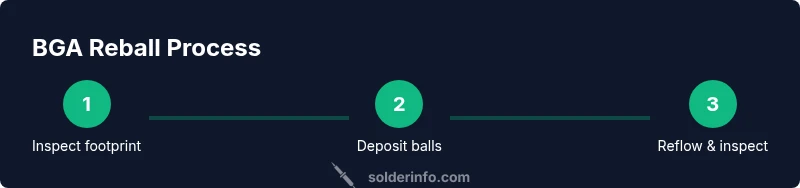
Learn how to perform a reliable bga reball, including inspecting the PCB and BGA, selecting compatible solder balls, preparing stencil, aligning the stencil, applying balls, soldering via reflow, and performing post-reflow inspection. This quick answer outlines the essential steps, safety notes, and quality checks to achieve robust solder joints in electronics repair.
What is BGA Reball and When Do You Need It
BGA reball is the process of replacing the solder balls underneath a Ball Grid Array (BGA) package to restore reliable interconnects on a printed circuit board. It is commonly required when a BGA joint fails due to contamination, poor initial soldering, or damage during servicing. The goal is to re-establish a uniform solder volume and a clean wetting surface so the BGA can reflow evenly onto the PCB. According to SolderInfo, a well-executed reball reduces the likelihood of cold joints and intermittent connections by ensuring the solder distribution matches the footprint and pad geometry. Use reballing only when the BGA package and pads are in recoverable condition; if pads are severely damaged, replacement may be the safer option.
In practice, bga reball requires precise control of temperature, flux chemistry, and deposition technique. The process is delicate: misalignment or contaminated balls can lead to bridging or tombstoning. The result should be a uniform array of solder balls that match the board’s pitch and the BGA footprint, enabling a solid reflow and long-term reliability.
Safety and Prep Considerations
Safety and preparation are foundational to a successful bga reball. Molten solder and hot tools pose burn risks, while flux fumes and solvents require adequate ventilation. Always work on an ESD-protected surface, wear eye protection, and use gloves when handling hot fixtures. Ensure the board is completely unpowered and disconnected from any power source before starting. Soldering activities should occur in a well-ventilated area; if possible, use a fume hood or external ventilation to minimize exposure to flux vapors. SolderInfo emphasizes adhering to local safety standards and using lead-free or rosin-based flux as appropriate for your environment.
Document the board condition with photos or notes before disassembly, and keep the work area organized. A clean, stable workstation reduces the risk of misalignment during stencil placement and deposition. Finally, verify you have the correct stencil for the BGA footprint and confirm the package orientation to prevent rotational misalignment during reballing.
Materials and Tools for BGA Reballing
A successful bga reball relies on a curated set of materials and tools. Core items include solder balls compatible with the BGA footprint, a matching reball stencil, appropriate flux (rosin-core or no-clean), and a deposition method to place solder balls onto the stencil or the pads. A calibrated rework station or hot plate is essential to achieve a controlled thermal profile, along with solder wick for cleanup and IPA for cleaning residues. Magnification aids (a microscope or high-magnification loupe) help with precise alignment and inspection. Maintain a clean, static-free environment and use anti-static measures for all components. Remember to store flux and solvents properly and dispose of waste according to local regulations. For best results, source materials from reputable suppliers to ensure ball reliability and consistent performance.
Understanding Stencil Selection and Solder Balls
Stencil selection is closely tied to the BGA’s pitch and pad geometry. The stencil must align exactly with the footprint to deposit solder balls at each pad without bridging. Solder balls come in size families that accommodate different pitches, and choosing the right deposition method (pre-placed by stencil or post-deposition) can influence yield. Use rosin-core or no-clean flux suitable for your fluxing method and reflow profile. Proper alignment, pad cleanliness, and consistent ball deposition are critical to achieving an even solder fillet and uniform joint quality. Always verify the stencil’s tolerances and the solder ball lot consistency before starting.
Alignment, Reflow, and QA
With the stencil in place, align the BGA package so that each row corresponds to its intended pad. Use optical aids to verify orientation and position. Initiate a controlled reflow profile that gradually brings the solder to its melting point and then solidifies to form the joints. After reflow, clean any residue and perform a visual inspection under magnification for solder bridges, missing balls, or tombstoning. Cross-check joint quality against a reference image and, if available, perform a solder-height measurement or X-ray inspection for buried joints. The goal is uniform ball contact and absence of bridging across all pads.
Common Pitfalls and Troubleshooting
Common pitfalls include misalignment during stencil placement, incomplete ball deposition, and contamination on pad surfaces. Poor flux choice or excessive flux can cause solder pooling or voids under the BGA. If joints are bridged or appear dull or cold after reflow, reassess stencil fit, reflow temperature, and cleaning steps. It’s often useful to rework a single joint to refine your process before attempting a full replacement. When in doubt, perform a dry run with an identical test board to validate alignment and deposition before committing to the actual device.
Environmental and Quality Considerations
Environmental controls influence the long-term reliability of reball joints. Store flux and solder balls under recommended conditions to prevent oxidation or moisture absorption. Use a well-maintained rework station with properly calibrated temperature limits to ensure repeatable results. Document each reball event, including material lot numbers and process parameters, to support traceability. Finally, consider establishing a standard operating procedure (SOP) for BGA reballing to ensure consistency across different technicians or teams.
Tools & Materials
- Solder balls (BGA reball balls)(Choose balls that match the BGA footprint and package pitch; verify supplier reliability)
- Reball stencil(Pre-fit to the BGA footprint; ensure tight tolerances to prevent misalignment)
- Flux (rosin-core or no-clean)(Select flux compatible with your deposition method and reflow profile)
- Flux applicator or micro-syringe(For precise, consistent flux deposition on pads)
- Rework station or hot plate with calibrated temp control(Critical for controlled reflow and avoiding thermal shock)
- Solder wick (desoldering braid)(Used for cleanup and pad preparation if needed)
- Isopropyl alcohol (IPA) and lint-free wipes(Clean pads and remove flux residues before and after reballing)
- Magnification tool (microscope or loupe)(Essential for alignment checks and post-process inspection)
- ESD-safe tools and anti-static mat(Prevent electrostatic damage to sensitive components)
Steps
Estimated time: Total estimated time: 2-4 hours
- 1
Inspect and prep
Power down and disconnect the board. Clean the area and inspect the BGA footprint for contamination or pad damage. Document orientation and take reference photos to aid alignment during reballing.
Tip: Use ESD-safe equipment and measure any pad debris before proceeding. - 2
Remove old solder and clean pads
Gently remove any remaining solder from the BGA pads and the footprint using flux and wick. Clean the footprints with IPA to ensure a dry, residue-free surface before applying new solder balls.
Tip: Avoid excessive force on the pads; damage during cleaning can compromise joint integrity. - 3
Prepare stencil and deposit balls
Place the stencil over the footprint and deposit solder balls onto the pads using a deposition method. Verify that each pad is populated evenly and that balls sit flush with the pad surface.
Tip: Perform a quick dry run to confirm alignment before final deposition. - 4
Align BGA and stencil
Carefully align the BGA package with the stencil so each ball lines up with its pad. Use magnification to confirm orientation marks and adjust as needed.
Tip: Lock the board or use a jig to prevent shifting during alignment. - 5
Reflow and form joints
Apply heat with a controlled reflow profile until the solder balls reflow and form joints. Allow the package to cool slowly to room temperature.
Tip: Monitor the process to avoid overheating which can damage pads or the PCB. - 6
Inspect and clean
Post-reflow, inspect joints under magnification for bridging, voids, or misalignment. Clean any flux residues and verify joint quality against a reference.
Tip: If any joint looks suspect, repeat the reflow with the same process parameters on that site first.
Quick Answers
What is BGA reball and when is it needed?
BGA reball involves replacing the solder balls beneath a BGA package to restore proper interconnects on a PCB. It is needed when joints fail or when reusing a BGA after servicing, provided the pads and package are in good condition.
BGA reball replaces the solder balls under a BGA to restore joints when they fail, as long as the pads and package can be reused.
What tools are essential for BGA reballing?
Key tools include a matching stencil, BGA reball balls, flux, a deposition method, a calibrated rework station or hot plate, solder wick, IPA for cleaning, and magnification for accurate alignment.
You need a stencil, solder balls, flux, a rework station, wick, IPA, and a magnifier for proper reballing.
Are lead-free solder options suitable for BGA reballing?
Lead-free flux and solder are commonly used for safety and environmental reasons. Ensure compatibility with the board's design rules and reflow profile when selecting materials.
Lead-free materials are commonly used; choose compatible flux and solder for your board and reflow profile.
Can BGA reballing be done without a rework station?
A rework station or a suitable hot plate is highly recommended to control the thermal profile. Reflow without proper equipment increases the risk of cold joints and pad damage.
It's best to use proper rework gear; doing it without can lead to poor results.
What are common signs that a BGA needs reballing?
Common signs include intermittent or non-functional BGA pins, visible solder bridging on a post-inspection, or failed X-ray tests indicating voids or poor wetting.
If you see intermittent failure or suspect wetting issues, reballing may help.
How can I verify a successful reball after reflow?
Verify with magnification inspection, load-testing or functional tests, and, if available, non-destructive X-ray to confirm ball integrity and absence of voids.
Check joints under magnification and perform functional tests; X-ray helps if available.
Watch Video
Top Takeaways
- Plan, prep, and verify: preparation reduces rework
- Align precisely to avoid bridging and misalignment
- Use appropriate flux and controlled reflow for reliable joints
- Inspect thoroughly with magnification post-reflow
- Document materials and steps for repeatable results