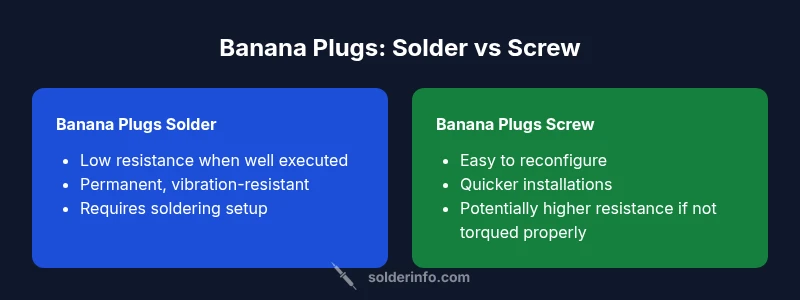
Banana Plugs Solder vs Screw: Practical Comparison
A detailed, analytical comparison of banana plugs solder vs screw terminations for electronics, audio, and DIY. Learn performance, installation, durability, and best-use scenarios to select the right method.


Banana plugs solder vs screw: which termination delivers reliable performance for electronics, audio, and DIY projects? This quick comparison weighs electrical contact quality, ease of installation, and long-term durability. According to SolderInfo, soldered banana plugs offer lower and more stable contact resistance in fixed installations, while screw-type terminations excel in modular or field-service setups where quick adjustments are required.
banana plugs solder vs screw: An Overview
In the world of banana plug terminations, two broad approaches dominate: soldered banana plugs and screw-terminal banana plugs. The choice influences electrical performance, mechanical reliability, and how you approach maintenance. The term banana plugs solder vs screw is commonly used in electronics, audio, and DIY contexts to contrast a fixed, soldered connection against a removable, screw-based termination. For most hobbyists and professionals, the decision hinges on whether you prioritize a permanent, low-resistance contact or flexibility for future changes. Across types of equipment—from signal generators to loudspeakers—the right choice depends on how often you expect to modify wiring, how much space you have, and how rigorous your safety practices must be. This article uses the banana plugs solder vs screw framework to explore the nuanced trade-offs for reliable wiring.
What Banana Plugs Solder vs Screw Are Made For
Both approaches address a simple goal: create a solid, low-resistance electrical path between a wire and a device’s banana jack. Soldered banana plugs integrate the conductor with a solder fillet that bonds to the plug’s terminal, ideal for permanent installations where movement is minimal. Screw banana plugs use a small set screw or clamping mechanism to pinch the conductor, offering rapid disassembly and reconfiguration. Each method has its own manufacturing tolerances, insulation considerations, and recommended wire gauges. Understanding these basics helps you anticipate potential issues, such as solder wicking, cold joints, or loose screws that increase resistance or loosen over time. In many lab or studio environments, the banana plugs solder vs screw decision reflects how often teams rewire gear and how critical consistent contact is to signal integrity.
Electrical Performance Differences
Electrical performance is a core differentiator in the banana plugs solder vs screw debate. A properly soldered termination typically provides a lower contact resistance once cooled and settled, thanks to a continuous metal bridge between wire and plug. Conversely, a screw-based termination relies on mechanical pressure, which can vary with torque, wire stripping quality, and terminal seating. Poor solder joints can introduce intermittent faults or elevated resistance if flux residues are not cleaned. Screw terminations may exhibit slightly higher effective resistance but can be advantageous in environments where high humidity or temperature fluctuations might degrade a brittle solder joint. In RF or audio-signaling scenarios, both approaches should maintain clean contact surfaces and proper insulation to minimize parasitics.
Mechanical Reliability and Strain Relief
Mechanical reliability is another key consideration in banana plugs solder vs screw. Soldered terminations tend to be more vibration-resistant in fixed installations because the wire is physically bonded to the plug. However, solder joints can be damaged by repeated bending or thermal cycling if strain relief is inadequate. Screw-based terminations offer easier field maintenance: you can loosen and re-seat wires without re-soldering, which reduces downtime but introduces potential issues if the screw loosens or the clamping mechanism corrodes. A robust design combines adequate strain relief with locking features or thread-resistant fasteners to preserve both contact integrity and mechanical stability. Ultimately, the long-term durability depends on wire gauge compatibility and the quality of the terminal design.
Safety Considerations and Heat Management
Safety is a critical factor in choosing between banana plugs solder vs screw. Soldered connections require careful heat management to avoid insulation damage or melted jack housings, especially with larger gauge wires or high-current applications. Flux residue should be cleaned to prevent leakage paths, and insulating sleeves or heat shrink should be used where exposed metal could contact other conductors. Screw-based terminations reduce heat exposure risk during installation since there’s less heat involved, but ensure screws are tightened to the recommended torque and insulated where needed. Regardless of method, avoid over-tightening, which can deform the plug or damage the banana jack, and always follow device manufacturer guidelines for safe operation.
Installation Difficulty and Tool Requirements
Installation complexity is often the deciding factor for banana plugs solder vs screw. Soldering demands a basic soldering setup (iron, flux, solder, proper ventilation) and some skill to avoid cold joints or overheating the wire. Screw terminations require a small screwdriver and a wire stripper, plus a check for secure clamping. In environments where tools are scarce or space is tight, screw-terminals can be installed quickly, while soldered options might offer better long-term stability in bench setups. Consider your typical workflow: if you rewire frequently, screws may save time; if you want maximum signal stability in a fixed installation, soldering might be preferable.
Signal Integrity and High-Frequency Considerations
Signal integrity at higher frequencies is influenced by the quality of the connection, including contact area and plating quality. Soldered joints can provide a continuous electrical path with minimal discontinuities when made correctly, supporting cleaner high-frequency performance and reduced contact resistance. Screw-terminals can introduce minor impedance discontinuities if the wire is not perfectly seated or if the clamp creates micro-gaps. For lab-grade measurements or precision audio equipment, maintain tight tolerances, use quality materials, and verify that the connection remains clean and free of corrosion. Regular inspection helps ensure banana plugs solder vs screw connections remain optimal over time.
Durability Under Vibration and Longevity
In real-world usage, vibration and long-term cycling test a connection’s durability. Soldered banana plugs generally fare well in fixed installations subject to movement-free, stable environments. They can survive extended thermal cycling if the insulation and strain relief are well designed, but rapid bending near the joint can introduce micro-cracks. Screw-based terminations can tolerate more frequent reconfiguration, yet the mechanical clamping surfaces may wear, leading to gradual loosening. The best practice combines secure mounting, robust wire preparation, and appropriate insulation to minimize wear in either approach. For noisy or mechanically demanding settings, route cables away from vibration sources and use grommets or cable management to reduce stress at the termination.
Cost, Availability, and Maintenance Implications
From a cost perspective, banana plugs solder vs screw approaches typically differ in capital and labor costs rather than material costs. Soldered terminations require solder and flux, plus time for proper technique, which adds labor cost but can reduce future maintenance if wiring is permanent. Screw-terminals reduce upfront tooling needs and enable quick swaps, but hardware wear and the need for occasional re-tightening can add maintenance overhead. Availability is generally good for both styles, though high-end industrial connectors may favor one approach due to compatibility with existing equipment. When budgeting, consider not only the plugs but also the overall system durability and ease of future servicing.
Application-Specific Guidance: Audio, Lab, and DIY Projects
Different applications benefit from tailored choices. For audio systems where long-term stability and minimal signal degradation are paramount, soldered banana plugs often win in fixed installations such as loudspeaker wiring in studios. In lab benches or test rigs requiring frequent reconfiguration, screw-type banana plugs shine due to fast re-termination. DIY projects with unknown future needs might start with screw-terminals for flexibility, while still maintaining a plan to rework if a dedicated fixed layout is established. Remember to match wire gauge, insulation, and plug design to your device’s banana jack footprint and to observe safety guidelines.
Practical Step-by-Step: Choosing and Implementing
- Assess how often you’ll rewire: if rarely, consider solder. 2) Check wire gauge compatibility with the plug’s clamp or solder cup. 3) Inspect insulation and strain relief options to prevent shorts. 4) If using solder, clean flux residues and apply a neat fillet without excessive heat. 5) If using screws, tighten to recommended torque and verify conductor seating. 6) Test continuity with a multimeter and inspect for any signs of corrosion or loose hardware. 7) Document the setup for future maintenance and potential rework. 8) Periodically inspect connections for signs of wear in vibration-prone setups.
Common Mistakes and Troubleshooting
The banana plugs solder vs screw debate often falters when users skip strain relief or rush through installation. Common mistakes include overheating the solder point, leaving exposed conductors, under-tightening screws, and neglecting insulation. Troubleshooting starts with rechecking torque and ensuring a proper solder fillet or clamped wire seating. Clean any flux residue; re-terminate if a joint loosens, and replace worn screws or terminals as needed. Regular inspection and adherence to device specifications prevent most reliability issues.
Final Notes on Making the Right Choice
The banana plugs solder vs screw decision hinges on your environment, frequency of maintenance, and required signal fidelity. A fixed, vibration-free installation typically benefits from soldered terminations for minimal resistance and robust electrical contact. An environment demanding modularity and quick swaps favors screw-based terminations. By balancing installation effort, long-term reliability, and safety considerations, you can select the approach that best aligns with your project goals and equipment compatibility.
Comparison
| Feature | banana plugs solder | banana plugs screw |
|---|---|---|
| Electrical contact quality | low residual resistance when done properly | depends on torque and seating; can vary |
| Mechanical reliability | high permanence; great vibration resistance in fixed setups | easy to replace or re-seat; moderate long-term stability |
| Installation effort | requires soldering equipment and skill | requires screwdriver and wire prep; quicker |
| Maintenance/rehab | difficult to adapt without redoing solder | knows how to torque screw; easier upgrades |
| Safety and insulation | needs insulation to prevent shorts; flux residues to clean | safe when screws are tightened and insulated |
| Current handling & size | suitable for compact, fixed-wiring | flexible for various wire gauges with clamps |
| Best use scenario | fixed installations; high fidelity and reliability | field-service, modular gear; quick changes |
Advantages
- Potentially lower contact resistance with proper soldering
- Permanent, vibration-resistant connections
- Cleaner appearance for fixed setups
- Strong long-term stability when properly executed
Cons
- Requires soldering equipment and skill
- Harder to modify after assembly
- Solder can wick and cause shorts if insulation is inadequate
- Repair or rework can be time-consuming
Choose soldered banana plugs for fixed, high-reliability installations; opt for screw terminations where frequent reconfiguration is expected.
Soldered terminations excel in stability and low resistance in stationary setups, while screw-based terminations offer flexibility and faster servicing. Your environment and maintenance expectations should drive the final choice.
Quick Answers
What are the main advantages of banana plugs solder vs screw terminations?
Soldered banana plugs typically deliver lower and more stable contact resistance in fixed installations, providing strong long-term reliability. Screw-terminals offer quick field replacements and easy reconfiguration, which is valuable in modular systems or test benches.
Soldered plugs are usually more stable and have lower contact resistance when fixed, while screw-terminals let you swap wires fast in modular setups.
Are banana plugs with screws better for high-current applications?
Both approaches can handle typical hobbyist currents, but high-current applications require careful engineering: ensure the terminal clamps or solder cups are rated for the current and that connections remain tight and well-insulated to avoid resistance increases.
Both can handle typical currents, but you must ensure the clamp or solder joint is rated and kept tight and insulated.
Can I convert from banana plugs solder to screw without rewiring everything?
Converting usually requires re-terminating the wire since soldered joints and screw clamps are not directly interchangeable. Plan for the conversion by selecting compatible wire sizes and plug bodies, and be prepared to re-strip and terminate.
Converting isn’t always straightforward—you’ll likely need to re-terminate and choose compatible parts.
What safety practices should I follow regardless of method?
Always unplug equipment before servicing, insulate exposed conductors, use proper tools, and clean flux residues if soldering. Verify no loose wires or screws can short against other components, and test with a multimeter after termination.
Unplug, insulate exposed conductors, and test the setup after finishing.
Which method is recommended for beginners in electronics projects?
For beginners, screw-based banana plugs can be easier to learn with and offer quick practice on re-terminations, while providing a path toward learning soldering for fixed, higher-fidelity builds.
Screws are easier to start with, but soldering teaches solid long-term practice.
How important is wire gauge when choosing between solder and screw?
Wire gauge compatibility matters for both methods. Solder joints benefit from proper wire sizing to avoid cold joints, while screws require clamps that fit the conductor without crushing it.
Choose wire gauge that matches the terminal design to avoid weak joints.
Top Takeaways
- Assess maintenance needs before wiring choices
- Prioritize solder in stable setups for best contact
- Prefer screws when reconfiguration is common
- Ensure proper insulation and strain relief
- Test continuity after installation